

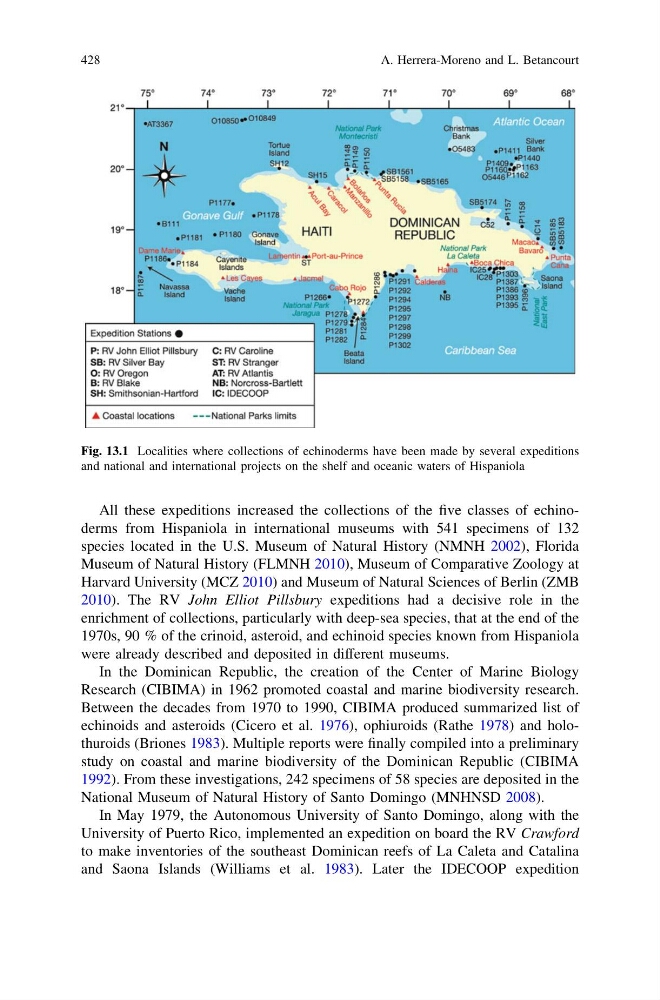
All these expeditions increased the collections of the five classes of echinoderms from Hispaniola in international museums with 541 specimens of 132
species located in the U.S. Museum of Natural History (NMNH 2002), Florida
Museum of Natural History (FLMNH 2010), Museum of Comparative Zoology at
Harvard University (MCZ 2010) and Museum of Natural Sciences of Berlin (ZMB
2010). The RV John Elliot Pillsbury expeditions had a decisive role in the
enrichment of collections, particularly with deep-sea species, that at the end of the
1970s, 90 % of the crinoid, asteroid, and echinoid species known from Hispaniola
were already described and deposited in different museums.
In the Dominican Republic, the creation of the Center of Marine Biology
Research (CIBIMA) in 1962 promoted coastal and marine biodiversity research.
Between the decades from 1970 to 1990, CIBIMA produced summarized list of
echinoids and asteroids (Cicero et al. 1976), ophiuroids (Rathe 1978) and holothuroids (Briones 1983). Multiple reports were finally compiled into a preliminary
study on coastal and marine biodiversity of the Dominican Republic (CIBIMA
1992). From these investigations, 242 specimens of 58 species are deposited in the
National Museum of Natural History of Santo Domingo (MNHNSD 2008).
In May 1979, the Autonomous University of Santo Domingo, along with the
University of Puerto Rico, implemented an expedition on board the RV Crawford
to make inventories of the southeast Dominican reefs of La Caleta and Catalina
and Saona Islands (Williams et al. 1983). Later the IDECOOP expedition
Fig. 13.1 Localities where collections of echinoderms have been made by several expeditions
and national and international projects on the shelf and oceanic waters of Hispaniola
428
A. Herrera-Moreno and L. Betancourt
species located in the U.S. Museum of Natural History (NMNH 2002), Florida
Museum of Natural History (FLMNH 2010), Museum of Comparative Zoology at
Harvard University (MCZ 2010) and Museum of Natural Sciences of Berlin (ZMB
2010). The RV John Elliot Pillsbury expeditions had a decisive role in the
enrichment of collections, particularly with deep-sea species, that at the end of the
1970s, 90 % of the crinoid, asteroid, and echinoid species known from Hispaniola
were already described and deposited in different museums.
In the Dominican Republic, the creation of the Center of Marine Biology
Research (CIBIMA) in 1962 promoted coastal and marine biodiversity research.
Between the decades from 1970 to 1990, CIBIMA produced summarized list of
echinoids and asteroids (Cicero et al. 1976), ophiuroids (Rathe 1978) and holothuroids (Briones 1983). Multiple reports were finally compiled into a preliminary
study on coastal and marine biodiversity of the Dominican Republic (CIBIMA
1992). From these investigations, 242 specimens of 58 species are deposited in the
National Museum of Natural History of Santo Domingo (MNHNSD 2008).
In May 1979, the Autonomous University of Santo Domingo, along with the
University of Puerto Rico, implemented an expedition on board the RV Crawford
to make inventories of the southeast Dominican reefs of La Caleta and Catalina
and Saona Islands (Williams et al. 1983). Later the IDECOOP expedition
Fig. 13.1 Localities where collections of echinoderms have been made by several expeditions
and national and international projects on the shelf and oceanic waters of Hispaniola
428
A. Herrera-Moreno and L. Betancourt