

waves and winds present. This became evident with the high values recorded by
the Agitation Index (IA) by Alcolado (1990): rear zone (IA = 98), pounding zone
(IA = 100), and abrasive rocky esplanade (IA = 99). These harsh conditions,
along with the major input of organic matter received from Isle of Youth and the
numerous adjacent cays and little cays, create a constant and severe re-suspension
of sediment in these zones. This stress factor may turn out to be intolerable for
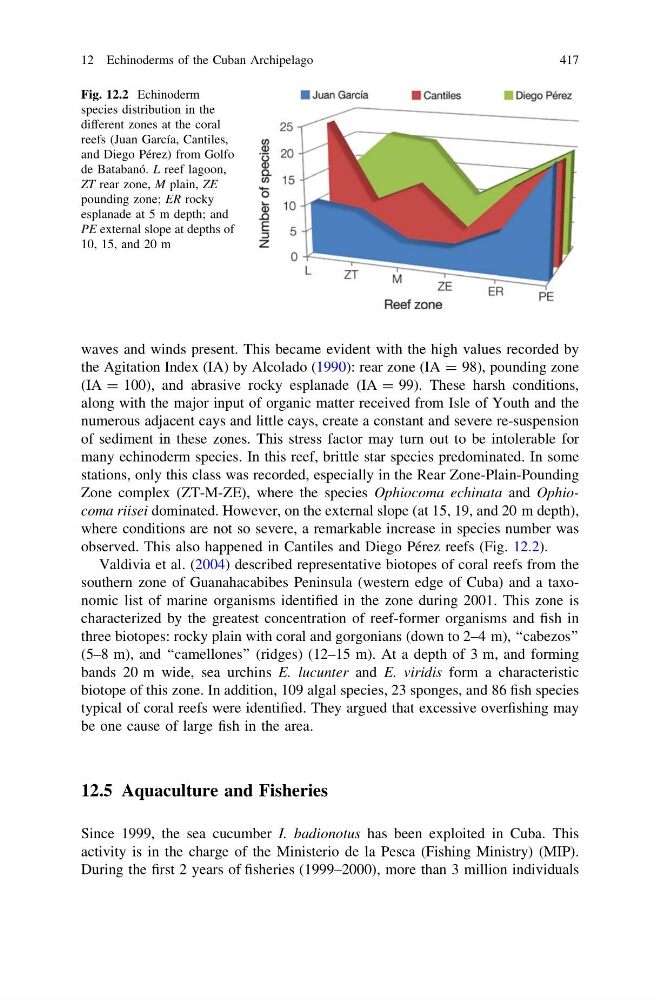
many echinoderm species. In this reef, brittle star species predominated. In some
stations, only this class was recorded, especially in the Rear Zone-Plain-Pounding
Zone complex (ZT-M-ZE), where the species Ophiocoma echinata and Ophiocoma riisei dominated. However, on the external slope (at 15, 19, and 20 m depth),
where conditions are not so severe, a remarkable increase in species number was
observed. This also happened in Cantiles and Diego Pérez reefs (Fig. 12.2).
Valdivia et al. (2004) described representative biotopes of coral reefs from the
southern zone of Guanahacabibes Peninsula (western edge of Cuba) and a taxonomic list of marine organisms identified in the zone during 2001. This zone is
characterized by the greatest concentration of reef-former organisms and fish in
three biotopes: rocky plain with coral and gorgonians (down to 2–4 m), ‘‘cabezos’’
(5–8 m), and ‘‘camellones’’ (ridges) (12–15 m). At a depth of 3 m, and forming
bands 20 m wide, sea urchins E. lucunter and E. viridis form a characteristic
biotope of this zone. In addition, 109 algal species, 23 sponges, and 86 fish species
typical of coral reefs were identified. They argued that excessive overfishing may
be one cause of large fish in the area.
12.5 Aquaculture and Fisheries
Since 1999, the sea cucumber I. badionotus has been exploited in Cuba. This
activity is in the charge of the Ministerio de la Pesca (Fishing Ministry) (MIP).
During the first 2 years of fisheries (1999–2000), more than 3 million individuals
Fig. 12.2 Echinoderm
species distribution in the
different zones at the coral
reefs (Juan García, Cantiles,
and Diego Pérez) from Golfo
de Batabanó. L reef lagoon,
ZT rear zone, M plain, ZE
pounding zone; ER rocky
esplanade at 5 m depth; and
PE external slope at depths of
10, 15, and 20 m
12 Echinoderms of the Cuban Archipelago
417
the Agitation Index (IA) by Alcolado (1990): rear zone (IA = 98), pounding zone
(IA = 100), and abrasive rocky esplanade (IA = 99). These harsh conditions,
along with the major input of organic matter received from Isle of Youth and the
numerous adjacent cays and little cays, create a constant and severe re-suspension
of sediment in these zones. This stress factor may turn out to be intolerable for
many echinoderm species. In this reef, brittle star species predominated. In some
stations, only this class was recorded, especially in the Rear Zone-Plain-Pounding
Zone complex (ZT-M-ZE), where the species Ophiocoma echinata and Ophiocoma riisei dominated. However, on the external slope (at 15, 19, and 20 m depth),
where conditions are not so severe, a remarkable increase in species number was
observed. This also happened in Cantiles and Diego Pérez reefs (Fig. 12.2).
Valdivia et al. (2004) described representative biotopes of coral reefs from the
southern zone of Guanahacabibes Peninsula (western edge of Cuba) and a taxonomic list of marine organisms identified in the zone during 2001. This zone is
characterized by the greatest concentration of reef-former organisms and fish in
three biotopes: rocky plain with coral and gorgonians (down to 2–4 m), ‘‘cabezos’’
(5–8 m), and ‘‘camellones’’ (ridges) (12–15 m). At a depth of 3 m, and forming
bands 20 m wide, sea urchins E. lucunter and E. viridis form a characteristic
biotope of this zone. In addition, 109 algal species, 23 sponges, and 86 fish species
typical of coral reefs were identified. They argued that excessive overfishing may
be one cause of large fish in the area.
12.5 Aquaculture and Fisheries
Since 1999, the sea cucumber I. badionotus has been exploited in Cuba. This
activity is in the charge of the Ministerio de la Pesca (Fishing Ministry) (MIP).
During the first 2 years of fisheries (1999–2000), more than 3 million individuals
Fig. 12.2 Echinoderm
species distribution in the
different zones at the coral
reefs (Juan García, Cantiles,
and Diego Pérez) from Golfo
de Batabanó. L reef lagoon,
ZT rear zone, M plain, ZE
pounding zone; ER rocky
esplanade at 5 m depth; and
PE external slope at depths of
10, 15, and 20 m
12 Echinoderms of the Cuban Archipelago
417