

Chile, on the Pacific Ocean coast. The sea urchin occurs from intertidal to 340 m
depth (Bernasconi 1953) and lives in a wide variety of habitats, including tidepools
and rocky and mixed gravel-sand bottoms. It can also be found as associated biota
on Macrocystis kelp and in mussel beds (Carriquiriborde et al. 1983; Bremec and
Roux 1997; Adami and Gordillo 1999; Penchaszadeh et al. 2004; Marzinelli et al.
2006). At SJG P. magellanicus has a wide distribution, and its abundance appears
to be related primarily to sites with strong surface currents, dominated by coarse
substrates at intermediate depths (Zaixso and Lizarralde 2000). This distribution
seems different from that of A. dufresnii and may be related to the consumption of
both live food (algae and animals) and drift-material produced by currents (Zaixso
and Lizarralde 2000). Pseudechinus magellanicus has been noted as a member of
various major macrozoobenthos associations in SJG (Carriquiriborde et al. 1983;
Zaixso et al. 1998) and SJOG (Roux et al. 1995). A parasitic gastropod (Pelseneeria sudamericana) is attached to the test in Isla de los Estados (54°45
0 S,
63°52
0 W) (Pastorino and Zelaya 2001). In the Beagle Channel (54°50
0 S) this
species was sexual mature at a diameter of 12 mm. The relative fecundity
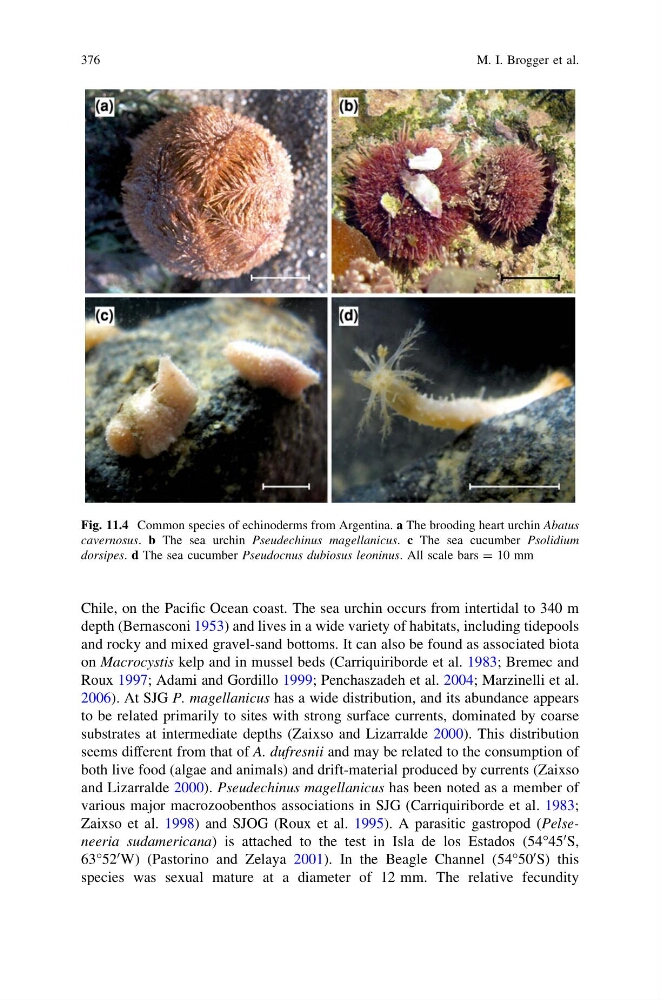
Fig. 11.4 Common species of echinoderms from Argentina. a The brooding heart urchin Abatus
cavernosus. b The sea urchin Pseudechinus magellanicus. c The sea cucumber Psolidium
dorsipes. d The sea cucumber Pseudocnus dubiosus leoninus. All scale bars = 10 mm
376
M. I. Brogger et al.
depth (Bernasconi 1953) and lives in a wide variety of habitats, including tidepools
and rocky and mixed gravel-sand bottoms. It can also be found as associated biota
on Macrocystis kelp and in mussel beds (Carriquiriborde et al. 1983; Bremec and
Roux 1997; Adami and Gordillo 1999; Penchaszadeh et al. 2004; Marzinelli et al.
2006). At SJG P. magellanicus has a wide distribution, and its abundance appears
to be related primarily to sites with strong surface currents, dominated by coarse
substrates at intermediate depths (Zaixso and Lizarralde 2000). This distribution
seems different from that of A. dufresnii and may be related to the consumption of
both live food (algae and animals) and drift-material produced by currents (Zaixso
and Lizarralde 2000). Pseudechinus magellanicus has been noted as a member of
various major macrozoobenthos associations in SJG (Carriquiriborde et al. 1983;
Zaixso et al. 1998) and SJOG (Roux et al. 1995). A parasitic gastropod (Pelseneeria sudamericana) is attached to the test in Isla de los Estados (54°45
0 S,
63°52
0 W) (Pastorino and Zelaya 2001). In the Beagle Channel (54°50
0 S) this
species was sexual mature at a diameter of 12 mm. The relative fecundity
Fig. 11.4 Common species of echinoderms from Argentina. a The brooding heart urchin Abatus
cavernosus. b The sea urchin Pseudechinus magellanicus. c The sea cucumber Psolidium
dorsipes. d The sea cucumber Pseudocnus dubiosus leoninus. All scale bars = 10 mm
376
M. I. Brogger et al.