

The sea star population appears to be maintained primarily by fission, as only two
females of 840 individuals examined were found. Fission in A. capensis lasts
approximately eight hours. At the beginning of the process the body wall begins to
lose its stiffness just before the two halves start to walk away from each other in
opposite directions opening a wound across the disc. The oral tissue splits easily,
in about four hours. The two halves remain joined only by the aboral tissues and
they continue moving apart until the tissue completely breaks. After fission, the
two new individuals are usually immobile while the wound heals. The body wall
contracts to seal the wound. The tips of the new arms can be observed one week
after fission. Individuals had a variable regeneration rate related to body size and
number of regenerating arms. Larger individuals showed higher regeneration rates
than smaller individuals. Accordingly, individuals regenerating four or five arms
had faster regeneration rates than those regenerating three arms (Rubilar et al.
2006).
The effect of fission and regeneration on feeding, energy storage and gonad
production was evaluated during the different stages of regeneration in the
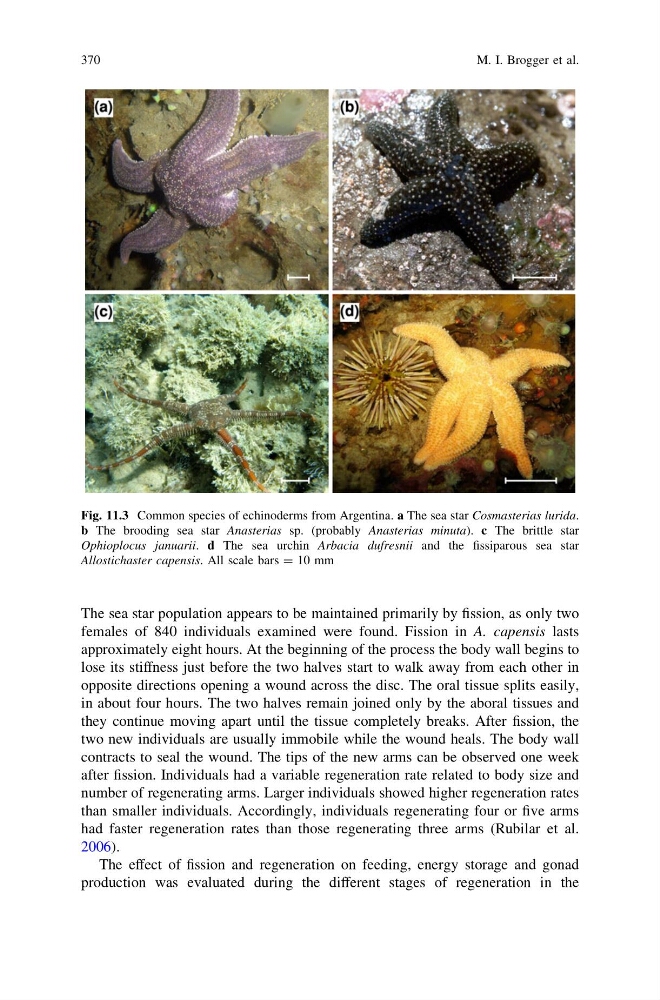
Fig. 11.3 Common species of echinoderms from Argentina. a The sea star Cosmasterias lurida.
b The brooding sea star Anasterias sp. (probably Anasterias minuta). c The brittle star
Ophioplocus januarii. d The sea urchin Arbacia dufresnii and the fissiparous sea star
Allostichaster capensis. All scale bars = 10 mm
370
M. I. Brogger et al.
females of 840 individuals examined were found. Fission in A. capensis lasts
approximately eight hours. At the beginning of the process the body wall begins to
lose its stiffness just before the two halves start to walk away from each other in
opposite directions opening a wound across the disc. The oral tissue splits easily,
in about four hours. The two halves remain joined only by the aboral tissues and
they continue moving apart until the tissue completely breaks. After fission, the
two new individuals are usually immobile while the wound heals. The body wall
contracts to seal the wound. The tips of the new arms can be observed one week
after fission. Individuals had a variable regeneration rate related to body size and
number of regenerating arms. Larger individuals showed higher regeneration rates
than smaller individuals. Accordingly, individuals regenerating four or five arms
had faster regeneration rates than those regenerating three arms (Rubilar et al.
2006).
The effect of fission and regeneration on feeding, energy storage and gonad
production was evaluated during the different stages of regeneration in the
Fig. 11.3 Common species of echinoderms from Argentina. a The sea star Cosmasterias lurida.
b The brooding sea star Anasterias sp. (probably Anasterias minuta). c The brittle star
Ophioplocus januarii. d The sea urchin Arbacia dufresnii and the fissiparous sea star
Allostichaster capensis. All scale bars = 10 mm
370
M. I. Brogger et al.