

seasonal and inter annual variability. The substrate is dominated by soft sediments,
with few areas consolidated or constituted by crystalline rocks (Correia et al.
1996).
The Uruguayan Atlantic coast shows arched (sometimes rather straight), wave
dominated sandy beaches of variable size, delimitated by rocky points (Fig. 10.2).
They have a wide range of morphodynamic grades, from dissipative to reflective.
Coastal morphology is conditioned more by its geological background than by the
present dynamics (Brazeiro et al. 2003; Gómez Pivel 2006). Astronomic tides are
between 0.4 and 0.6 m, sea level changes induced by the wind being more
important (Wells and Daborn 1997; SOHMA 2002).
Jurisdictional issues are regulated by the ‘‘Treaty between Uruguay and
Argentina concerning the Río de la Plata and the Corresponding Maritime
Boundary’’, signed November 19th 1973 (English version can be consulted in UN
2002, Spanish one in FREPLATA 2011). Apart from the Río de la Plata and
Atlantic coastal boundaries, it establishes a ‘‘common fishing zone, beyond 12
nautical miles measured from the corresponding coastal baselines, for duly registered vessels flying their flag. Such zone shall be that determined by two arcs of
circumferences of a radius of 200 nautical miles, the centers of which are located
at Punta del Este (Eastern Republic of Uruguay) and Punta Rasa del Cabo San
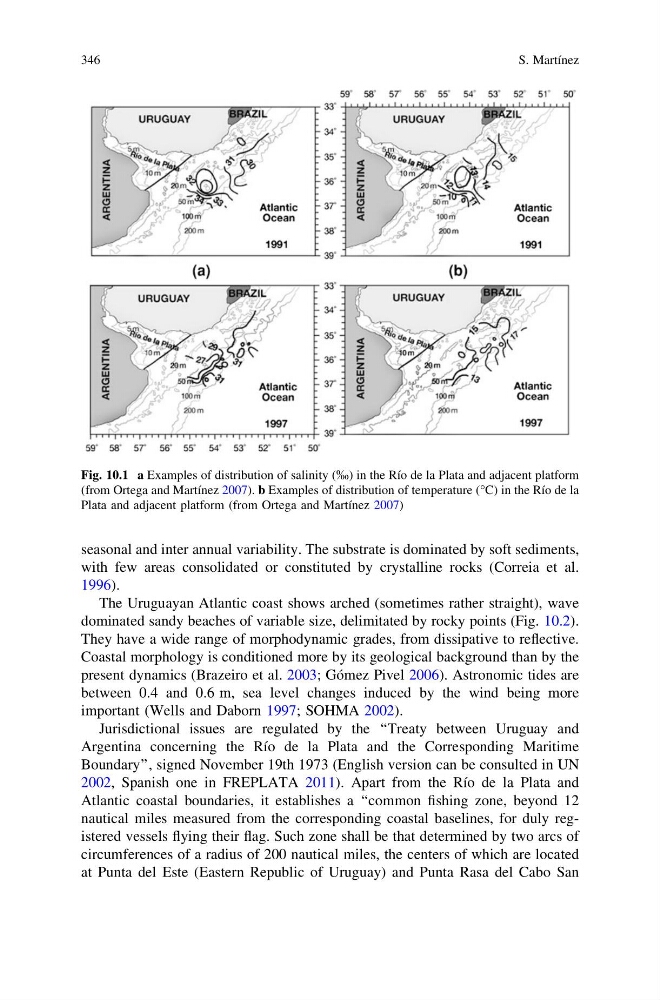
Fig. 10.1 a Examples of distribution of salinity (%) in the Río de la Plata and adjacent platform
(from Ortega and Martínez 2007). b Examples of distribution of temperature (°C) in the Río de la
Plata and adjacent platform (from Ortega and Martínez 2007)
346
S. Martínez
with few areas consolidated or constituted by crystalline rocks (Correia et al.
1996).
The Uruguayan Atlantic coast shows arched (sometimes rather straight), wave
dominated sandy beaches of variable size, delimitated by rocky points (Fig. 10.2).
They have a wide range of morphodynamic grades, from dissipative to reflective.
Coastal morphology is conditioned more by its geological background than by the
present dynamics (Brazeiro et al. 2003; Gómez Pivel 2006). Astronomic tides are
between 0.4 and 0.6 m, sea level changes induced by the wind being more
important (Wells and Daborn 1997; SOHMA 2002).
Jurisdictional issues are regulated by the ‘‘Treaty between Uruguay and
Argentina concerning the Río de la Plata and the Corresponding Maritime
Boundary’’, signed November 19th 1973 (English version can be consulted in UN
2002, Spanish one in FREPLATA 2011). Apart from the Río de la Plata and
Atlantic coastal boundaries, it establishes a ‘‘common fishing zone, beyond 12
nautical miles measured from the corresponding coastal baselines, for duly registered vessels flying their flag. Such zone shall be that determined by two arcs of
circumferences of a radius of 200 nautical miles, the centers of which are located
at Punta del Este (Eastern Republic of Uruguay) and Punta Rasa del Cabo San
Fig. 10.1 a Examples of distribution of salinity (%) in the Río de la Plata and adjacent platform
(from Ortega and Martínez 2007). b Examples of distribution of temperature (°C) in the Río de la
Plata and adjacent platform (from Ortega and Martínez 2007)
346
S. Martínez