

In the entire sector between the border with Ecuador and 4°15
0 S the layer of
oxygen that exists south of 6°S cannot be detected. There, life is present in all
bathymetric gradients, maintaining high richness even below 1,000 m depth. The area
called ‘‘Banco de Mancora’’, located about 40 km off Zorritos, a submarine mountain
plateau between 90 and 500 m in depth, has high richness exists and some fish and
invertebrate species seem to maintain their population centers (Edgar et al. 2004).
Another important factor affecting richness in the Peruvian littoral is the El Niño
phenomenon. During these oceanographic events, trade winds push and weaken the
Peruvian Current, causing the current to lose strength. As a result, tropical waters
invade the Peruvian coast, reaching even to the Chilean north. The entire temperate
waters fauna is seriously affected by temperature increases up to 10 °C at some
points of the coast. Moreover, when upwellings decreases or disappear, nutrients
and primary productivity is notably reduced. This affects macroalgae and filter
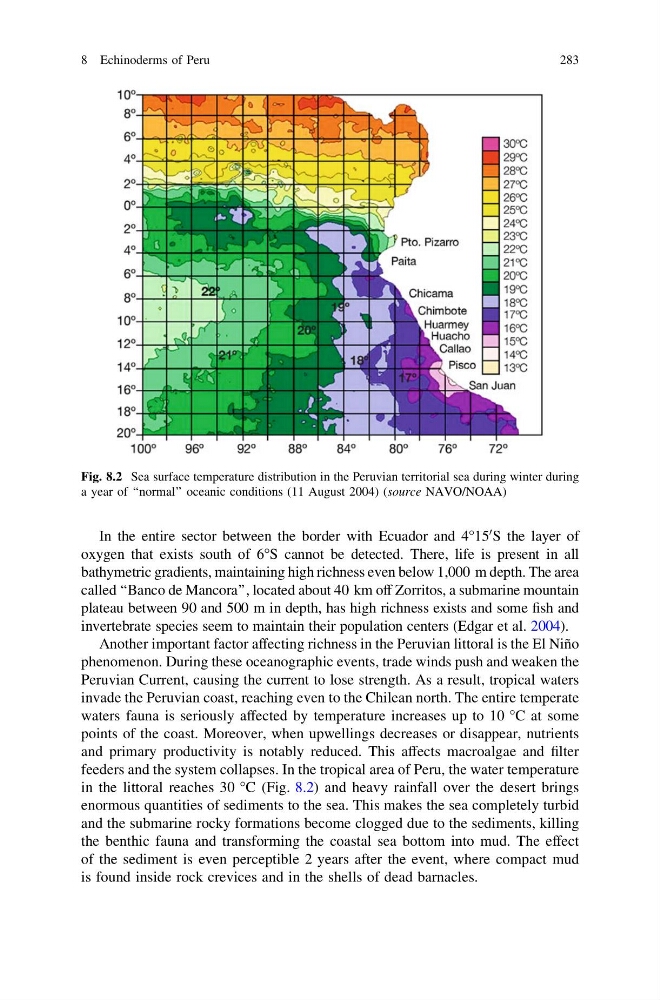
feeders and the system collapses. In the tropical area of Peru, the water temperature
in the littoral reaches 30 °C (Fig. 8.2) and heavy rainfall over the desert brings
enormous quantities of sediments to the sea. This makes the sea completely turbid
and the submarine rocky formations become clogged due to the sediments, killing
the benthic fauna and transforming the coastal sea bottom into mud. The effect
of the sediment is even perceptible 2 years after the event, where compact mud
is found inside rock crevices and in the shells of dead barnacles.
Fig. 8.2 Sea surface temperature distribution in the Peruvian territorial sea during winter during
a year of ‘‘normal’’ oceanic conditions (11 August 2004) (source NAVO/NOAA)
8 Echinoderms of Peru
283
0 S the layer of
oxygen that exists south of 6°S cannot be detected. There, life is present in all
bathymetric gradients, maintaining high richness even below 1,000 m depth. The area
called ‘‘Banco de Mancora’’, located about 40 km off Zorritos, a submarine mountain
plateau between 90 and 500 m in depth, has high richness exists and some fish and
invertebrate species seem to maintain their population centers (Edgar et al. 2004).
Another important factor affecting richness in the Peruvian littoral is the El Niño
phenomenon. During these oceanographic events, trade winds push and weaken the
Peruvian Current, causing the current to lose strength. As a result, tropical waters
invade the Peruvian coast, reaching even to the Chilean north. The entire temperate
waters fauna is seriously affected by temperature increases up to 10 °C at some
points of the coast. Moreover, when upwellings decreases or disappear, nutrients
and primary productivity is notably reduced. This affects macroalgae and filter
feeders and the system collapses. In the tropical area of Peru, the water temperature
in the littoral reaches 30 °C (Fig. 8.2) and heavy rainfall over the desert brings
enormous quantities of sediments to the sea. This makes the sea completely turbid
and the submarine rocky formations become clogged due to the sediments, killing
the benthic fauna and transforming the coastal sea bottom into mud. The effect
of the sediment is even perceptible 2 years after the event, where compact mud
is found inside rock crevices and in the shells of dead barnacles.
Fig. 8.2 Sea surface temperature distribution in the Peruvian territorial sea during winter during
a year of ‘‘normal’’ oceanic conditions (11 August 2004) (source NAVO/NOAA)
8 Echinoderms of Peru
283