

million. Thus, the demand of the Asiatic countries is supplied both by aquaculture
and by importation of sea cucumbers fished in other regions.
7.5.1 Extraction and Fishing
The consumption of sea urchins in Venezuela is known since prehispanic times
(Pauls 1992). However, sea urchins in general are not highly appreciated in the
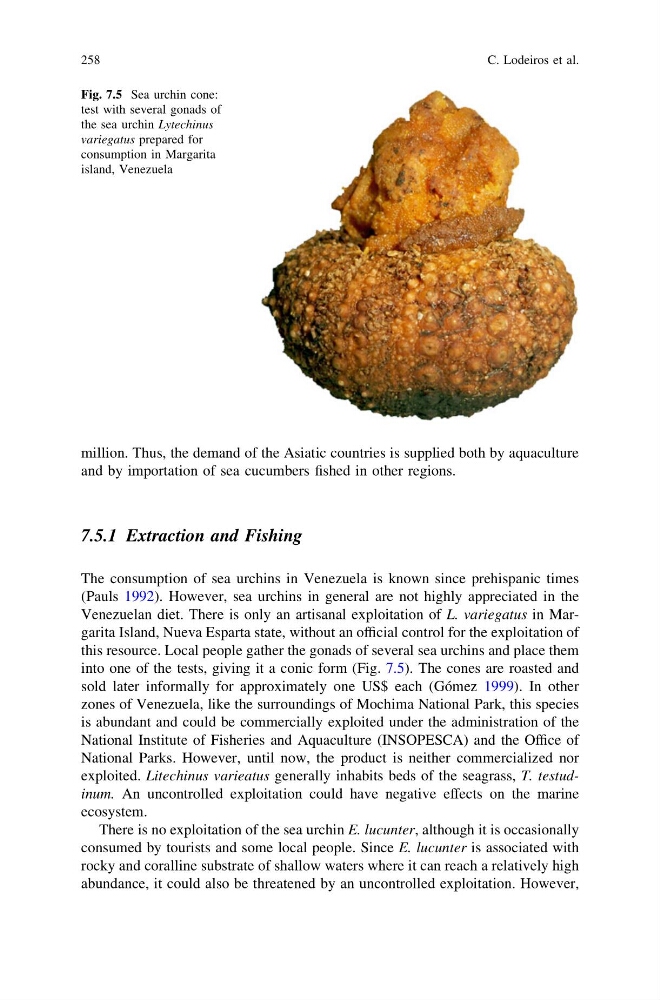
Venezuelan diet. There is only an artisanal exploitation of L. variegatus in Margarita Island, Nueva Esparta state, without an official control for the exploitation of
this resource. Local people gather the gonads of several sea urchins and place them
into one of the tests, giving it a conic form (Fig. 7.5). The cones are roasted and
sold later informally for approximately one US$ each (Gómez 1999). In other
zones of Venezuela, like the surroundings of Mochima National Park, this species
is abundant and could be commercially exploited under the administration of the
National Institute of Fisheries and Aquaculture (INSOPESCA) and the Office of
National Parks. However, until now, the product is neither commercialized nor
exploited. Litechinus varieatus generally inhabits beds of the seagrass, T. testudinum. An uncontrolled exploitation could have negative effects on the marine
ecosystem.
There is no exploitation of the sea urchin E. lucunter, although it is occasionally
consumed by tourists and some local people. Since E. lucunter is associated with
rocky and coralline substrate of shallow waters where it can reach a relatively high
abundance, it could also be threatened by an uncontrolled exploitation. However,
Fig. 7.5 Sea urchin cone:
test with several gonads of
the sea urchin Lytechinus
variegatus prepared for
consumption in Margarita
island, Venezuela
258
C. Lodeiros et al.
and by importation of sea cucumbers fished in other regions.
7.5.1 Extraction and Fishing
The consumption of sea urchins in Venezuela is known since prehispanic times
(Pauls 1992). However, sea urchins in general are not highly appreciated in the
Venezuelan diet. There is only an artisanal exploitation of L. variegatus in Margarita Island, Nueva Esparta state, without an official control for the exploitation of
this resource. Local people gather the gonads of several sea urchins and place them
into one of the tests, giving it a conic form (Fig. 7.5). The cones are roasted and
sold later informally for approximately one US$ each (Gómez 1999). In other
zones of Venezuela, like the surroundings of Mochima National Park, this species
is abundant and could be commercially exploited under the administration of the
National Institute of Fisheries and Aquaculture (INSOPESCA) and the Office of
National Parks. However, until now, the product is neither commercialized nor
exploited. Litechinus varieatus generally inhabits beds of the seagrass, T. testudinum. An uncontrolled exploitation could have negative effects on the marine
ecosystem.
There is no exploitation of the sea urchin E. lucunter, although it is occasionally
consumed by tourists and some local people. Since E. lucunter is associated with
rocky and coralline substrate of shallow waters where it can reach a relatively high
abundance, it could also be threatened by an uncontrolled exploitation. However,
Fig. 7.5 Sea urchin cone:
test with several gonads of
the sea urchin Lytechinus
variegatus prepared for
consumption in Margarita
island, Venezuela
258
C. Lodeiros et al.