

2.1 Oceanography and Marine Environments in Mexico
Mexico is the twelfth largest country in the world in terms of extent of coastline and
marine surface area. It has an exclusive economic zone of 314,992,000 ha, a continental platform of 39,460,300 ha and a coastline of 11,500 km. 1,600,000 ha are
estuarine areas and about 1,250,000 ha are coastal lagoons. Approximately
6,000 km
2 of islands are found in the Pacific Ocean (including the remote Guadalupe
Island and the Revillagigedo Islands), Gulf of Mexico, Caribbean, and Gulf of
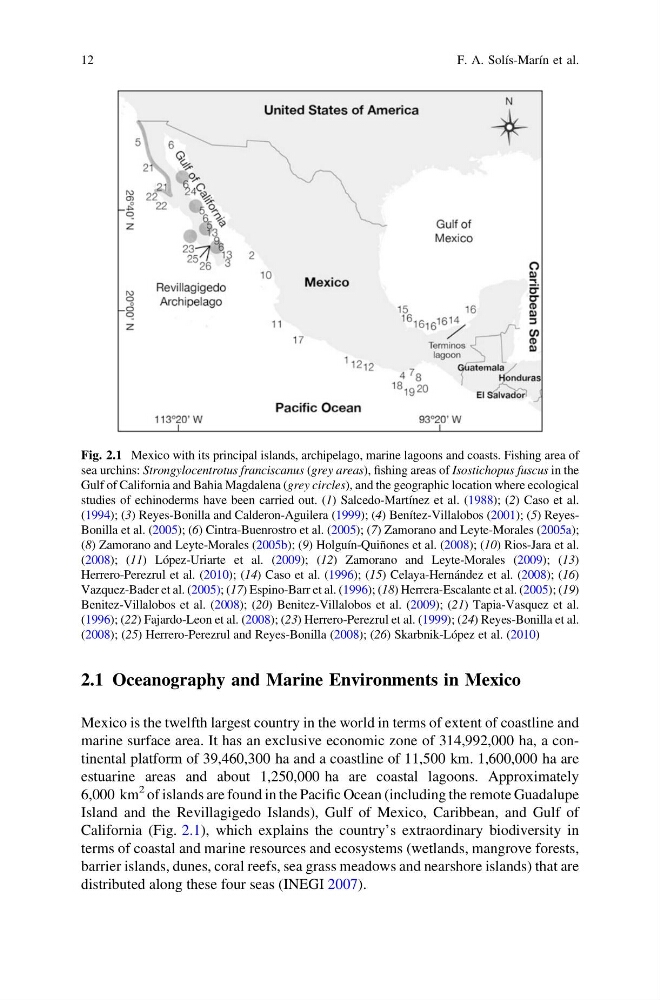
California (Fig. 2.1), which explains the country’s extraordinary biodiversity in
terms of coastal and marine resources and ecosystems (wetlands, mangrove forests,
barrier islands, dunes, coral reefs, sea grass meadows and nearshore islands) that are
distributed along these four seas (INEGI 2007).
Fig. 2.1 Mexico with its principal islands, archipelago, marine lagoons and coasts. Fishing area of
sea urchins: Strongylocentrotus franciscanus (grey areas), fishing areas of Isostichopus fuscus in the
Gulf of California and Bahia Magdalena (grey circles), and the geographic location where ecological
studies of echinoderms have been carried out. (1) Salcedo-Martínez et al. (1988); (2) Caso et al.
(1994); (3) Reyes-Bonilla and Calderon-Aguilera (1999); (4) Benítez-Villalobos (2001); (5) ReyesBonilla et al. (2005); (6) Cintra-Buenrostro et al. (2005); (7) Zamorano and Leyte-Morales (2005a);
(8) Zamorano and Leyte-Morales (2005b); (9) Holguín-Quiñones et al. (2008); (10) Rios-Jara et al.
(2008); (11) López-Uriarte et al. (2009); (12) Zamorano and Leyte-Morales (2009); (13)
Herrero-Perezrul et al. (2010); (14) Caso et al. (1996); (15) Celaya-Hernández et al. (2008); (16)
Vazquez-Bader et al. (2005); (17) Espino-Barr et al. (1996); (18) Herrera-Escalante et al. (2005); (19)
Benitez-Villalobos et al. (2008); (20) Benitez-Villalobos et al. (2009); (21) Tapia-Vasquez et al.
(1996); (22) Fajardo-Leon et al. (2008); (23) Herrero-Perezrul et al. (1999); (24) Reyes-Bonilla et al.
(2008); (25) Herrero-Perezrul and Reyes-Bonilla (2008); (26) Skarbnik-López et al. (2010)
12
F. A. Solís-Marín et al.
Mexico is the twelfth largest country in the world in terms of extent of coastline and
marine surface area. It has an exclusive economic zone of 314,992,000 ha, a continental platform of 39,460,300 ha and a coastline of 11,500 km. 1,600,000 ha are
estuarine areas and about 1,250,000 ha are coastal lagoons. Approximately
6,000 km
2 of islands are found in the Pacific Ocean (including the remote Guadalupe
Island and the Revillagigedo Islands), Gulf of Mexico, Caribbean, and Gulf of
California (Fig. 2.1), which explains the country’s extraordinary biodiversity in
terms of coastal and marine resources and ecosystems (wetlands, mangrove forests,
barrier islands, dunes, coral reefs, sea grass meadows and nearshore islands) that are
distributed along these four seas (INEGI 2007).
Fig. 2.1 Mexico with its principal islands, archipelago, marine lagoons and coasts. Fishing area of
sea urchins: Strongylocentrotus franciscanus (grey areas), fishing areas of Isostichopus fuscus in the
Gulf of California and Bahia Magdalena (grey circles), and the geographic location where ecological
studies of echinoderms have been carried out. (1) Salcedo-Martínez et al. (1988); (2) Caso et al.
(1994); (3) Reyes-Bonilla and Calderon-Aguilera (1999); (4) Benítez-Villalobos (2001); (5) ReyesBonilla et al. (2005); (6) Cintra-Buenrostro et al. (2005); (7) Zamorano and Leyte-Morales (2005a);
(8) Zamorano and Leyte-Morales (2005b); (9) Holguín-Quiñones et al. (2008); (10) Rios-Jara et al.
(2008); (11) López-Uriarte et al. (2009); (12) Zamorano and Leyte-Morales (2009); (13)
Herrero-Perezrul et al. (2010); (14) Caso et al. (1996); (15) Celaya-Hernández et al. (2008); (16)
Vazquez-Bader et al. (2005); (17) Espino-Barr et al. (1996); (18) Herrera-Escalante et al. (2005); (19)
Benitez-Villalobos et al. (2008); (20) Benitez-Villalobos et al. (2009); (21) Tapia-Vasquez et al.
(1996); (22) Fajardo-Leon et al. (2008); (23) Herrero-Perezrul et al. (1999); (24) Reyes-Bonilla et al.
(2008); (25) Herrero-Perezrul and Reyes-Bonilla (2008); (26) Skarbnik-López et al. (2010)
12
F. A. Solís-Marín et al.