

and aeromonads (Gilles and Pearse 1986). Sonnenholzner and Lawrence (1998)
studied the occurrence of predation and disease in a population of the sand dollar
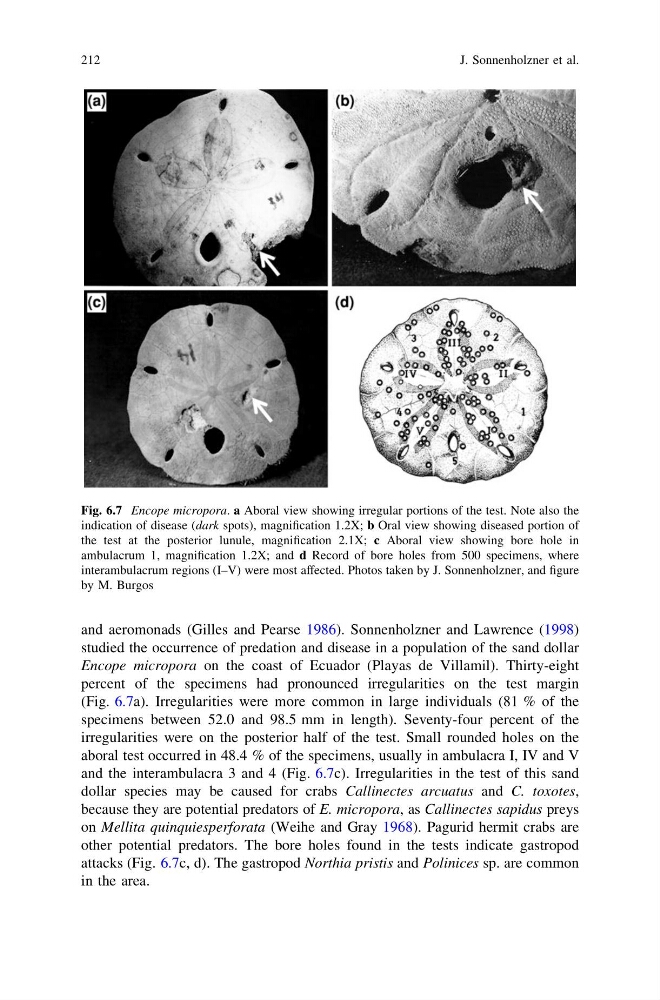
Encope micropora on the coast of Ecuador (Playas de Villamil). Thirty-eight
percent of the specimens had pronounced irregularities on the test margin
(Fig. 6.7a). Irregularities were more common in large individuals (81 % of the
specimens between 52.0 and 98.5 mm in length). Seventy-four percent of the
irregularities were on the posterior half of the test. Small rounded holes on the
aboral test occurred in 48.4 % of the specimens, usually in ambulacra I, IV and V
and the interambulacra 3 and 4 (Fig. 6.7c). Irregularities in the test of this sand
dollar species may be caused for crabs Callinectes arcuatus and C. toxotes,
because they are potential predators of E. micropora, as Callinectes sapidus preys
on Mellita quinquiesperforata (Weihe and Gray 1968). Pagurid hermit crabs are
other potential predators. The bore holes found in the tests indicate gastropod
attacks (Fig. 6.7c, d). The gastropod Northia pristis and Polinices sp. are common
in the area.
Fig. 6.7 Encope micropora. a Aboral view showing irregular portions of the test. Note also the
indication of disease (dark spots), magnification 1.2X; b Oral view showing diseased portion of
the test at the posterior lunule, magnification 2.1X; c Aboral view showing bore hole in
ambulacrum 1, magnification 1.2X; and d Record of bore holes from 500 specimens, where
interambulacrum regions (I–V) were most affected. Photos taken by J. Sonnenholzner, and figure
by M. Burgos
212
J. Sonnenholzner et al.
studied the occurrence of predation and disease in a population of the sand dollar
Encope micropora on the coast of Ecuador (Playas de Villamil). Thirty-eight
percent of the specimens had pronounced irregularities on the test margin
(Fig. 6.7a). Irregularities were more common in large individuals (81 % of the
specimens between 52.0 and 98.5 mm in length). Seventy-four percent of the
irregularities were on the posterior half of the test. Small rounded holes on the
aboral test occurred in 48.4 % of the specimens, usually in ambulacra I, IV and V
and the interambulacra 3 and 4 (Fig. 6.7c). Irregularities in the test of this sand
dollar species may be caused for crabs Callinectes arcuatus and C. toxotes,
because they are potential predators of E. micropora, as Callinectes sapidus preys
on Mellita quinquiesperforata (Weihe and Gray 1968). Pagurid hermit crabs are
other potential predators. The bore holes found in the tests indicate gastropod
attacks (Fig. 6.7c, d). The gastropod Northia pristis and Polinices sp. are common
in the area.
Fig. 6.7 Encope micropora. a Aboral view showing irregular portions of the test. Note also the
indication of disease (dark spots), magnification 1.2X; b Oral view showing diseased portion of
the test at the posterior lunule, magnification 2.1X; c Aboral view showing bore hole in
ambulacrum 1, magnification 1.2X; and d Record of bore holes from 500 specimens, where
interambulacrum regions (I–V) were most affected. Photos taken by J. Sonnenholzner, and figure
by M. Burgos
212
J. Sonnenholzner et al.