

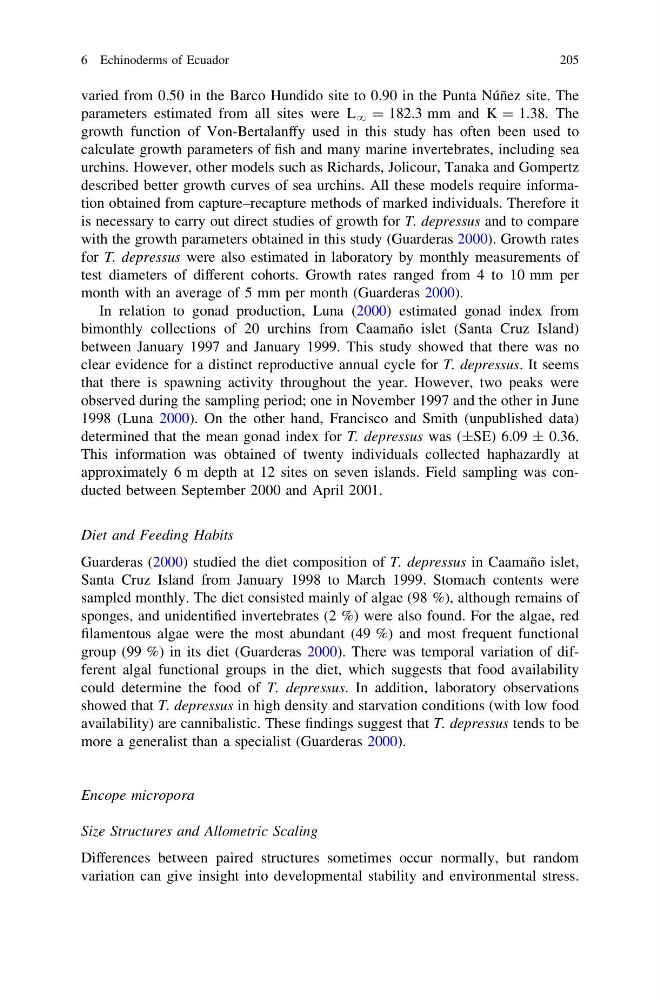
varied from 0.50 in the Barco Hundido site to 0.90 in the Punta Núñez site. The
parameters estimated from all sites were L ? = 182.3 mm and K = 1.38. The
growth function of Von-Bertalanffy used in this study has often been used to
calculate growth parameters of fish and many marine invertebrates, including sea
urchins. However, other models such as Richards, Jolicour, Tanaka and Gompertz
described better growth curves of sea urchins. All these models require information obtained from capture–recapture methods of marked individuals. Therefore it
is necessary to carry out direct studies of growth for T. depressus and to compare
with the growth parameters obtained in this study (Guarderas 2000). Growth rates
for T. depressus were also estimated in laboratory by monthly measurements of
test diameters of different cohorts. Growth rates ranged from 4 to 10 mm per
month with an average of 5 mm per month (Guarderas 2000).
In relation to gonad production, Luna (2000) estimated gonad index from
bimonthly collections of 20 urchins from Caamaño islet (Santa Cruz Island)
between January 1997 and January 1999. This study showed that there was no
clear evidence for a distinct reproductive annual cycle for T. depressus. It seems
that there is spawning activity throughout the year. However, two peaks were
observed during the sampling period; one in November 1997 and the other in June
1998 (Luna 2000). On the other hand, Francisco and Smith (unpublished data)
determined that the mean gonad index for T. depressus was (±SE) 6.09 ± 0.36.
This information was obtained of twenty individuals collected haphazardly at
approximately 6 m depth at 12 sites on seven islands. Field sampling was conducted between September 2000 and April 2001.
Diet and Feeding Habits
Guarderas (2000) studied the diet composition of T. depressus in Caamaño islet,
Santa Cruz Island from January 1998 to March 1999. Stomach contents were
sampled monthly. The diet consisted mainly of algae (98 %), although remains of
sponges, and unidentified invertebrates (2 %) were also found. For the algae, red
filamentous algae were the most abundant (49 %) and most frequent functional
group (99 %) in its diet (Guarderas 2000). There was temporal variation of different algal functional groups in the diet, which suggests that food availability
could determine the food of T. depressus. In addition, laboratory observations
showed that T. depressus in high density and starvation conditions (with low food
availability) are cannibalistic. These findings suggest that T. depressus tends to be
more a generalist than a specialist (Guarderas 2000).
Encope micropora
Size Structures and Allometric Scaling
Differences between paired structures sometimes occur normally, but random
variation can give insight into developmental stability and environmental stress.
6 Echinoderms of Ecuador
205
parameters estimated from all sites were L ? = 182.3 mm and K = 1.38. The
growth function of Von-Bertalanffy used in this study has often been used to
calculate growth parameters of fish and many marine invertebrates, including sea
urchins. However, other models such as Richards, Jolicour, Tanaka and Gompertz
described better growth curves of sea urchins. All these models require information obtained from capture–recapture methods of marked individuals. Therefore it
is necessary to carry out direct studies of growth for T. depressus and to compare
with the growth parameters obtained in this study (Guarderas 2000). Growth rates
for T. depressus were also estimated in laboratory by monthly measurements of
test diameters of different cohorts. Growth rates ranged from 4 to 10 mm per
month with an average of 5 mm per month (Guarderas 2000).
In relation to gonad production, Luna (2000) estimated gonad index from
bimonthly collections of 20 urchins from Caamaño islet (Santa Cruz Island)
between January 1997 and January 1999. This study showed that there was no
clear evidence for a distinct reproductive annual cycle for T. depressus. It seems
that there is spawning activity throughout the year. However, two peaks were
observed during the sampling period; one in November 1997 and the other in June
1998 (Luna 2000). On the other hand, Francisco and Smith (unpublished data)
determined that the mean gonad index for T. depressus was (±SE) 6.09 ± 0.36.
This information was obtained of twenty individuals collected haphazardly at
approximately 6 m depth at 12 sites on seven islands. Field sampling was conducted between September 2000 and April 2001.
Diet and Feeding Habits
Guarderas (2000) studied the diet composition of T. depressus in Caamaño islet,
Santa Cruz Island from January 1998 to March 1999. Stomach contents were
sampled monthly. The diet consisted mainly of algae (98 %), although remains of
sponges, and unidentified invertebrates (2 %) were also found. For the algae, red
filamentous algae were the most abundant (49 %) and most frequent functional
group (99 %) in its diet (Guarderas 2000). There was temporal variation of different algal functional groups in the diet, which suggests that food availability
could determine the food of T. depressus. In addition, laboratory observations
showed that T. depressus in high density and starvation conditions (with low food
availability) are cannibalistic. These findings suggest that T. depressus tends to be
more a generalist than a specialist (Guarderas 2000).
Encope micropora
Size Structures and Allometric Scaling
Differences between paired structures sometimes occur normally, but random
variation can give insight into developmental stability and environmental stress.
6 Echinoderms of Ecuador
205