

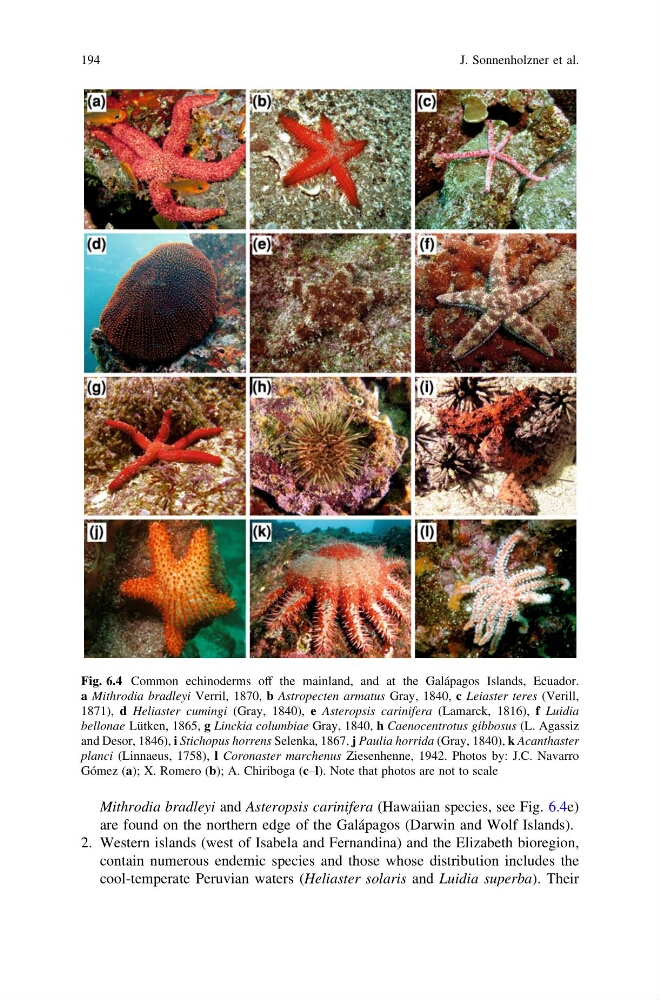
Mithrodia bradleyi and Asteropsis carinifera (Hawaiian species, see Fig. 6.4e)
are found on the northern edge of the Galápagos (Darwin and Wolf Islands).
2. Western islands (west of Isabela and Fernandina) and the Elizabeth bioregion,
contain numerous endemic species and those whose distribution includes the
cool-temperate Peruvian waters (Heliaster solaris and Luidia superba). Their
Fig. 6.4 Common echinoderms off the mainland, and at the Galápagos Islands, Ecuador.
a Mithrodia bradleyi Verril, 1870, b Astropecten armatus Gray, 1840, c Leiaster teres (Verill,
1871), d Heliaster cumingi (Gray, 1840), e Asteropsis carinifera (Lamarck, 1816), f Luidia
bellonae Lütken, 1865, g Linckia columbiae Gray, 1840, h Caenocentrotus gibbosus (L. Agassiz
and Desor, 1846), i Stichopus horrens Selenka, 1867, j Paulia horrida (Gray, 1840), k Acanthaster
planci (Linnaeus, 1758), l Coronaster marchenus Ziesenhenne, 1942. Photos by: J.C. Navarro
Gómez (a); X. Romero (b); A. Chiriboga (c–l). Note that photos are not to scale
194
J. Sonnenholzner et al.
are found on the northern edge of the Galápagos (Darwin and Wolf Islands).
2. Western islands (west of Isabela and Fernandina) and the Elizabeth bioregion,
contain numerous endemic species and those whose distribution includes the
cool-temperate Peruvian waters (Heliaster solaris and Luidia superba). Their
Fig. 6.4 Common echinoderms off the mainland, and at the Galápagos Islands, Ecuador.
a Mithrodia bradleyi Verril, 1870, b Astropecten armatus Gray, 1840, c Leiaster teres (Verill,
1871), d Heliaster cumingi (Gray, 1840), e Asteropsis carinifera (Lamarck, 1816), f Luidia
bellonae Lütken, 1865, g Linckia columbiae Gray, 1840, h Caenocentrotus gibbosus (L. Agassiz
and Desor, 1846), i Stichopus horrens Selenka, 1867, j Paulia horrida (Gray, 1840), k Acanthaster
planci (Linnaeus, 1758), l Coronaster marchenus Ziesenhenne, 1942. Photos by: J.C. Navarro
Gómez (a); X. Romero (b); A. Chiriboga (c–l). Note that photos are not to scale
194
J. Sonnenholzner et al.