

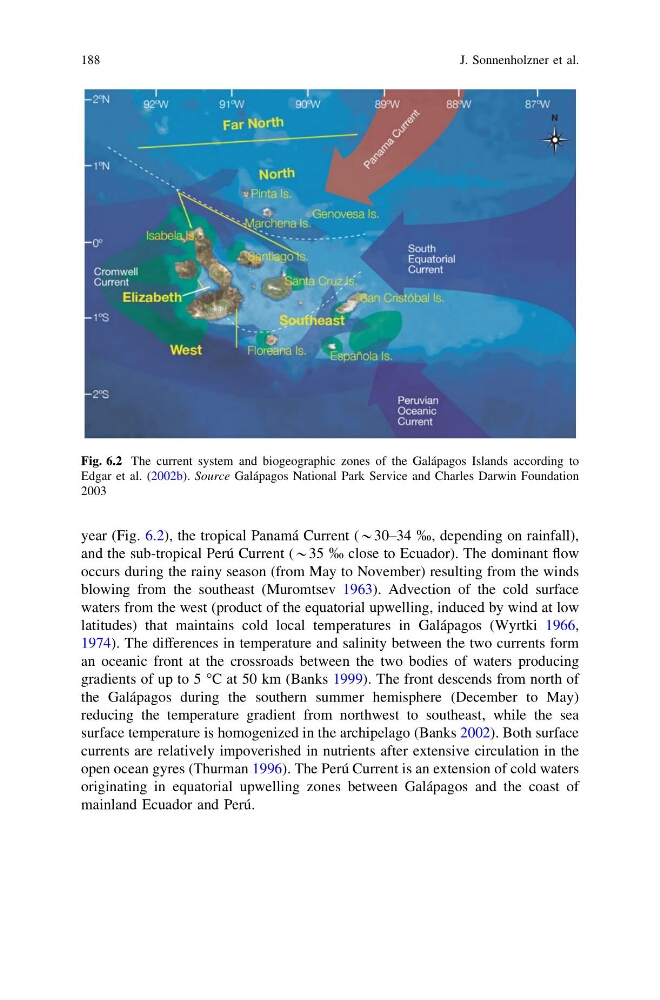
year (Fig. 6.2), the tropical Panamá Current (*30–34 %, depending on rainfall),
and the sub-tropical Perú Current (*35 % close to Ecuador). The dominant flow
occurs during the rainy season (from May to November) resulting from the winds
blowing from the southeast (Muromtsev 1963). Advection of the cold surface
waters from the west (product of the equatorial upwelling, induced by wind at low
latitudes) that maintains cold local temperatures in Galápagos (Wyrtki 1966,
1974). The differences in temperature and salinity between the two currents form
an oceanic front at the crossroads between the two bodies of waters producing
gradients of up to 5 °C at 50 km (Banks 1999). The front descends from north of
the Galápagos during the southern summer hemisphere (December to May)
reducing the temperature gradient from northwest to southeast, while the sea
surface temperature is homogenized in the archipelago (Banks 2002). Both surface
currents are relatively impoverished in nutrients after extensive circulation in the
open ocean gyres (Thurman 1996). The Perú Current is an extension of cold waters
originating in equatorial upwelling zones between Galápagos and the coast of
mainland Ecuador and Perú.
Fig. 6.2 The current system and biogeographic zones of the Galápagos Islands according to
Edgar et al. (2002b). Source Galápagos National Park Service and Charles Darwin Foundation
2003
188
J. Sonnenholzner et al.
and the sub-tropical Perú Current (*35 % close to Ecuador). The dominant flow
occurs during the rainy season (from May to November) resulting from the winds
blowing from the southeast (Muromtsev 1963). Advection of the cold surface
waters from the west (product of the equatorial upwelling, induced by wind at low
latitudes) that maintains cold local temperatures in Galápagos (Wyrtki 1966,
1974). The differences in temperature and salinity between the two currents form
an oceanic front at the crossroads between the two bodies of waters producing
gradients of up to 5 °C at 50 km (Banks 1999). The front descends from north of
the Galápagos during the southern summer hemisphere (December to May)
reducing the temperature gradient from northwest to southeast, while the sea
surface temperature is homogenized in the archipelago (Banks 2002). Both surface
currents are relatively impoverished in nutrients after extensive circulation in the
open ocean gyres (Thurman 1996). The Perú Current is an extension of cold waters
originating in equatorial upwelling zones between Galápagos and the coast of
mainland Ecuador and Perú.
Fig. 6.2 The current system and biogeographic zones of the Galápagos Islands according to
Edgar et al. (2002b). Source Galápagos National Park Service and Charles Darwin Foundation
2003
188
J. Sonnenholzner et al.