

marine and coastal area constitutes a remarkable transition zone in the eastern
Pacific, characterized by a significant spatial and temporal variability of the
physical-oceanographic conditions.
The ocean circulation in the eastern equatorial Pacific area is dominated by the
action of the winds and the circulation patterns of several currents, mainly
the North and South Equatorial Currents, the Equatorial Counter Current, the
California Current, the Panamá Current (PC), the Perú or Humboldt Current, and
the Equatorial Undercurrent or Cromwell Current (Allauca 1990). All of these
currents carry water that contributes to the formation of the Equatorial Front, which
moves from north to south depending on the displacement of the Inter-tropical
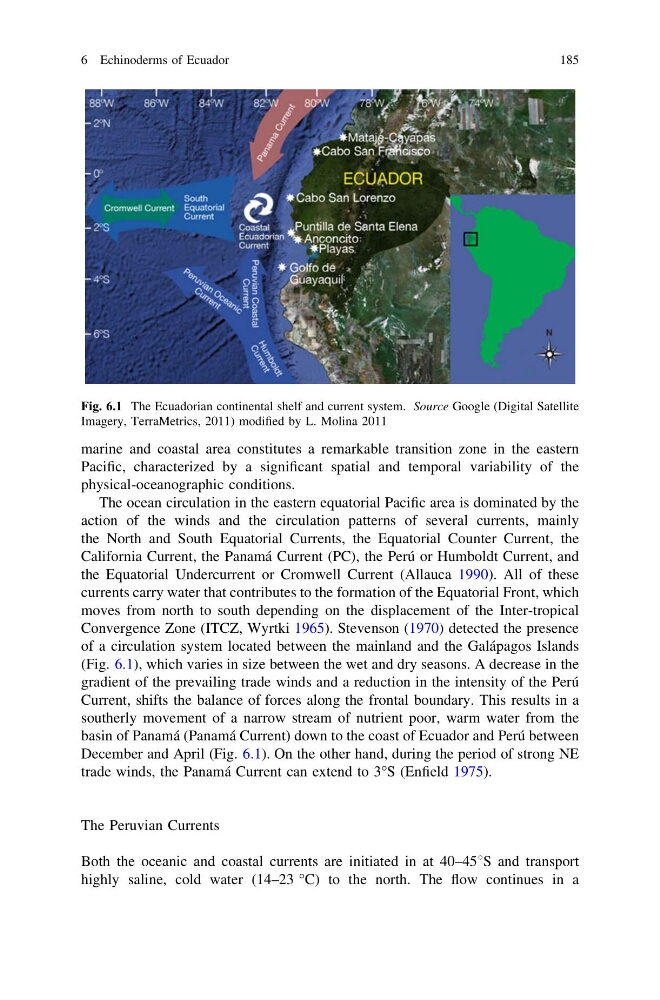
Convergence Zone (ITCZ, Wyrtki 1965). Stevenson (1970) detected the presence
of a circulation system located between the mainland and the Galápagos Islands
(Fig. 6.1), which varies in size between the wet and dry seasons. A decrease in the
gradient of the prevailing trade winds and a reduction in the intensity of the Perú
Current, shifts the balance of forces along the frontal boundary. This results in a
southerly movement of a narrow stream of nutrient poor, warm water from the
basin of Panamá (Panamá Current) down to the coast of Ecuador and Perú between
December and April (Fig. 6.1). On the other hand, during the period of strong NE
trade winds, the Panamá Current can extend to 3°S (Enfield 1975).
The Peruvian Currents
Both the oceanic and coastal currents are initiated in at 40–458S and transport
highly saline, cold water (14–23 °C) to the north. The flow continues in a
Fig. 6.1 The Ecuadorian continental shelf and current system. Source Google (Digital Satellite
Imagery, TerraMetrics, 2011) modified by L. Molina 2011
6 Echinoderms of Ecuador
185
Pacific, characterized by a significant spatial and temporal variability of the
physical-oceanographic conditions.
The ocean circulation in the eastern equatorial Pacific area is dominated by the
action of the winds and the circulation patterns of several currents, mainly
the North and South Equatorial Currents, the Equatorial Counter Current, the
California Current, the Panamá Current (PC), the Perú or Humboldt Current, and
the Equatorial Undercurrent or Cromwell Current (Allauca 1990). All of these
currents carry water that contributes to the formation of the Equatorial Front, which
moves from north to south depending on the displacement of the Inter-tropical
Convergence Zone (ITCZ, Wyrtki 1965). Stevenson (1970) detected the presence
of a circulation system located between the mainland and the Galápagos Islands
(Fig. 6.1), which varies in size between the wet and dry seasons. A decrease in the
gradient of the prevailing trade winds and a reduction in the intensity of the Perú
Current, shifts the balance of forces along the frontal boundary. This results in a
southerly movement of a narrow stream of nutrient poor, warm water from the
basin of Panamá (Panamá Current) down to the coast of Ecuador and Perú between
December and April (Fig. 6.1). On the other hand, during the period of strong NE
trade winds, the Panamá Current can extend to 3°S (Enfield 1975).
The Peruvian Currents
Both the oceanic and coastal currents are initiated in at 40–458S and transport
highly saline, cold water (14–23 °C) to the north. The flow continues in a
Fig. 6.1 The Ecuadorian continental shelf and current system. Source Google (Digital Satellite
Imagery, TerraMetrics, 2011) modified by L. Molina 2011
6 Echinoderms of Ecuador
185