

Mortality of sea urchins on the fringing reef-flat off Galeta Island has been
reported to occur twice yearly as the result of physical stress generated by
extended aerial exposure of the reef platform (Glynn 1968; Hendler 1977; Cubit
et al. 1986). Tripneustes ventricosus (Lamarck, 1816), Lytechinus variegatus
(Lamarck, 1816) and Diadema antillarum Philippi, 1845 were found to be less
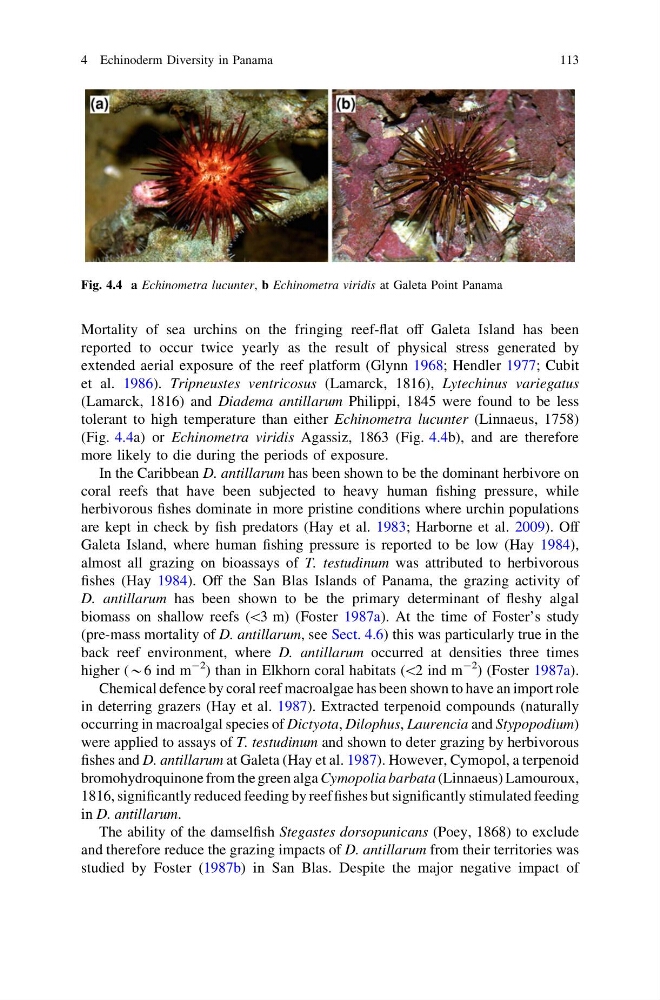
tolerant to high temperature than either Echinometra lucunter (Linnaeus, 1758)
(Fig. 4.4a) or Echinometra viridis Agassiz, 1863 (Fig. 4.4b), and are therefore
more likely to die during the periods of exposure.
In the Caribbean D. antillarum has been shown to be the dominant herbivore on
coral reefs that have been subjected to heavy human fishing pressure, while
herbivorous fishes dominate in more pristine conditions where urchin populations
are kept in check by fish predators (Hay et al. 1983; Harborne et al. 2009). Off
Galeta Island, where human fishing pressure is reported to be low (Hay 1984),
almost all grazing on bioassays of T. testudinum was attributed to herbivorous
fishes (Hay 1984). Off the San Blas Islands of Panama, the grazing activity of
D. antillarum has been shown to be the primary determinant of fleshy algal
biomass on shallow reefs (\3 m) (Foster 1987a). At the time of Foster’s study
(pre-mass mortality of D. antillarum, see Sect. 4.6) this was particularly true in the
back reef environment, where D. antillarum occurred at densities three times
higher (*6 ind m
-2 ) than in Elkhorn coral habitats (\2 ind m
-2 ) (Foster 1987a).
Chemical defence by coral reef macroalgae has been shown to have an import role
in deterring grazers (Hay et al. 1987). Extracted terpenoid compounds (naturally
occurring in macroalgal species of Dictyota, Dilophus, Laurencia and Stypopodium)
were applied to assays of T. testudinum and shown to deter grazing by herbivorous
fishes and D. antillarum at Galeta (Hay et al. 1987). However, Cymopol, a terpenoid
bromohydroquinone from the green alga Cymopolia barbata (Linnaeus) Lamouroux,
1816, significantly reduced feeding by reef fishes but significantly stimulated feeding
in D. antillarum.
The ability of the damselfish Stegastes dorsopunicans (Poey, 1868) to exclude
and therefore reduce the grazing impacts of D. antillarum from their territories was
studied by Foster (1987b) in San Blas. Despite the major negative impact of
Fig. 4.4 a Echinometra lucunter, b Echinometra viridis at Galeta Point Panama
4 Echinoderm Diversity in Panama
113
reported to occur twice yearly as the result of physical stress generated by
extended aerial exposure of the reef platform (Glynn 1968; Hendler 1977; Cubit
et al. 1986). Tripneustes ventricosus (Lamarck, 1816), Lytechinus variegatus
(Lamarck, 1816) and Diadema antillarum Philippi, 1845 were found to be less
tolerant to high temperature than either Echinometra lucunter (Linnaeus, 1758)
(Fig. 4.4a) or Echinometra viridis Agassiz, 1863 (Fig. 4.4b), and are therefore
more likely to die during the periods of exposure.
In the Caribbean D. antillarum has been shown to be the dominant herbivore on
coral reefs that have been subjected to heavy human fishing pressure, while
herbivorous fishes dominate in more pristine conditions where urchin populations
are kept in check by fish predators (Hay et al. 1983; Harborne et al. 2009). Off
Galeta Island, where human fishing pressure is reported to be low (Hay 1984),
almost all grazing on bioassays of T. testudinum was attributed to herbivorous
fishes (Hay 1984). Off the San Blas Islands of Panama, the grazing activity of
D. antillarum has been shown to be the primary determinant of fleshy algal
biomass on shallow reefs (\3 m) (Foster 1987a). At the time of Foster’s study
(pre-mass mortality of D. antillarum, see Sect. 4.6) this was particularly true in the
back reef environment, where D. antillarum occurred at densities three times
higher (*6 ind m
-2 ) than in Elkhorn coral habitats (\2 ind m
-2 ) (Foster 1987a).
Chemical defence by coral reef macroalgae has been shown to have an import role
in deterring grazers (Hay et al. 1987). Extracted terpenoid compounds (naturally
occurring in macroalgal species of Dictyota, Dilophus, Laurencia and Stypopodium)
were applied to assays of T. testudinum and shown to deter grazing by herbivorous
fishes and D. antillarum at Galeta (Hay et al. 1987). However, Cymopol, a terpenoid
bromohydroquinone from the green alga Cymopolia barbata (Linnaeus) Lamouroux,
1816, significantly reduced feeding by reef fishes but significantly stimulated feeding
in D. antillarum.
The ability of the damselfish Stegastes dorsopunicans (Poey, 1868) to exclude
and therefore reduce the grazing impacts of D. antillarum from their territories was
studied by Foster (1987b) in San Blas. Despite the major negative impact of
Fig. 4.4 a Echinometra lucunter, b Echinometra viridis at Galeta Point Panama
4 Echinoderm Diversity in Panama
113