

(2) hurricanes; and (3) tectonic activity. On April 22, 1991, a 7.5 magnitude
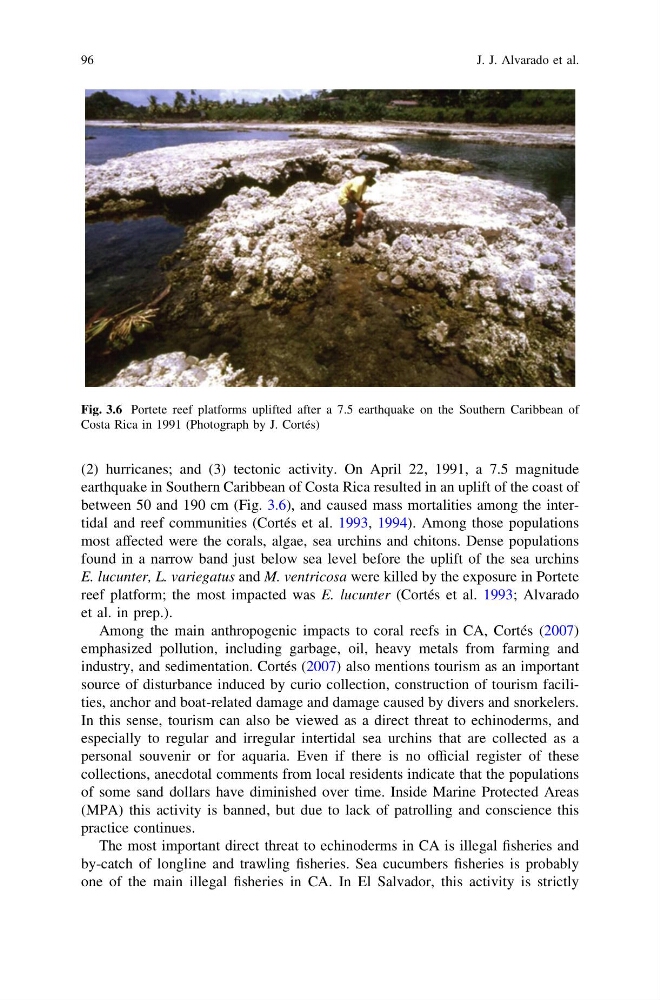
earthquake in Southern Caribbean of Costa Rica resulted in an uplift of the coast of
between 50 and 190 cm (Fig. 3.6), and caused mass mortalities among the intertidal and reef communities (Cortés et al. 1993, 1994). Among those populations
most affected were the corals, algae, sea urchins and chitons. Dense populations
found in a narrow band just below sea level before the uplift of the sea urchins
E. lucunter, L. variegatus and M. ventricosa were killed by the exposure in Portete
reef platform; the most impacted was E. lucunter (Cortés et al. 1993; Alvarado
et al. in prep.).
Among the main anthropogenic impacts to coral reefs in CA, Cortés (2007)
emphasized pollution, including garbage, oil, heavy metals from farming and
industry, and sedimentation. Cortés (2007) also mentions tourism as an important
source of disturbance induced by curio collection, construction of tourism facilities, anchor and boat-related damage and damage caused by divers and snorkelers.
In this sense, tourism can also be viewed as a direct threat to echinoderms, and
especially to regular and irregular intertidal sea urchins that are collected as a
personal souvenir or for aquaria. Even if there is no official register of these
collections, anecdotal comments from local residents indicate that the populations
of some sand dollars have diminished over time. Inside Marine Protected Areas
(MPA) this activity is banned, but due to lack of patrolling and conscience this
practice continues.
The most important direct threat to echinoderms in CA is illegal fisheries and
by-catch of longline and trawling fisheries. Sea cucumbers fisheries is probably
one of the main illegal fisheries in CA. In El Salvador, this activity is strictly
Fig. 3.6 Portete reef platforms uplifted after a 7.5 earthquake on the Southern Caribbean of
Costa Rica in 1991 (Photograph by J. Cortés)
96
J. J. Alvarado et al.
earthquake in Southern Caribbean of Costa Rica resulted in an uplift of the coast of
between 50 and 190 cm (Fig. 3.6), and caused mass mortalities among the intertidal and reef communities (Cortés et al. 1993, 1994). Among those populations
most affected were the corals, algae, sea urchins and chitons. Dense populations
found in a narrow band just below sea level before the uplift of the sea urchins
E. lucunter, L. variegatus and M. ventricosa were killed by the exposure in Portete
reef platform; the most impacted was E. lucunter (Cortés et al. 1993; Alvarado
et al. in prep.).
Among the main anthropogenic impacts to coral reefs in CA, Cortés (2007)
emphasized pollution, including garbage, oil, heavy metals from farming and
industry, and sedimentation. Cortés (2007) also mentions tourism as an important
source of disturbance induced by curio collection, construction of tourism facilities, anchor and boat-related damage and damage caused by divers and snorkelers.
In this sense, tourism can also be viewed as a direct threat to echinoderms, and
especially to regular and irregular intertidal sea urchins that are collected as a
personal souvenir or for aquaria. Even if there is no official register of these
collections, anecdotal comments from local residents indicate that the populations
of some sand dollars have diminished over time. Inside Marine Protected Areas
(MPA) this activity is banned, but due to lack of patrolling and conscience this
practice continues.
The most important direct threat to echinoderms in CA is illegal fisheries and
by-catch of longline and trawling fisheries. Sea cucumbers fisheries is probably
one of the main illegal fisheries in CA. In El Salvador, this activity is strictly
Fig. 3.6 Portete reef platforms uplifted after a 7.5 earthquake on the Southern Caribbean of
Costa Rica in 1991 (Photograph by J. Cortés)
96
J. J. Alvarado et al.