

68
3. MEASURING GROWTH AND FORM
3.1.1 Branch Ordering
Branching networks have a hierarchical structure that we would like to capture in a mathematical description. A reasonable scheme would assign the
trunk or stem of a plant to be one end of a spectrum and the leaves or tips to
be the other end with a range of intermediate levels in between.
One method that has these qualities was first developed in the study of
river networks by Horton (1945). A later improvement by Strahler (1957) led
to a method known as "Horton- Strahler stream ordering" or often simply as
"stream ordering:' Here, we will use the more general term "branch ordering"
since the method applies to any branching network. Indeed, much use of this
ordering technique has been made outside of the study of river networks,
a good example being the study of venous and arterial blood networks in
biology (Fung 1990, Zamir 1999).
The basic idea is to assign indices of significance to branches, affording
a means of comparing branch lengths, branch cross-sections, numbers of
branches, and so on. The process of ordering branches involves an iterative
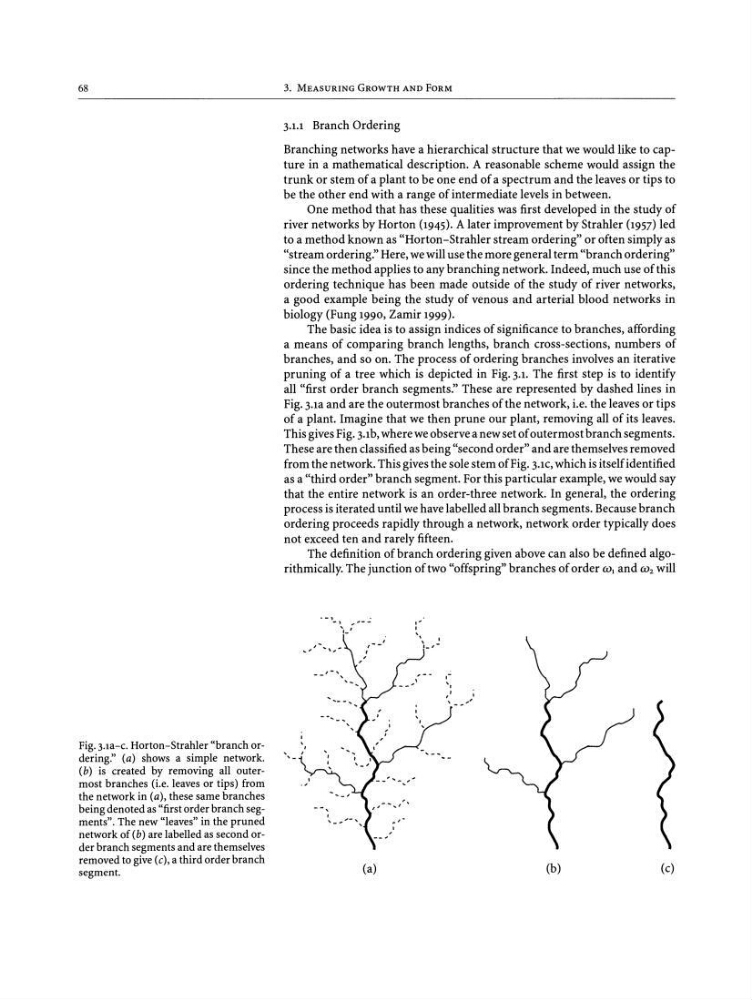
pruning of a tree which is depicted in Fig. 3.1. The first step is to identify
all "first order branch segments:' These are represented by dashed lines in
Fig. 3.1aand are the outermost branches of the network, i.e. the leaves or tips
of a plant. Imagine that we then prune our plant, removing all of its leaves.
This gives Fig. 3.1b, where we observe a new set of outermost branch segments.
These are then classified as being "second order" and are themselves removed
from the network. This gives the sole stem of Fig. pc, which is itselfidentified
as a "third order" branch segment. For this particular example, we would say
that the entire network is an order-three network. In general, the ordering
process is iterated until we have labelled all branch segments. Because branch
ordering proceeds rapidly through a network, network order typically does
not exceed ten and rarely fifteen.
The definition of branch ordering given above can also be defined algorithmically. The junction of two "offspring" branches of order WI and W 2 will
Fig. pa-c. Horton-Strahler "branch ordering." (a) shows a simple network.
(b) is created by removing all outermost branches (i.e. leaves or tips) from
the network in (a), these same branches
beingdenotedas"firstorder branch segments". The new"leaves" in the pruned
networkof (b) are labelledas secondorder branch segmentsand are themselves
removedto give(c) , a third order branch
segment.
. _,
-, ... "'-'._'
,
'(a)
,
-'
(b)
(c)
3. MEASURING GROWTH AND FORM
3.1.1 Branch Ordering
Branching networks have a hierarchical structure that we would like to capture in a mathematical description. A reasonable scheme would assign the
trunk or stem of a plant to be one end of a spectrum and the leaves or tips to
be the other end with a range of intermediate levels in between.
One method that has these qualities was first developed in the study of
river networks by Horton (1945). A later improvement by Strahler (1957) led
to a method known as "Horton- Strahler stream ordering" or often simply as
"stream ordering:' Here, we will use the more general term "branch ordering"
since the method applies to any branching network. Indeed, much use of this
ordering technique has been made outside of the study of river networks,
a good example being the study of venous and arterial blood networks in
biology (Fung 1990, Zamir 1999).
The basic idea is to assign indices of significance to branches, affording
a means of comparing branch lengths, branch cross-sections, numbers of
branches, and so on. The process of ordering branches involves an iterative
pruning of a tree which is depicted in Fig. 3.1. The first step is to identify
all "first order branch segments:' These are represented by dashed lines in
Fig. 3.1aand are the outermost branches of the network, i.e. the leaves or tips
of a plant. Imagine that we then prune our plant, removing all of its leaves.
This gives Fig. 3.1b, where we observe a new set of outermost branch segments.
These are then classified as being "second order" and are themselves removed
from the network. This gives the sole stem of Fig. pc, which is itselfidentified
as a "third order" branch segment. For this particular example, we would say
that the entire network is an order-three network. In general, the ordering
process is iterated until we have labelled all branch segments. Because branch
ordering proceeds rapidly through a network, network order typically does
not exceed ten and rarely fifteen.
The definition of branch ordering given above can also be defined algorithmically. The junction of two "offspring" branches of order WI and W 2 will
Fig. pa-c. Horton-Strahler "branch ordering." (a) shows a simple network.
(b) is created by removing all outermost branches (i.e. leaves or tips) from
the network in (a), these same branches
beingdenotedas"firstorder branch segments". The new"leaves" in the pruned
networkof (b) are labelledas secondorder branch segmentsand are themselves
removedto give(c) , a third order branch
segment.
. _,
-, ... "'-'._'
,
'(a)
,
-'
(b)
(c)