

34
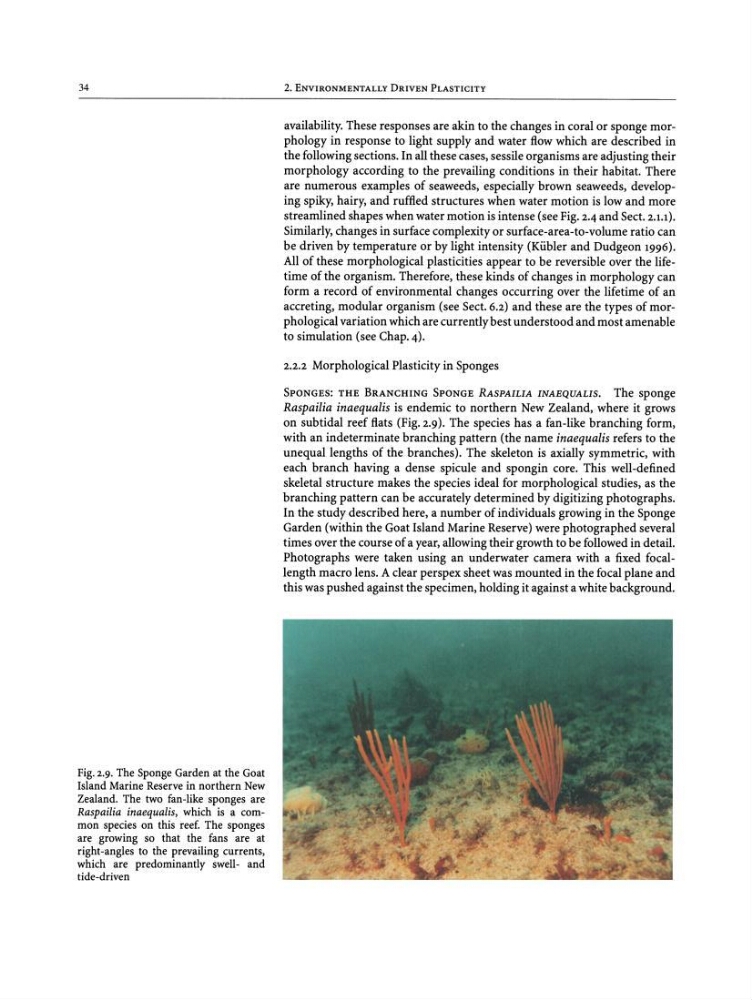
Fig. 2.9. The Sponge Garden at the Goat
Island Marine Reserve in northern New
Zealand. The two fan-like sponges are
Raspailia inaequalis, which is a common species on this reef. The sponges
are growing so that the fans are at
right-angles to the prevailing currents,
which are predominantly swell- and
tide-driven
2. ENVIRONMENTALLY DRIVEN PLASTICITY
availability. These responses are akin to the changes in coral or sponge morphology in response to light supply and water flow which are described in
the following sections. In all these cases, sessile organisms are adjusting their
morphology according to the prevailing conditions in their habitat. There
are numerous examples of seaweeds, especially brown seaweeds, developing spiky, hairy, and ruffled structures when water motion is low and more
streamlined shapes when water motion is intense (see Fig. 2.4 and Sect. 2 .1.1).
Similarly, changes in surface complexity or surface-area-to-volume ratio can
be driven by temperature or by light intensity (Kubler and Dudgeon 1996).
All of these morphological plasticities appear to be reversible over the lifetime of the organism. Therefore, these kinds of changes in morphology can
form a record of environmental changes occurring over the lifetime of an
accreting, modular organism (see Sect. 6.2) and these are the types of morphological variation which are currently best understood and most amenable
to simulation (see Chap. 4).
2.2.2 Morphological Plasticity in Sponges
SPONGES: THE BRANCHING SPONGE RASPAILIA INAEQUALIS. The sponge
Raspailia inaequalis is endemic to northern New Zealand, where it grows
on subtidal reef flats (Fig. 2.9). The species has a fan-like branching form,
with an indeterminate branching pattern (the name inaequalis refers to the
unequal lengths of the branches). The skeleton is axially symmetric, with
each branch having a dense spicule and spongin core. This well-defined
skeletal structure makes the species ideal for morphological studies, as the
branching pattern can be accurately determined by digitizing photographs.
In the study described here, a number of individuals growing in the Sponge
Garden (within the Goat Island Marine Reserve) were photographed several
times over the course of a year, allowing their growth to be followed in detail.
Photographs were taken using an underwater camera with a fixed focallength macro lens. A clear perspex sheet was mounted in the focal plane and
this was pushed against the specimen, holding it against a white background.
Fig. 2.9. The Sponge Garden at the Goat
Island Marine Reserve in northern New
Zealand. The two fan-like sponges are
Raspailia inaequalis, which is a common species on this reef. The sponges
are growing so that the fans are at
right-angles to the prevailing currents,
which are predominantly swell- and
tide-driven
2. ENVIRONMENTALLY DRIVEN PLASTICITY
availability. These responses are akin to the changes in coral or sponge morphology in response to light supply and water flow which are described in
the following sections. In all these cases, sessile organisms are adjusting their
morphology according to the prevailing conditions in their habitat. There
are numerous examples of seaweeds, especially brown seaweeds, developing spiky, hairy, and ruffled structures when water motion is low and more
streamlined shapes when water motion is intense (see Fig. 2.4 and Sect. 2 .1.1).
Similarly, changes in surface complexity or surface-area-to-volume ratio can
be driven by temperature or by light intensity (Kubler and Dudgeon 1996).
All of these morphological plasticities appear to be reversible over the lifetime of the organism. Therefore, these kinds of changes in morphology can
form a record of environmental changes occurring over the lifetime of an
accreting, modular organism (see Sect. 6.2) and these are the types of morphological variation which are currently best understood and most amenable
to simulation (see Chap. 4).
2.2.2 Morphological Plasticity in Sponges
SPONGES: THE BRANCHING SPONGE RASPAILIA INAEQUALIS. The sponge
Raspailia inaequalis is endemic to northern New Zealand, where it grows
on subtidal reef flats (Fig. 2.9). The species has a fan-like branching form,
with an indeterminate branching pattern (the name inaequalis refers to the
unequal lengths of the branches). The skeleton is axially symmetric, with
each branch having a dense spicule and spongin core. This well-defined
skeletal structure makes the species ideal for morphological studies, as the
branching pattern can be accurately determined by digitizing photographs.
In the study described here, a number of individuals growing in the Sponge
Garden (within the Goat Island Marine Reserve) were photographed several
times over the course of a year, allowing their growth to be followed in detail.
Photographs were taken using an underwater camera with a fixed focallength macro lens. A clear perspex sheet was mounted in the focal plane and
this was pushed against the specimen, holding it against a white background.