

(a)
2.1. THE PHYSICAL ENVIRONMENT
(b)
25
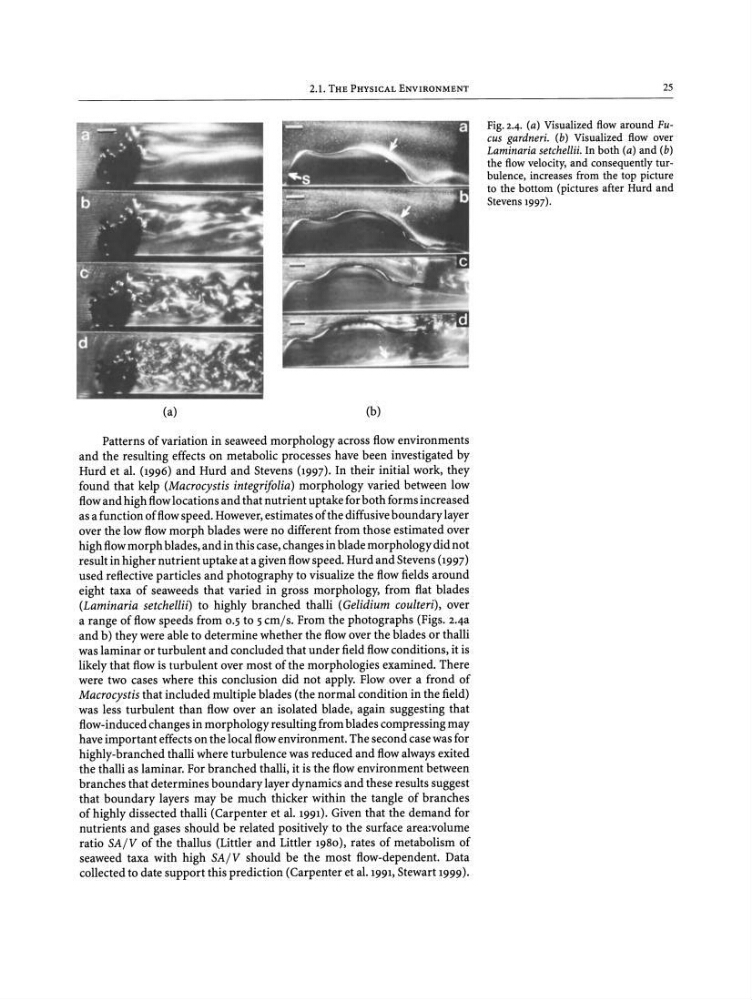
Fig. 2.4. (a) Visualized flow around Fucus gardneri. (b) Visualized flow over
Laminaria setchellii. In both (a) and (b)
the flow velocity, and consequently turbulence, increases from the top picture
to the bottom (pictures after Hurd and
Stevens 1997).
Patterns of variation in seaweed morphology across flow environments
and the resulting effects on metabolic processes have been investigated by
Hurd et al. (1996) and Hurd and Stevens (1997). In their initial work, they
found that kelp (Macrocystis integrifolia) morphology varied between low
flowand high flowlocat ions and that nutrient uptake for both forms increased
as a function of flowspeed. However, estimates of the diffusive boundary layer
over the low flow morph blades were no different from those estimated over
high flowmorph blades, and in this case, changes in blade morphology did not
result in higher nutrient uptake at a given flowspeed. Hurd and Stevens (1997)
used reflective particles and photography to visualize the flow fields around
eight taxa of seaweeds that varied in gross morphology, from flat blades
(Laminaria setchellii) to highly branched thalli (Gelidium coulteri), over
a range of flow speeds from 0.5 to 5 ctu ]s. From the photographs (Figs. 2-4a
and b) they were able to determine whether the flow over the blades or thalli
was laminar or turbulent and concluded that under field flow conditions, it is
likely that flow is turbulent over most of the morphologies examined. There
were two cases where this conclusion did not apply. Flow over a frond of
Macrocystis that included multiple blades (the normal condition in the field)
was less turbulent than flow over an isolated blade, again suggesting that
flow-induced changes in morphology resulting from blades compressing may
have important effects on the local flowenvironment. The second case was for
highly-branched thalli where turbulence was reduced and flow always exited
the thalli as laminar. For branched thalli, it is the flow environment between
branches that determines boundary layer dynamics and these results suggest
that boundary layers may be much thicker within the tangle of branches
of highly dissected thalli (Carpenter et al. 1991). Given that the demand for
nutrients and gases should be related positively to the surface area:volume
ratio SA/V of the thallus (Littler and Littler 1980), rates of metabolism of
seaweed taxa with high SA /V should be the most flow-dependent. Data
collected to date support this prediction (Carpenter et al. 1991,Stewart 1999).
2.1. THE PHYSICAL ENVIRONMENT
(b)
25
Fig. 2.4. (a) Visualized flow around Fucus gardneri. (b) Visualized flow over
Laminaria setchellii. In both (a) and (b)
the flow velocity, and consequently turbulence, increases from the top picture
to the bottom (pictures after Hurd and
Stevens 1997).
Patterns of variation in seaweed morphology across flow environments
and the resulting effects on metabolic processes have been investigated by
Hurd et al. (1996) and Hurd and Stevens (1997). In their initial work, they
found that kelp (Macrocystis integrifolia) morphology varied between low
flowand high flowlocat ions and that nutrient uptake for both forms increased
as a function of flowspeed. However, estimates of the diffusive boundary layer
over the low flow morph blades were no different from those estimated over
high flowmorph blades, and in this case, changes in blade morphology did not
result in higher nutrient uptake at a given flowspeed. Hurd and Stevens (1997)
used reflective particles and photography to visualize the flow fields around
eight taxa of seaweeds that varied in gross morphology, from flat blades
(Laminaria setchellii) to highly branched thalli (Gelidium coulteri), over
a range of flow speeds from 0.5 to 5 ctu ]s. From the photographs (Figs. 2-4a
and b) they were able to determine whether the flow over the blades or thalli
was laminar or turbulent and concluded that under field flow conditions, it is
likely that flow is turbulent over most of the morphologies examined. There
were two cases where this conclusion did not apply. Flow over a frond of
Macrocystis that included multiple blades (the normal condition in the field)
was less turbulent than flow over an isolated blade, again suggesting that
flow-induced changes in morphology resulting from blades compressing may
have important effects on the local flowenvironment. The second case was for
highly-branched thalli where turbulence was reduced and flow always exited
the thalli as laminar. For branched thalli, it is the flow environment between
branches that determines boundary layer dynamics and these results suggest
that boundary layers may be much thicker within the tangle of branches
of highly dissected thalli (Carpenter et al. 1991). Given that the demand for
nutrients and gases should be related positively to the surface area:volume
ratio SA/V of the thallus (Littler and Littler 1980), rates of metabolism of
seaweed taxa with high SA /V should be the most flow-dependent. Data
collected to date support this prediction (Carpenter et al. 1991,Stewart 1999).