

4.6. ACCRETIVE GROWTH
In our bidirectional flow simulations objects are found with a roughly radial
symmetry and where the degree of compactness increases with an increasing
influence of hydrodynamics, and the model may be used as a simple explanation of a similar phenomenon which is observed in the morphology of
various marine sessile organisms.
4.6 Accretive Growth
4.6.1 Surface Normal Deposition in Marine Sessile Organisms
In many marine sessile organisms a skeleton is formed by a surface normal
deposition process. In this growth process skeleton material is deposited on
top of previous layers, which remain unchanged, during the growth process
as shown in Fig. 1.4. In many cases the skeleton formed in this growth process is characterized by a radiate accretive architecture (see for example the
sponge Haliclona oculata in Fig. 2.17); a similar architecture is found in many
stony corals (Graus and Macintyre 1982) and stromatolites (Grotzinger and
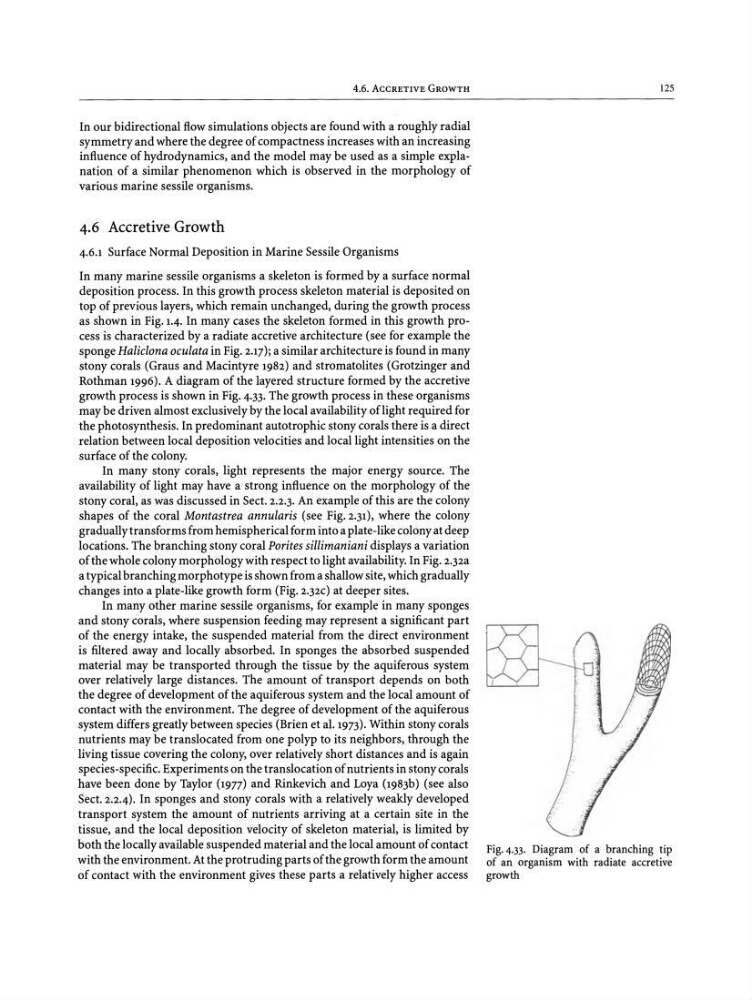
Rothman 1996). A diagram of the layered structure formed by the accretive
growth process is shown in Fig. 4.33. The growth process in these organisms
may be driven almost exclusively by the local availability oflight required for
the photosynthesis. In predominant autotrophic stony corals there is a direct
relation between local deposition velocities and local light intensities on the
surface of the colony.
In many stony corals, light represents the major energy source . The
availability of light may have a strong influence on the morphology of the
stony coral, as was discussed in Sect. 2.2.3. An example of this are the colony
shapes of the coral Montastrea annularis (see Fig. 2.31), where the colony
gradually transforms from hemispherical form into a plate-like colony at deep
locations. The branching stony coral Porites sillimaniani displays a variation
of the whole colony morphology with respect to light availability. In Fig. 2.32a
a typical branching morphotype is shown from a shallow site, which gradually
changes into a plate-like growth form (Fig. 2.32C) at deeper sites.
In many other marine sessile organisms, for example in many sponges
and stony corals, where suspension feeding may represent a significant part
of the energy intake, the suspended material from the direct environment
is filtered away and locally absorbed. In sponges the absorbed suspended
material may be transported through the tissue by the aquiferous system
over relatively large distances. The amount of transport depends on both
the degree of development of the aquiferous system and the local amount of
contact with the environment. The degree of development of the aquiferous
system differs greatly between species (Brien et al. 1973). Within stony corals
nutrients may be translocated from one polyp to its neighbors, through the
living tissue covering the colony, over relatively short distances and is again
species-specific. Experiments on the translocation of nutrients in stony corals
have been done by Taylor (1977) and Rinkevich and Loya (1983b) (see also
Sect. 2.2-4). In sponges and stony corals with a relatively weakly developed
transport system the amount of nutrients arriving at a certain site in the
tissue, and the local deposition velocity of skeleton material, is limited by
both the locally available suspended material and the local amount of contact
with the environment. At the protruding parts of the growth form the amount
of contact with the environment gives these parts a relatively higher access
125
Fig. 4.33. Diagram of a branching tip
of an organism with radiate accretive
growth
In our bidirectional flow simulations objects are found with a roughly radial
symmetry and where the degree of compactness increases with an increasing
influence of hydrodynamics, and the model may be used as a simple explanation of a similar phenomenon which is observed in the morphology of
various marine sessile organisms.
4.6 Accretive Growth
4.6.1 Surface Normal Deposition in Marine Sessile Organisms
In many marine sessile organisms a skeleton is formed by a surface normal
deposition process. In this growth process skeleton material is deposited on
top of previous layers, which remain unchanged, during the growth process
as shown in Fig. 1.4. In many cases the skeleton formed in this growth process is characterized by a radiate accretive architecture (see for example the
sponge Haliclona oculata in Fig. 2.17); a similar architecture is found in many
stony corals (Graus and Macintyre 1982) and stromatolites (Grotzinger and
Rothman 1996). A diagram of the layered structure formed by the accretive
growth process is shown in Fig. 4.33. The growth process in these organisms
may be driven almost exclusively by the local availability oflight required for
the photosynthesis. In predominant autotrophic stony corals there is a direct
relation between local deposition velocities and local light intensities on the
surface of the colony.
In many stony corals, light represents the major energy source . The
availability of light may have a strong influence on the morphology of the
stony coral, as was discussed in Sect. 2.2.3. An example of this are the colony
shapes of the coral Montastrea annularis (see Fig. 2.31), where the colony
gradually transforms from hemispherical form into a plate-like colony at deep
locations. The branching stony coral Porites sillimaniani displays a variation
of the whole colony morphology with respect to light availability. In Fig. 2.32a
a typical branching morphotype is shown from a shallow site, which gradually
changes into a plate-like growth form (Fig. 2.32C) at deeper sites.
In many other marine sessile organisms, for example in many sponges
and stony corals, where suspension feeding may represent a significant part
of the energy intake, the suspended material from the direct environment
is filtered away and locally absorbed. In sponges the absorbed suspended
material may be transported through the tissue by the aquiferous system
over relatively large distances. The amount of transport depends on both
the degree of development of the aquiferous system and the local amount of
contact with the environment. The degree of development of the aquiferous
system differs greatly between species (Brien et al. 1973). Within stony corals
nutrients may be translocated from one polyp to its neighbors, through the
living tissue covering the colony, over relatively short distances and is again
species-specific. Experiments on the translocation of nutrients in stony corals
have been done by Taylor (1977) and Rinkevich and Loya (1983b) (see also
Sect. 2.2-4). In sponges and stony corals with a relatively weakly developed
transport system the amount of nutrients arriving at a certain site in the
tissue, and the local deposition velocity of skeleton material, is limited by
both the locally available suspended material and the local amount of contact
with the environment. At the protruding parts of the growth form the amount
of contact with the environment gives these parts a relatively higher access
125
Fig. 4.33. Diagram of a branching tip
of an organism with radiate accretive
growth