

104
4. SIMULATING GROWTH AND FORM
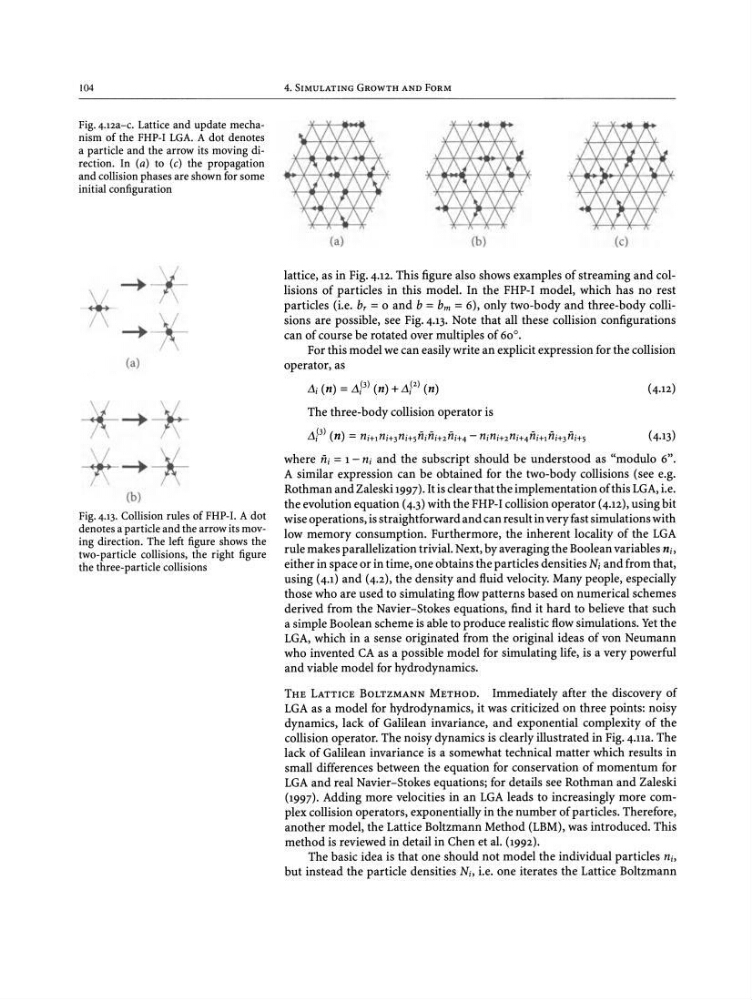
Fig.4.12a-C. Lattice and update mechanism of the FHP-I LGA. A dot denotes
a particle and the arrow its moving direction. In (a) to (c) the propagation
and collision phases are shown for some
initial configuration
(a)
(b)
(c)
\/ --+*
- ~
/\ --+---(a)
* --+*
\/--+ /
7\
(b)
Fig. 4.13. Collision rules of FHP-I. A dot
denotes a particle and the arrow its moving direction. The left figure shows the
two-particle collisions, the right figure
the three-particle collisions
lattice, as in Fig. 4.12. This figure also shows examples of streaming and collisions of particles in this model. In the FHP-I model, which has no rest
particles (i.e, b, = 0 and b = b,« = 6), only two-body and three-body collisions are possible, see Fig. 4.13. Note that all these collision configurations
can of course be rotated over multiples of 60 °.
For this model we can easily write an explicit expression for the collision
operator, as
Lli (n) = LlP) (n) + Lll
2
) (n)
The three-body collision operator is
Lll
3
) (n) = ni+lni+3ni+5nini+2ni+4 - nin i+2ni+4ni+lni+3n i+5
where ni = 1- n, and the subscript should be understood as "modulo 6".
A similar expression can be obtained for the two-body collisions (see e.g.
Rothman and Zaleski 1997).It is clear that the implementation ofthis LGA,i.e.
the evolution equation (4.3) with the FHP-I collision operator (4.12),using bit
wise operations, is straightforward and can result in very fast simulations with
low memory consumption. Furthermore, the inherent locality of the LGA
rule makes parallelization trivial. Next, by averaging the Boolean variables ni,
either in space or in time, one obtains the particles densities N, and from that,
using (4.1) and (4.2), the density and fluid velocity. Many people, especially
those who are used to simulating flow patterns based on numerical schemes
derived from the Navier-Stokes equations, find it hard to believe that such
a simple Boolean scheme is able to produce realistic flow simulations. Yetthe
LGA, which in a sense originated from the original ideas of von Neumann
who invented CA as a poss ible model for simulating life, is a very powerful
and viable model for hydrodynamics.
THE LATTICE BOLTZMANN METHOD. Immediately after the discovery of
LGA as a model for hydrodynamics, it was criticized on three points: noisy
dynamics, lack of Galilean invariance, and exponential complexity of the
collision operator. The noisy dynamics is clearly illustrated in Fig. 4.ua. The
lack of Galilean invariance is a somewhat technical matter which results in
small differences between the equation for conservation of momentum for
LGA and real Navier-Stokes equations; for details see Rothman and Zaleski
(1997). Adding more velocities in an LGA leads to increasingly more complex collision operators, exponentially in the number of particles. Therefore,
another model, the Lattice Boltzmann Method (LBM), was introduced. This
method is reviewed in detail in Chen et al. (1992).
The basic idea is that one should not model the individual particles ni,
but instead the particle densities Ni' i.e. one iterates the Lattice Boltzmann
4. SIMULATING GROWTH AND FORM
Fig.4.12a-C. Lattice and update mechanism of the FHP-I LGA. A dot denotes
a particle and the arrow its moving direction. In (a) to (c) the propagation
and collision phases are shown for some
initial configuration
(a)
(b)
(c)
\/ --+*
- ~
/\ --+---(a)
* --+*
\/--+ /
7\
(b)
Fig. 4.13. Collision rules of FHP-I. A dot
denotes a particle and the arrow its moving direction. The left figure shows the
two-particle collisions, the right figure
the three-particle collisions
lattice, as in Fig. 4.12. This figure also shows examples of streaming and collisions of particles in this model. In the FHP-I model, which has no rest
particles (i.e, b, = 0 and b = b,« = 6), only two-body and three-body collisions are possible, see Fig. 4.13. Note that all these collision configurations
can of course be rotated over multiples of 60 °.
For this model we can easily write an explicit expression for the collision
operator, as
Lli (n) = LlP) (n) + Lll
2
) (n)
The three-body collision operator is
Lll
3
) (n) = ni+lni+3ni+5nini+2ni+4 - nin i+2ni+4ni+lni+3n i+5
where ni = 1- n, and the subscript should be understood as "modulo 6".
A similar expression can be obtained for the two-body collisions (see e.g.
Rothman and Zaleski 1997).It is clear that the implementation ofthis LGA,i.e.
the evolution equation (4.3) with the FHP-I collision operator (4.12),using bit
wise operations, is straightforward and can result in very fast simulations with
low memory consumption. Furthermore, the inherent locality of the LGA
rule makes parallelization trivial. Next, by averaging the Boolean variables ni,
either in space or in time, one obtains the particles densities N, and from that,
using (4.1) and (4.2), the density and fluid velocity. Many people, especially
those who are used to simulating flow patterns based on numerical schemes
derived from the Navier-Stokes equations, find it hard to believe that such
a simple Boolean scheme is able to produce realistic flow simulations. Yetthe
LGA, which in a sense originated from the original ideas of von Neumann
who invented CA as a poss ible model for simulating life, is a very powerful
and viable model for hydrodynamics.
THE LATTICE BOLTZMANN METHOD. Immediately after the discovery of
LGA as a model for hydrodynamics, it was criticized on three points: noisy
dynamics, lack of Galilean invariance, and exponential complexity of the
collision operator. The noisy dynamics is clearly illustrated in Fig. 4.ua. The
lack of Galilean invariance is a somewhat technical matter which results in
small differences between the equation for conservation of momentum for
LGA and real Navier-Stokes equations; for details see Rothman and Zaleski
(1997). Adding more velocities in an LGA leads to increasingly more complex collision operators, exponentially in the number of particles. Therefore,
another model, the Lattice Boltzmann Method (LBM), was introduced. This
method is reviewed in detail in Chen et al. (1992).
The basic idea is that one should not model the individual particles ni,
but instead the particle densities Ni' i.e. one iterates the Lattice Boltzmann