

102
4. SIMULATING GROWTH AND FORM
- - - - - - --- ------- --- -- - - -- - ----- -------- - - - - - - - - -
-------------- - - - - - - - - -
-- --------- - -- - - - -
- - - - , .. ~ - - - .. - , , ----- - - .. .. .. ~
- - - .. - .... ... .... - - - - --. .. ... ---- . ... - .... ,-- -.- - -- - - - - -
--------- ---- - - - - - -
------------ - - - --------- ---- - - - - - - - -
- ------- - - -- - - - - - -
\ '
/
~ .
.... , I
I
...
1
\
-
- I
\
. .
..~~~~: . ~~~~ :..~:~/~::==~~~~=~~=:~,-:..... , - .. 1 .............. .,.·.·
•
_ - ....- - ; - """ , - ...- ... - - - / ..
....
\
....
' .. . ... ... ... .. .. ... - - - - -
... .... .... .. . ~ ..'"
.. ...... - ... -
. . . . . . -
- ...... - - .. -
-
-
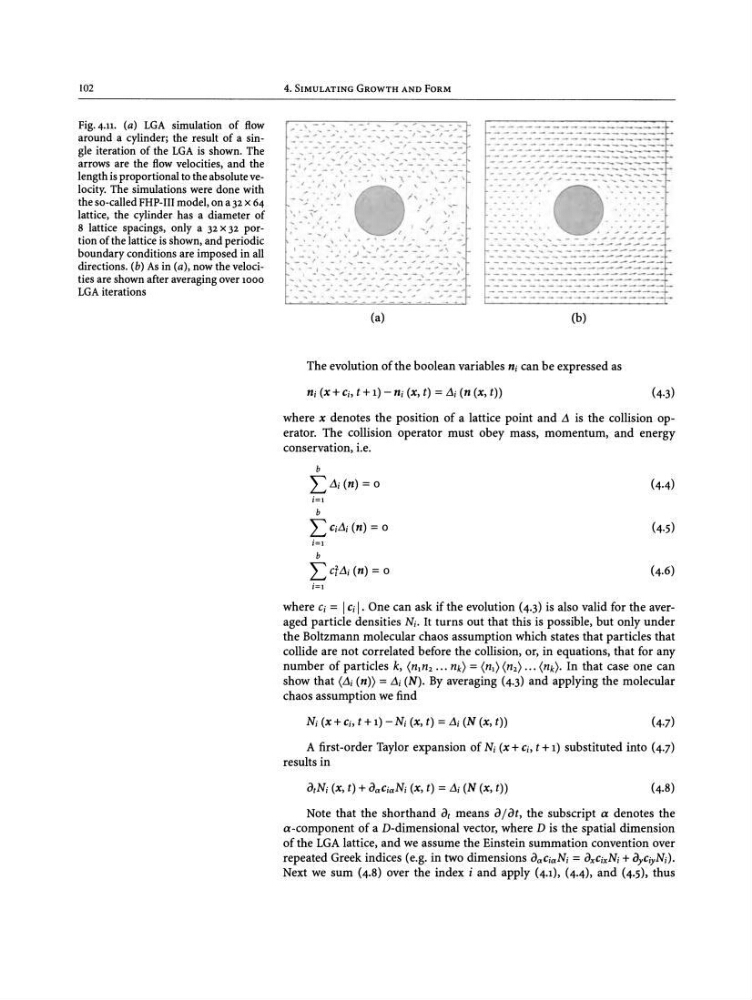
Fig. 4.11. (a) LGA simulation of flow
around a cylinder; the result of a single iteration of the LGA is shown. The
arrows are the flow velocities, and the
length is proportional to the absolute velocity. The simulations were done with
the so-called FHP-III model, on a 32 x 64
lattice, the cylinder has a diameter of
8 lattice spacings, only a 32 x 32 portion of the lattice is shown, and periodic
boundary conditions are imposed in all
directions. (b) As in (a) , now the velocities are shown after averaging over 1000
LGA iterations
(a)
(b)
The evolution of the boolean variables n, can be expressed as
n, (x + ci, t + 1) - n, (x, t) = ,1i (n (x, t»
where x denotes the position of a lattice point and ,1 is the collision operator. The collision operator must obey mass, momentum, and energy
conservation, i.e,
b
L,1i (n) = 0
(4-4)
;=1
b
L Ci,1i (n) = 0
(4.5)
;= 1
b
L cr,1i (n) = 0
(4.6)
;=1
where c, = 1CiI. One can ask if the evolution (4.3) is also valid for the averaged particle densities Ni. It turns out that this is possible, but only under
the Boltzmann molecular chaos assumption which states that particles that
collide are not correlated before the collision, or, in equations, that for any
number of particles k, (n tn2 ... nk) = (n t ) (n2) . .. (nk)' In that case one can
show that (,1i (n» = ,1i (N) . By averaging (4.3) and applying the molecular
chaos assumption we find
N, (x+ ci, t + 1) - N, (x, t) =,1i (N (x, t»
A first-order Taylor expansion of N, (x + ci, t + 1) substituted into (4.7)
results in
Note that the shorthand at means a/at, the subscript a denotes the
a-component of a D-dimensional vector, where D is the spatial dimension
of the LGA lattice, and we assume the Einstein summation convention over
repeated Greek indices (e.g, in two dimensions aaciaNi = axcixNi + ayciyNj).
Next we sum (4.8) over the index i and apply (4.1), (4.4), and (4.5), thus
4. SIMULATING GROWTH AND FORM
- - - - - - --- ------- --- -- - - -- - ----- -------- - - - - - - - - -
-------------- - - - - - - - - -
-- --------- - -- - - - -
- - - - , .. ~ - - - .. - , , ----- - - .. .. .. ~
- - - .. - .... ... .... - - - - --. .. ... ---- . ... - .... ,-- -.- - -- - - - - -
--------- ---- - - - - - -
------------ - - - --------- ---- - - - - - - - -
- ------- - - -- - - - - - -
\ '
/
~ .
.... , I
I
...
1
\
-
- I
\
. .
..~~~~: . ~~~~ :..~:~/~::==~~~~=~~=:~,-:..... , - .. 1 .............. .,.·.·
•
_ - ....- - ; - """ , - ...- ... - - - / ..
....
\
....
' .. . ... ... ... .. .. ... - - - - -
... .... .... .. . ~ ..'"
.. ...... - ... -
. . . . . . -
- ...... - - .. -
-
-
Fig. 4.11. (a) LGA simulation of flow
around a cylinder; the result of a single iteration of the LGA is shown. The
arrows are the flow velocities, and the
length is proportional to the absolute velocity. The simulations were done with
the so-called FHP-III model, on a 32 x 64
lattice, the cylinder has a diameter of
8 lattice spacings, only a 32 x 32 portion of the lattice is shown, and periodic
boundary conditions are imposed in all
directions. (b) As in (a) , now the velocities are shown after averaging over 1000
LGA iterations
(a)
(b)
The evolution of the boolean variables n, can be expressed as
n, (x + ci, t + 1) - n, (x, t) = ,1i (n (x, t»
where x denotes the position of a lattice point and ,1 is the collision operator. The collision operator must obey mass, momentum, and energy
conservation, i.e,
b
L,1i (n) = 0
(4-4)
;=1
b
L Ci,1i (n) = 0
(4.5)
;= 1
b
L cr,1i (n) = 0
(4.6)
;=1
where c, = 1CiI. One can ask if the evolution (4.3) is also valid for the averaged particle densities Ni. It turns out that this is possible, but only under
the Boltzmann molecular chaos assumption which states that particles that
collide are not correlated before the collision, or, in equations, that for any
number of particles k, (n tn2 ... nk) = (n t ) (n2) . .. (nk)' In that case one can
show that (,1i (n» = ,1i (N) . By averaging (4.3) and applying the molecular
chaos assumption we find
N, (x+ ci, t + 1) - N, (x, t) =,1i (N (x, t»
A first-order Taylor expansion of N, (x + ci, t + 1) substituted into (4.7)
results in
Note that the shorthand at means a/at, the subscript a denotes the
a-component of a D-dimensional vector, where D is the spatial dimension
of the LGA lattice, and we assume the Einstein summation convention over
repeated Greek indices (e.g, in two dimensions aaciaNi = axcixNi + ayciyNj).
Next we sum (4.8) over the index i and apply (4.1), (4.4), and (4.5), thus