

5 Insecta (Lepidoptera)
55
• • Results
Cells will migrate from explanted fat body fragments. These cells are not
necessarily fat cells, because fat bodies consist of several types of cells,
such as fat cells, uric cells, and undifferentiated cells. The migrated fat
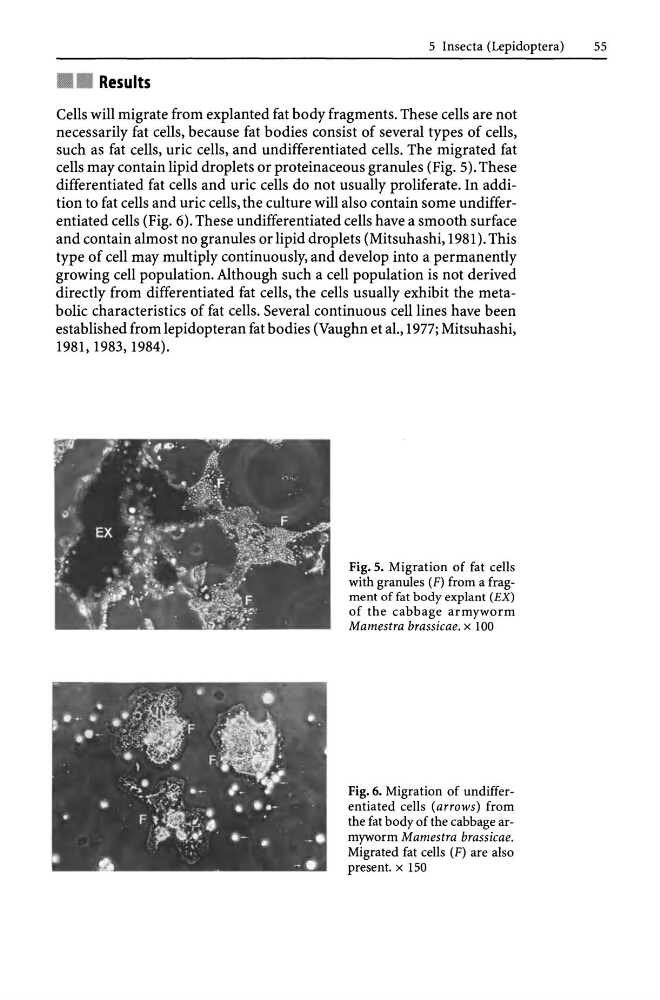
cells may contain lipid droplets or proteinaceous granules (Fig. 5). These
differentiated fat cells and uric cells do not usually proliferate. In addition to fat cells and uric cells, the culture will also contain some undifferentiated cells (Fig. 6). These undifferentiated cells have a smooth surface
and contain almost no granules or lipid droplets (Mitsuhashi, 1981). This
type of cell may multiply continuously, and develop into a permanently
growing cell population. Although such a cell population is not derived
directly from differentiated fat cells, the cells usually exhibit the metabolic characteristics of fat cells. Several continuous cell lines have been
established from lepidopteran fat bodies (Vaughn et aI., 1977; Mitsuhashi,
1981, 1983, 1984).
Fig. 5. Migration of fat cells
with granules (F) from a fragment of fat body explant (EX)
of the cabbage armyworm
Mamestra brassicae. x 100
Fig. 6. Migration of undifferentiated cells (arrows) from
the fat body of the cabbage armyworm Mamestra brassicae.
Migrated fat cells (F) are also
present. x 150
55
• • Results
Cells will migrate from explanted fat body fragments. These cells are not
necessarily fat cells, because fat bodies consist of several types of cells,
such as fat cells, uric cells, and undifferentiated cells. The migrated fat
cells may contain lipid droplets or proteinaceous granules (Fig. 5). These
differentiated fat cells and uric cells do not usually proliferate. In addition to fat cells and uric cells, the culture will also contain some undifferentiated cells (Fig. 6). These undifferentiated cells have a smooth surface
and contain almost no granules or lipid droplets (Mitsuhashi, 1981). This
type of cell may multiply continuously, and develop into a permanently
growing cell population. Although such a cell population is not derived
directly from differentiated fat cells, the cells usually exhibit the metabolic characteristics of fat cells. Several continuous cell lines have been
established from lepidopteran fat bodies (Vaughn et aI., 1977; Mitsuhashi,
1981, 1983, 1984).
Fig. 5. Migration of fat cells
with granules (F) from a fragment of fat body explant (EX)
of the cabbage armyworm
Mamestra brassicae. x 100
Fig. 6. Migration of undifferentiated cells (arrows) from
the fat body of the cabbage armyworm Mamestra brassicae.
Migrated fat cells (F) are also
present. x 150