

40 Cell Fusion
373
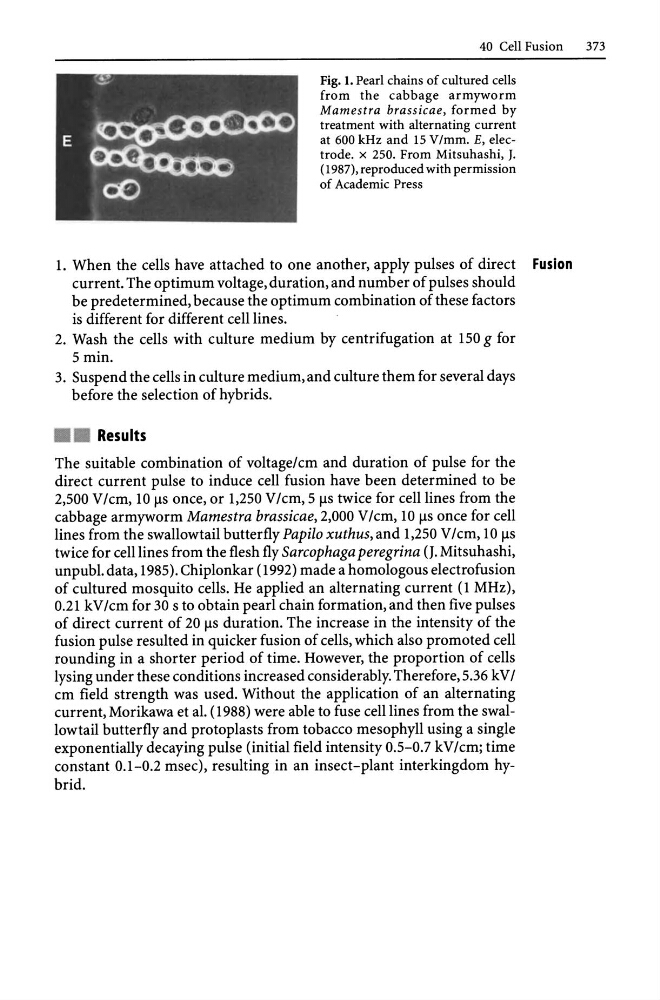
Fig. 1. Pearl chains of cultured cells
from the cabbage armyworm
Mamestra brassicae, formed by
treatment with alternating current
at 600 kHz and 15 V/mm. E, electrode. x 250. From Mitsuhashi, J.
(1987), reproduced with permission
of Academic Press
1. When the cells have attached to one another, apply pulses of direct Fusion
current. The optimum voltage, duration, and number of pulses should
be predetermined, because the optimum combination of these factors
is different for different cell lines.
2. Wash the cells with culture medium by centrifugation at 150 g for
5 min.
3. Suspend the cells in culture medium, and culture them for several days
before the selection of hybrids .
• • Results
The suitable combination of voltage/cm and duration of pulse for the
direct current pulse to induce cell fusion have been determined to be
2,500 V/cm, 10 fls once, or 1,250 V/cm, 5 fls twice for cell lines from the
cabbage armyworm Mamestra brassicae, 2,000 V/cm, 10 fls once for cell
lines from the swallowtail butterfly Papilo xuthus, and 1,250 V / cm, 10 fls
twice for cell lines from the flesh fly Sarcophaga peregrina 0. Mitsuhashi,
unpubl. data, 1985). Chiplonkar (1992) made a homologous electrofusion
of cultured mosquito cells. He applied an alternating current (1 MHz),
0.21 kV/cm for 30 s to obtain pearl chain formation, and then five pulses
of direct current of 20 fls duration. The increase in the intensity of the
fusion pulse resulted in quicker fusion of cells, which also promoted cell
rounding in a shorter period of time. However, the proportion of cells
lysing under these conditions increased considerably. Therefore, 5.36 k V /
cm field strength was used. Without the application of an alternating
current, Morikawa et al. (1988) were able to fuse cell lines from the swallowtail butterfly and protoplasts from tobacco mesophyll using a single
exponentially decaying pulse (initial field intensity 0.5-0.7 kV /cm; time
constant 0.1-0.2 msec), resulting in an insect-plant interkingdom hybrid.
373
Fig. 1. Pearl chains of cultured cells
from the cabbage armyworm
Mamestra brassicae, formed by
treatment with alternating current
at 600 kHz and 15 V/mm. E, electrode. x 250. From Mitsuhashi, J.
(1987), reproduced with permission
of Academic Press
1. When the cells have attached to one another, apply pulses of direct Fusion
current. The optimum voltage, duration, and number of pulses should
be predetermined, because the optimum combination of these factors
is different for different cell lines.
2. Wash the cells with culture medium by centrifugation at 150 g for
5 min.
3. Suspend the cells in culture medium, and culture them for several days
before the selection of hybrids .
• • Results
The suitable combination of voltage/cm and duration of pulse for the
direct current pulse to induce cell fusion have been determined to be
2,500 V/cm, 10 fls once, or 1,250 V/cm, 5 fls twice for cell lines from the
cabbage armyworm Mamestra brassicae, 2,000 V/cm, 10 fls once for cell
lines from the swallowtail butterfly Papilo xuthus, and 1,250 V / cm, 10 fls
twice for cell lines from the flesh fly Sarcophaga peregrina 0. Mitsuhashi,
unpubl. data, 1985). Chiplonkar (1992) made a homologous electrofusion
of cultured mosquito cells. He applied an alternating current (1 MHz),
0.21 kV/cm for 30 s to obtain pearl chain formation, and then five pulses
of direct current of 20 fls duration. The increase in the intensity of the
fusion pulse resulted in quicker fusion of cells, which also promoted cell
rounding in a shorter period of time. However, the proportion of cells
lysing under these conditions increased considerably. Therefore, 5.36 k V /
cm field strength was used. Without the application of an alternating
current, Morikawa et al. (1988) were able to fuse cell lines from the swallowtail butterfly and protoplasts from tobacco mesophyll using a single
exponentially decaying pulse (initial field intensity 0.5-0.7 kV /cm; time
constant 0.1-0.2 msec), resulting in an insect-plant interkingdom hybrid.