

362
Related Techniques
Inoculation 1. Prepare serial two- to lO-fold dilutions of the virus with culture medium.
2. Replace the culture medium with 1001-11 virus inoculum. Make eight
replicates for each dilution.
3. Incubate for 4 h at 25°C with gentle shaking.
4. Remove the inoculum and add 100 1-11 culture medium.
5. Continue to culture at 25°C for a further 6 days.
6. When the infection has developed fully, score each well for the presence of a cytopathic effect. Record the number of wells positive for
each dilution and calculate the TCID so by probit analysis.
Results
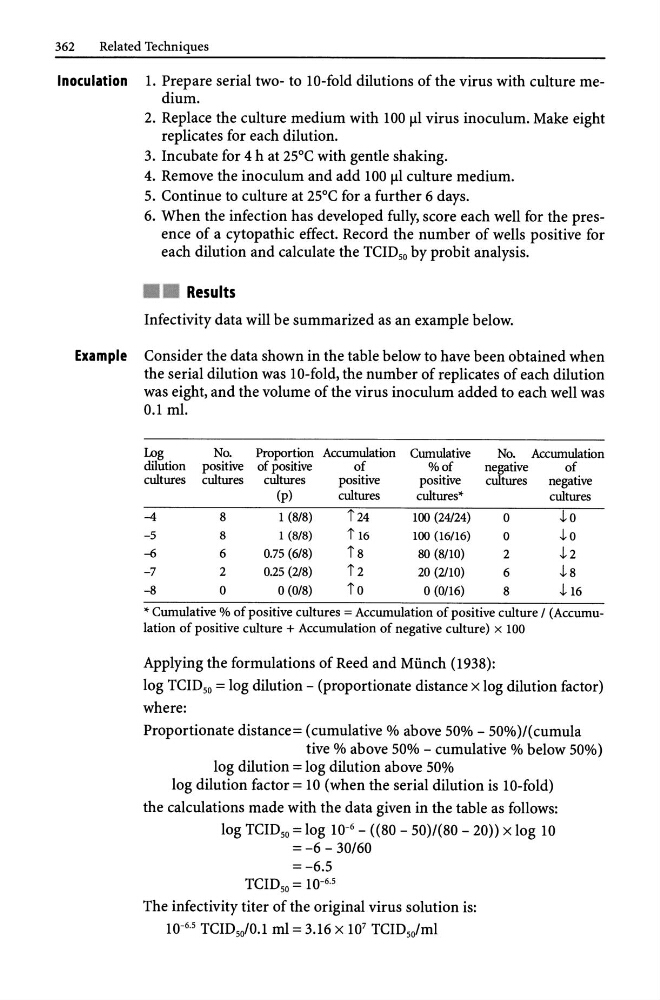
Infectivity data will be summarized as an example below.
Example Consider the data shown in the table below to have been obtained when
the serial dilution was lO-fold, the number of replicates of each dilution
was eight, and the volume of the virus inoculum added to each well was
0.1 ml.
Log
No.
Proportion Accumulation Cumulative
No. Accumulation
dilution positive of positive
of
% of
negative
of
cultures cultures
cultures
positive
positive
cultures
negative
(p)
cultures
cultures*
cultures
-4
8
1 (8/8)
124
100 (24/24)
0
.to
-5
8
1 (8/8)
116
100 (16/16)
0
.to
-6
6
0.75 (6/8)
Is
80 (8/10)
2
.t2
-7
2
025 (2/8)
12
20 (2/10)
6
h
-8
0
0(0/8)
10
0(0/16)
8
.t 16
* Cumulative % of positive cultures = Accumulation of positive culture / (Accumulation of positive culture + Accumulation of negative culture) x 100
Applying the formulations of Reed and Munch (1938):
log TCID so = log dilution - (proportionate distance x log dilution factor)
where:
Proportionate distance = (cumulative % above 50% - 50%)/(cumula
tive % above 50% - cumulative % below 50%)
log dilution = log dilution above 50%
log dilution factor = 10 (when the serial dilution is 10-fold)
the calculations made with the data given in the table as follows:
log TCID so = log 10- 6 - «80 - 50)/(80 - 20)) x log 10
= -6 - 30/60
=-6.5
TCID so = 1O- 6 . s
The infectivity titer of the original virus solution is:
1O- 6 . s TCID s olO.l ml = 3.16 x 10 7 TCIDsolml
Related Techniques
Inoculation 1. Prepare serial two- to lO-fold dilutions of the virus with culture medium.
2. Replace the culture medium with 1001-11 virus inoculum. Make eight
replicates for each dilution.
3. Incubate for 4 h at 25°C with gentle shaking.
4. Remove the inoculum and add 100 1-11 culture medium.
5. Continue to culture at 25°C for a further 6 days.
6. When the infection has developed fully, score each well for the presence of a cytopathic effect. Record the number of wells positive for
each dilution and calculate the TCID so by probit analysis.
Results
Infectivity data will be summarized as an example below.
Example Consider the data shown in the table below to have been obtained when
the serial dilution was lO-fold, the number of replicates of each dilution
was eight, and the volume of the virus inoculum added to each well was
0.1 ml.
Log
No.
Proportion Accumulation Cumulative
No. Accumulation
dilution positive of positive
of
% of
negative
of
cultures cultures
cultures
positive
positive
cultures
negative
(p)
cultures
cultures*
cultures
-4
8
1 (8/8)
124
100 (24/24)
0
.to
-5
8
1 (8/8)
116
100 (16/16)
0
.to
-6
6
0.75 (6/8)
Is
80 (8/10)
2
.t2
-7
2
025 (2/8)
12
20 (2/10)
6
h
-8
0
0(0/8)
10
0(0/16)
8
.t 16
* Cumulative % of positive cultures = Accumulation of positive culture / (Accumulation of positive culture + Accumulation of negative culture) x 100
Applying the formulations of Reed and Munch (1938):
log TCID so = log dilution - (proportionate distance x log dilution factor)
where:
Proportionate distance = (cumulative % above 50% - 50%)/(cumula
tive % above 50% - cumulative % below 50%)
log dilution = log dilution above 50%
log dilution factor = 10 (when the serial dilution is 10-fold)
the calculations made with the data given in the table as follows:
log TCID so = log 10- 6 - «80 - 50)/(80 - 20)) x log 10
= -6 - 30/60
=-6.5
TCID so = 1O- 6 . s
The infectivity titer of the original virus solution is:
1O- 6 . s TCID s olO.l ml = 3.16 x 10 7 TCIDsolml