

33 Identification of Cell Lines
327
NIAS-AMI-2
NIH-5aPe-4
FRI-$pIm-l229
NIAs-MoB,-as
NIAs-MaB,-e2
FRI-AnC0-5B
NIAlH'X-Q
TUAT-$pLl-221
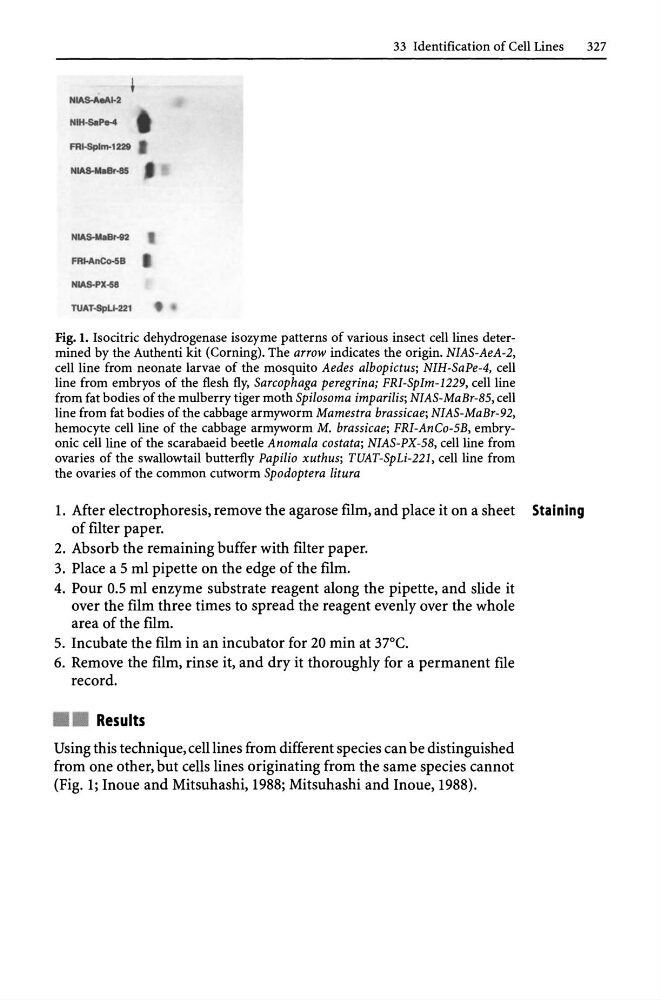
Fig. 1. Isocitric dehydrogenase isozyme patterns of various insect cell lines determined by the Authenti kit (Corning). The arrow indicates the origin. NIAS-AeA-2,
cell line from neonate larvae of the mosquito Aedes albopictus; NIH-SaPe-4, cell
line from embryos of the flesh fly, Sarcophaga peregrina; FRI-Splm-1229, cell line
from fat bodies of the mulberry tiger moth Spilosoma imparilis; NIAS-MaBr-8S, cell
line from fat bodies of the cabbage armyworm Mamestra brassicae; NIAS-MaBr-92,
hemocyte cell line of the cabbage armyworm M. brassicae; FRI-AnCo-SB, embryonic cell line of the scarabaeid beetle Anomala costata; NIAS-PX-S8, cell line from
ovaries of the swallowtail butterfly Papilio xuthus; TUAT-SpLi-221, cell line from
the ovaries of the common cutworm Spodoptera litura
1. After electrophoresis, remove the agarose film, and place it on a sheet Staining
of filter paper.
2. Absorb the remaining buffer with filter paper.
3. Place a 5 ml pipette on the edge of the film.
4. Pour 0.5 ml enzyme substrate reagent along the pipette, and slide it
over the film three times to spread the reagent evenly over the whole
area of the film.
5. Incubate the film in an incubator for 20 min at 37°C.
6. Remove the film, rinse it, and dry it thoroughly for a permanent file
record .
• • Results
Using this technique, cell lines from different species can be distinguished
from one other, but cells lines originating from the same species cannot
(Fig. 1; Inoue and Mitsuhashi, 1988; Mitsuhashi and Inoue, 1988).
327
NIAS-AMI-2
NIH-5aPe-4
FRI-$pIm-l229
NIAs-MoB,-as
NIAs-MaB,-e2
FRI-AnC0-5B
NIAlH'X-Q
TUAT-$pLl-221
Fig. 1. Isocitric dehydrogenase isozyme patterns of various insect cell lines determined by the Authenti kit (Corning). The arrow indicates the origin. NIAS-AeA-2,
cell line from neonate larvae of the mosquito Aedes albopictus; NIH-SaPe-4, cell
line from embryos of the flesh fly, Sarcophaga peregrina; FRI-Splm-1229, cell line
from fat bodies of the mulberry tiger moth Spilosoma imparilis; NIAS-MaBr-8S, cell
line from fat bodies of the cabbage armyworm Mamestra brassicae; NIAS-MaBr-92,
hemocyte cell line of the cabbage armyworm M. brassicae; FRI-AnCo-SB, embryonic cell line of the scarabaeid beetle Anomala costata; NIAS-PX-S8, cell line from
ovaries of the swallowtail butterfly Papilio xuthus; TUAT-SpLi-221, cell line from
the ovaries of the common cutworm Spodoptera litura
1. After electrophoresis, remove the agarose film, and place it on a sheet Staining
of filter paper.
2. Absorb the remaining buffer with filter paper.
3. Place a 5 ml pipette on the edge of the film.
4. Pour 0.5 ml enzyme substrate reagent along the pipette, and slide it
over the film three times to spread the reagent evenly over the whole
area of the film.
5. Incubate the film in an incubator for 20 min at 37°C.
6. Remove the film, rinse it, and dry it thoroughly for a permanent file
record .
• • Results
Using this technique, cell lines from different species can be distinguished
from one other, but cells lines originating from the same species cannot
(Fig. 1; Inoue and Mitsuhashi, 1988; Mitsuhashi and Inoue, 1988).