

318
Related Techniques
Seeding of
isolated cells
1. Follow the steps in subprotocol 1 from the beginning of Preparation
of cells to the end of Aspriration.
2. Release the isolated cell onto the upturned surface of the 3-cm petri
dish lid.
3. Add small amount of culture medium to the isolated cell so as to make
a single sitting drop of 3-5 mm diameter.
4. Leave the plated single cells overnight in a moist chamber (air-tight
plastic box, with wet absorbent cotton inside) to adhere the cell to the
surface.
5. Pipette off the medium covering the single cells on the 3-cm petri dish
lid, invert the lid, and lay it gently onto the S-cm petri dish containing
the feeder layer so that the surface of the 3-cm petri dish is dipped in
the medium.
6. Mark the single cells, and observe them carefully.
Maintenance 1. Change the feeder layer dish at intervals of approximately 4-5 days.
2. Once the clones have started to grow rapidly, transfer the lid of the
cloning dish to a fresh dish without a feeder layer for further growth.
3. When the clones have grown sufficiently, subculture the cloned cells
to a small culture vessel such as petri dish 3 cm diameter, and progressively move up to larger vessels with subsequent passages .
• • Results
The irradiated cells do not multiply and eventually die. The isolated cell
will grow by supplementation of growth factor from the feeder layer cells.
Using the non-irradiated feeder layer method, the feeder cells proliferate
and diffuse the conditioning factors into the medium. However, the structure of the cloning dish prevents contamination of single cells by feeder
layer cells.
I
Subprotocol 9
Nurse Culture
• • Materials
Equipment - Centrifuge and centrifuge tube
- 24-well culture plate
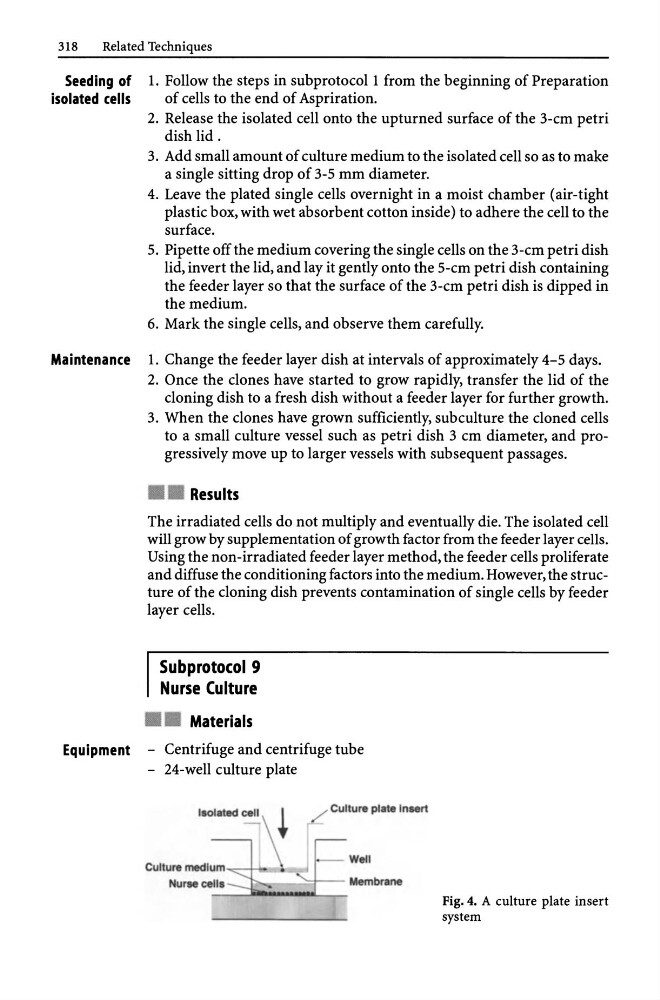
IlSQleled cell
/ " Cullure plele In8811
Culture medium
Well
Nuree cells
Membrene
- ---.:IiiIIIIo.--L-rFig. 4. A culture plate insert
system
Related Techniques
Seeding of
isolated cells
1. Follow the steps in subprotocol 1 from the beginning of Preparation
of cells to the end of Aspriration.
2. Release the isolated cell onto the upturned surface of the 3-cm petri
dish lid.
3. Add small amount of culture medium to the isolated cell so as to make
a single sitting drop of 3-5 mm diameter.
4. Leave the plated single cells overnight in a moist chamber (air-tight
plastic box, with wet absorbent cotton inside) to adhere the cell to the
surface.
5. Pipette off the medium covering the single cells on the 3-cm petri dish
lid, invert the lid, and lay it gently onto the S-cm petri dish containing
the feeder layer so that the surface of the 3-cm petri dish is dipped in
the medium.
6. Mark the single cells, and observe them carefully.
Maintenance 1. Change the feeder layer dish at intervals of approximately 4-5 days.
2. Once the clones have started to grow rapidly, transfer the lid of the
cloning dish to a fresh dish without a feeder layer for further growth.
3. When the clones have grown sufficiently, subculture the cloned cells
to a small culture vessel such as petri dish 3 cm diameter, and progressively move up to larger vessels with subsequent passages .
• • Results
The irradiated cells do not multiply and eventually die. The isolated cell
will grow by supplementation of growth factor from the feeder layer cells.
Using the non-irradiated feeder layer method, the feeder cells proliferate
and diffuse the conditioning factors into the medium. However, the structure of the cloning dish prevents contamination of single cells by feeder
layer cells.
I
Subprotocol 9
Nurse Culture
• • Materials
Equipment - Centrifuge and centrifuge tube
- 24-well culture plate
IlSQleled cell
/ " Cullure plele In8811
Culture medium
Well
Nuree cells
Membrene
- ---.:IiiIIIIo.--L-rFig. 4. A culture plate insert
system