

21 Insecta
241
discs, such as eye-antennal discs, wing discs. or leg discs (cf. chapter
6, Fig. 5).
3. Remove any extra tissues attached to the imaginal discs.
1. Transfer the discs into culture vessels with culture medium.
2. Keep the culture at 25°C.
• • Comments
Aseptic rearing of Drosophila:
- Collect eggs
- Sterilize the eggs in 0.05% mercuric chloride solution dissolved in 70%
ethanol for 30 min
- Wash the eggs in sterilized distilled water
- Transfer the eggs into autoc1aved bottles containing Drosophila diet
- Keep the bottles at 25°C; the third instar larvae will be obtained approximately 96 h after hatching
• • Results
Since Fischer and Gottschewski (1939) and Gottschewski and Fisher
(1939) reported the culture of Drosophila imaginal discs, many investigators have cultured imaginal discs of D. melanogaster for the study of
the differentiation of discs in specific hormonal environments. To this
end, in the early stages, imaginal discs were often cocultured with an
endocrine organ, such as brains or ring glands. Later investigators incorporated ecdysteroids or juvenile hormone into the culture media instead
of using a coculture with endocrine glands. In general, cultured discs
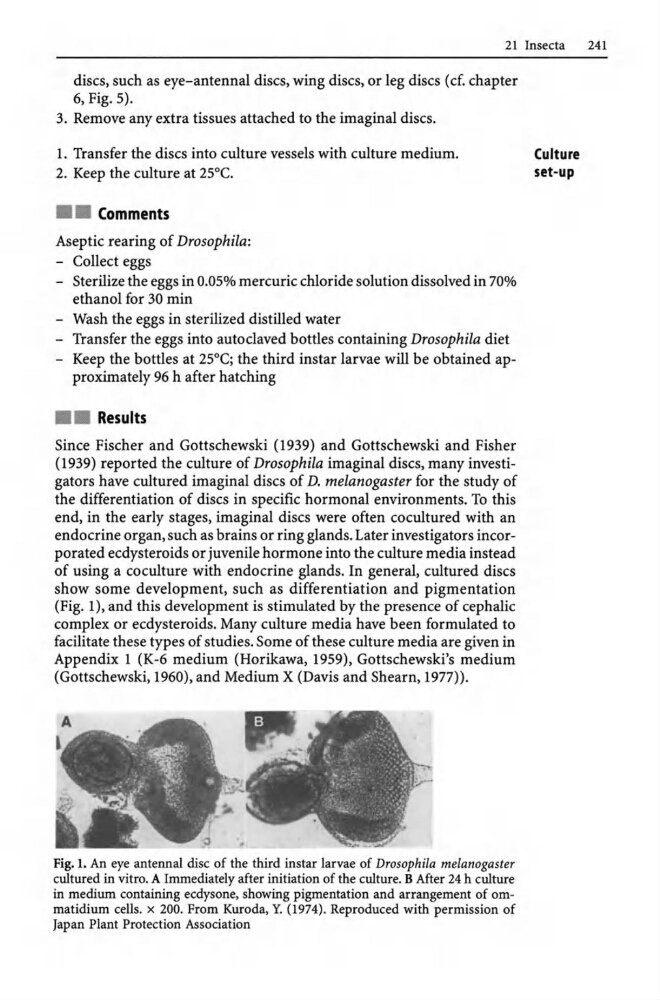
show some development. such as differentiation and pigmentation
(Fig. 1), and this development is stimulated by the presence of cephalic
complex or ecdysteroids. Many culture media have been formulated to
facilitate these types of studies. Some of these culture media are given in
Appendix 1 (K -6 medium (Horikawa, 1959). Gottschewski's medium
(Gottschewski, 1960). and Medium X (Davis and Shearn, 1977)).
Fig. I. An eye antennal disc of the third ins tar larvae of Drosophila melanogaster
cultured in vitro. A Immediately after initiation of the culture. B After 24 h culture
in medium containing ecdysone. showing pigmentation and arrangement of ommatidium cells. x 200. From Kuroda, Y. (1974). Reproduced with permission of
Japan Plant Protection Association
Culture
set-up
241
discs, such as eye-antennal discs, wing discs. or leg discs (cf. chapter
6, Fig. 5).
3. Remove any extra tissues attached to the imaginal discs.
1. Transfer the discs into culture vessels with culture medium.
2. Keep the culture at 25°C.
• • Comments
Aseptic rearing of Drosophila:
- Collect eggs
- Sterilize the eggs in 0.05% mercuric chloride solution dissolved in 70%
ethanol for 30 min
- Wash the eggs in sterilized distilled water
- Transfer the eggs into autoc1aved bottles containing Drosophila diet
- Keep the bottles at 25°C; the third instar larvae will be obtained approximately 96 h after hatching
• • Results
Since Fischer and Gottschewski (1939) and Gottschewski and Fisher
(1939) reported the culture of Drosophila imaginal discs, many investigators have cultured imaginal discs of D. melanogaster for the study of
the differentiation of discs in specific hormonal environments. To this
end, in the early stages, imaginal discs were often cocultured with an
endocrine organ, such as brains or ring glands. Later investigators incorporated ecdysteroids or juvenile hormone into the culture media instead
of using a coculture with endocrine glands. In general, cultured discs
show some development. such as differentiation and pigmentation
(Fig. 1), and this development is stimulated by the presence of cephalic
complex or ecdysteroids. Many culture media have been formulated to
facilitate these types of studies. Some of these culture media are given in
Appendix 1 (K -6 medium (Horikawa, 1959). Gottschewski's medium
(Gottschewski, 1960). and Medium X (Davis and Shearn, 1977)).
Fig. I. An eye antennal disc of the third ins tar larvae of Drosophila melanogaster
cultured in vitro. A Immediately after initiation of the culture. B After 24 h culture
in medium containing ecdysone. showing pigmentation and arrangement of ommatidium cells. x 200. From Kuroda, Y. (1974). Reproduced with permission of
Japan Plant Protection Association
Culture
set-up