

180
Methods for Setting Up Primary Cultures Specific to Animal Groups
vu 0 ' 0
0&
<:>
0
F
t9~
-0
0 0
o 00(l/:)
..0 0
<:>
00
<:>
0
)~ 't
0
(;)
(!)
~O-oa
E
0
Q
00
0
OQO<£, (;) 0
0
00 /.
0 0
0
0
'"O<:>OO~O 0 0
be> r$J
0
~
0
0.
0 00
• • Results
O~
6'
0
~O
0
0
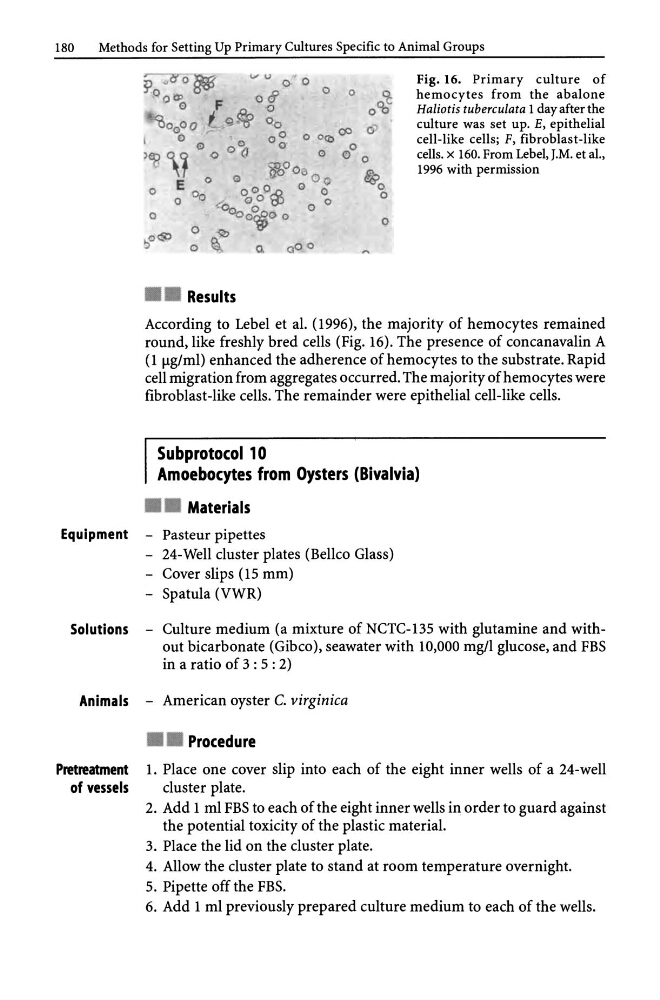
Fig. 16. Primary culture of
hemocytes from the abalone
Haliotis tuberculata 1 day after the
culture was set up. E, epithelial
cell-like cells; P, fibroblast-like
cells. x 160. From Lebel, T.M. et aI.,
1996 with permission
According to Lebel et al. (1996), the majority of hemocytes remained
round, like freshly bred cells (Fig. 16). The presence of concanavalin A
(1 fIg/ml) enhanced the adherence of hemocytes to the substrate. Rapid
cell migration from aggregates occurred. The majority of hemocytes were
fibroblast-like cells. The remainder were epithelial cell-like cells.
Subprotocol 10
Amoebocytes from Oysters (Bivalvia)
• • Materials
Equipment - Pasteur pipettes
- 24-Well cluster plates (Belko Glass)
- Cover slips (15 mm)
- Spatula (VWR)
Solutions - Culture medium (a mixture of NCTC-13S with glutamine and without bicarbonate (Gibco), seawater with 10,000 mg/l glucose, and FBS
in a ratio of 3 : 5 : 2)
Animals - American oyster C. virginica
Pretreatment
of vessels
• • Procedure
1. Place one cover slip into each of the eight inner wells of a 24-well
cluster plate.
2. Add 1 ml FBS to each of the eight inner wells in order to guard against
the potential toxicity of the plastic material.
3. Place the lid on the cluster plate.
4. Allow the cluster plate to stand at room temperature overnight.
5. Pipette off the FBS.
6. Add 1 ml previously prepared culture medium to each of the wells.
Methods for Setting Up Primary Cultures Specific to Animal Groups
vu 0 ' 0
0&
<:>
0
F
t9~
-0
0 0
o 00(l/:)
..0 0
<:>
00
<:>
0
)~ 't
0
(;)
(!)
~O-oa
E
0
Q
00
0
OQO<£, (;) 0
0
00 /.
0 0
0
0
'"O<:>OO~O 0 0
be> r$J
0
~
0
0.
0 00
• • Results
O~
6'
0
~O
0
0
Fig. 16. Primary culture of
hemocytes from the abalone
Haliotis tuberculata 1 day after the
culture was set up. E, epithelial
cell-like cells; P, fibroblast-like
cells. x 160. From Lebel, T.M. et aI.,
1996 with permission
According to Lebel et al. (1996), the majority of hemocytes remained
round, like freshly bred cells (Fig. 16). The presence of concanavalin A
(1 fIg/ml) enhanced the adherence of hemocytes to the substrate. Rapid
cell migration from aggregates occurred. The majority of hemocytes were
fibroblast-like cells. The remainder were epithelial cell-like cells.
Subprotocol 10
Amoebocytes from Oysters (Bivalvia)
• • Materials
Equipment - Pasteur pipettes
- 24-Well cluster plates (Belko Glass)
- Cover slips (15 mm)
- Spatula (VWR)
Solutions - Culture medium (a mixture of NCTC-13S with glutamine and without bicarbonate (Gibco), seawater with 10,000 mg/l glucose, and FBS
in a ratio of 3 : 5 : 2)
Animals - American oyster C. virginica
Pretreatment
of vessels
• • Procedure
1. Place one cover slip into each of the eight inner wells of a 24-well
cluster plate.
2. Add 1 ml FBS to each of the eight inner wells in order to guard against
the potential toxicity of the plastic material.
3. Place the lid on the cluster plate.
4. Allow the cluster plate to stand at room temperature overnight.
5. Pipette off the FBS.
6. Add 1 ml previously prepared culture medium to each of the wells.