

162
Methods for Setting Up Primary Cultures Specific to Animal Groups
2
3
4
Fig. 1. Development of a blastomere. 1, the egg 1 h after fertilization, with fertilization-membrane and polar bodies; 2, beginning of the first cleavage, formation of
the polar lobe; 3, trefoil, 1.25 h after fertilization; 4, two-cell stage; PB, polar body;
PL, polar lobe. From Wilson, E.B., Experimental studies on germinal localization,
Journal of Experimental Zoology, VoU, 1904, Copyright © 1904, John Wiley & Sons,
Inc. Reproduced by permission of Wiley-Liss, Inc., a subsidiary of John Wiley &
Sons, Inc.
lUI Results
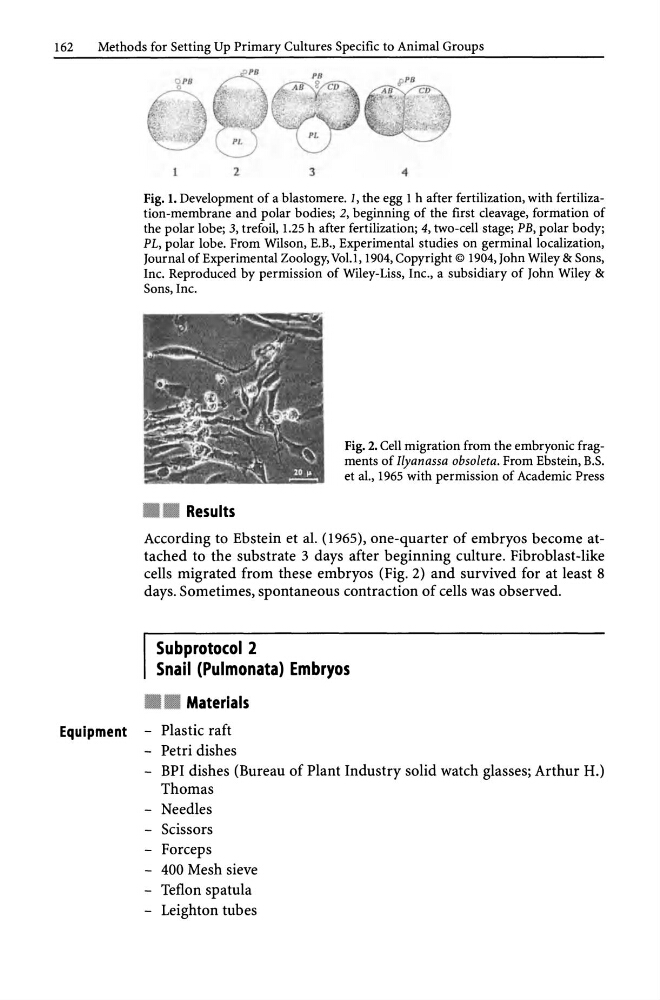
Fig. 2. Cell migration from the embryonic fragments of Ilyanassa obsoleta. From Ebstein, B.S.
et aI., 1965 with permission of Academic Press
According to Ebstein et al. (1965), one-quarter of embryos become attached to the substrate 3 days after beginning culture. Fibroblast-like
cells migrated from these embryos (Fig. 2) and survived for at least 8
days. Sometimes, spontaneous contraction of cells was observed.
Subprotocol 2
Snail (Pulmonata) Embryos
• • Materials
Equipment - Plastic raft
- Petri dishes
- BPI dishes (Bureau of Plant Industry solid watch glasses; Arthur H.)
Thomas
- Needles
- Scissors
- Forceps
- 400 Mesh sieve
- Teflon spatula
- Leighton tubes
Methods for Setting Up Primary Cultures Specific to Animal Groups
2
3
4
Fig. 1. Development of a blastomere. 1, the egg 1 h after fertilization, with fertilization-membrane and polar bodies; 2, beginning of the first cleavage, formation of
the polar lobe; 3, trefoil, 1.25 h after fertilization; 4, two-cell stage; PB, polar body;
PL, polar lobe. From Wilson, E.B., Experimental studies on germinal localization,
Journal of Experimental Zoology, VoU, 1904, Copyright © 1904, John Wiley & Sons,
Inc. Reproduced by permission of Wiley-Liss, Inc., a subsidiary of John Wiley &
Sons, Inc.
lUI Results
Fig. 2. Cell migration from the embryonic fragments of Ilyanassa obsoleta. From Ebstein, B.S.
et aI., 1965 with permission of Academic Press
According to Ebstein et al. (1965), one-quarter of embryos become attached to the substrate 3 days after beginning culture. Fibroblast-like
cells migrated from these embryos (Fig. 2) and survived for at least 8
days. Sometimes, spontaneous contraction of cells was observed.
Subprotocol 2
Snail (Pulmonata) Embryos
• • Materials
Equipment - Plastic raft
- Petri dishes
- BPI dishes (Bureau of Plant Industry solid watch glasses; Arthur H.)
Thomas
- Needles
- Scissors
- Forceps
- 400 Mesh sieve
- Teflon spatula
- Leighton tubes