

xx
Beklemishev 1969; Cook 1979; Ryland 1979; Cheetham and Cook 1983; McKinney and
Jackson 1989; Reed 1991; Viskova 1992; Taylor 1999; Lidgard et al. 2012).
Like many other kinds of colonial epibionts, bryozoans can regenerate very well (Levinsen
1907; Winston 1983; Ostrovsky 1997; O’Dea 2006; O’Dea et al. 2008), reproducing not only
sexually but also asexually. In some cases, asexual reproduction by fragmentation dominates
over sexual reproduction. This often depends on the growth form of the colony: for example,
half or even most of the increase in the abundance of populations of some bryozoans with treelike colonies is due to fragmentation (Winston 1983; Thomsen and Håkansson 1995; Cheetham
et al. 2001). Among free-living species (with non-attached colonies) there are those reproducing mostly by fragmentation and those relying mostly on sexual reproduction (O’Dea et al.
2004, 2008; O’Dea 2006). There are also species actively using both these means (O’Dea et al.
2010). Some encrusting forms are known to “switch” from sexual reproduction to asexual in
response to changes in environmental conditions. It has been shown that in populations reproducing mostly asexually, the number of fertile zooids (those forming ovaries) in the colonies is
much lower than in populations where sexual reproduction dominates (Thomsen and Håkansson
1995). In any case, sexual reproduction is an obligatory component of the bryozoan life cycle
and for many the only possible way to reproduce.
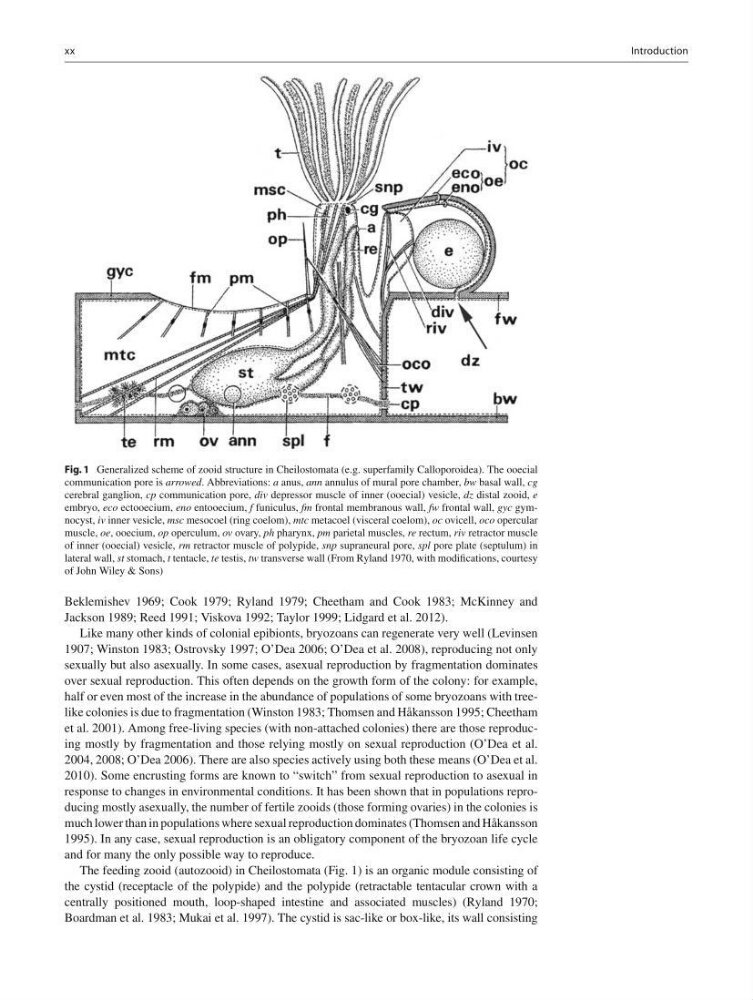
The feeding zooid (autozooid) in Cheilostomata (Fig. 1 ) is an organic module consisting of
the cystid (receptacle of the polypide) and the polypide (retractable tentacular crown with a
centrally positioned mouth, loop-shaped intestine and associated muscles) (Ryland 1970;
Boardman et al. 1983; Mukai et al. 1997). The cystid is sac-like or box-like, its wall consisting
Fig. 1 Generalized scheme of zooid structure in Cheilostomata (e.g. superfamily Calloporoidea). The ooecial
communication pore is arrowed . Abbreviations: a anus, ann annulus of mural pore chamber, bw basal wall, cg
cerebral ganglion, cp communication pore, div depressor muscle of inner (ooecial) vesicle, dz distal zooid, e
embryo, eco ectooecium, eno entooecium, f funiculus, fm frontal membranous wall, fw frontal wall, gyc gymnocyst, iv inner vesicle, msc mesocoel (ring coelom), mtc metacoel (visceral coelom), oc ovicell, oco opercular
muscle, oe , ooecium, op operculum, ov ovary, ph pharynx, pm parietal muscles, re rectum, riv retractor muscle
of inner (ooecial) vesicle, rm retractor muscle of polypide, snp supraneural pore, spl pore plate (septulum) in
lateral wall, st stomach, t tentacle, te testis, tw transverse wall (From Ryland 1970, with modifi cations, courtesy
of John Wiley & Sons)
Introduction
Beklemishev 1969; Cook 1979; Ryland 1979; Cheetham and Cook 1983; McKinney and
Jackson 1989; Reed 1991; Viskova 1992; Taylor 1999; Lidgard et al. 2012).
Like many other kinds of colonial epibionts, bryozoans can regenerate very well (Levinsen
1907; Winston 1983; Ostrovsky 1997; O’Dea 2006; O’Dea et al. 2008), reproducing not only
sexually but also asexually. In some cases, asexual reproduction by fragmentation dominates
over sexual reproduction. This often depends on the growth form of the colony: for example,
half or even most of the increase in the abundance of populations of some bryozoans with treelike colonies is due to fragmentation (Winston 1983; Thomsen and Håkansson 1995; Cheetham
et al. 2001). Among free-living species (with non-attached colonies) there are those reproducing mostly by fragmentation and those relying mostly on sexual reproduction (O’Dea et al.
2004, 2008; O’Dea 2006). There are also species actively using both these means (O’Dea et al.
2010). Some encrusting forms are known to “switch” from sexual reproduction to asexual in
response to changes in environmental conditions. It has been shown that in populations reproducing mostly asexually, the number of fertile zooids (those forming ovaries) in the colonies is
much lower than in populations where sexual reproduction dominates (Thomsen and Håkansson
1995). In any case, sexual reproduction is an obligatory component of the bryozoan life cycle
and for many the only possible way to reproduce.
The feeding zooid (autozooid) in Cheilostomata (Fig. 1 ) is an organic module consisting of
the cystid (receptacle of the polypide) and the polypide (retractable tentacular crown with a
centrally positioned mouth, loop-shaped intestine and associated muscles) (Ryland 1970;
Boardman et al. 1983; Mukai et al. 1997). The cystid is sac-like or box-like, its wall consisting
Fig. 1 Generalized scheme of zooid structure in Cheilostomata (e.g. superfamily Calloporoidea). The ooecial
communication pore is arrowed . Abbreviations: a anus, ann annulus of mural pore chamber, bw basal wall, cg
cerebral ganglion, cp communication pore, div depressor muscle of inner (ooecial) vesicle, dz distal zooid, e
embryo, eco ectooecium, eno entooecium, f funiculus, fm frontal membranous wall, fw frontal wall, gyc gymnocyst, iv inner vesicle, msc mesocoel (ring coelom), mtc metacoel (visceral coelom), oc ovicell, oco opercular
muscle, oe , ooecium, op operculum, ov ovary, ph pharynx, pm parietal muscles, re rectum, riv retractor muscle
of inner (ooecial) vesicle, rm retractor muscle of polypide, snp supraneural pore, spl pore plate (septulum) in
lateral wall, st stomach, t tentacle, te testis, tw transverse wall (From Ryland 1970, with modifi cations, courtesy
of John Wiley & Sons)
Introduction