

175
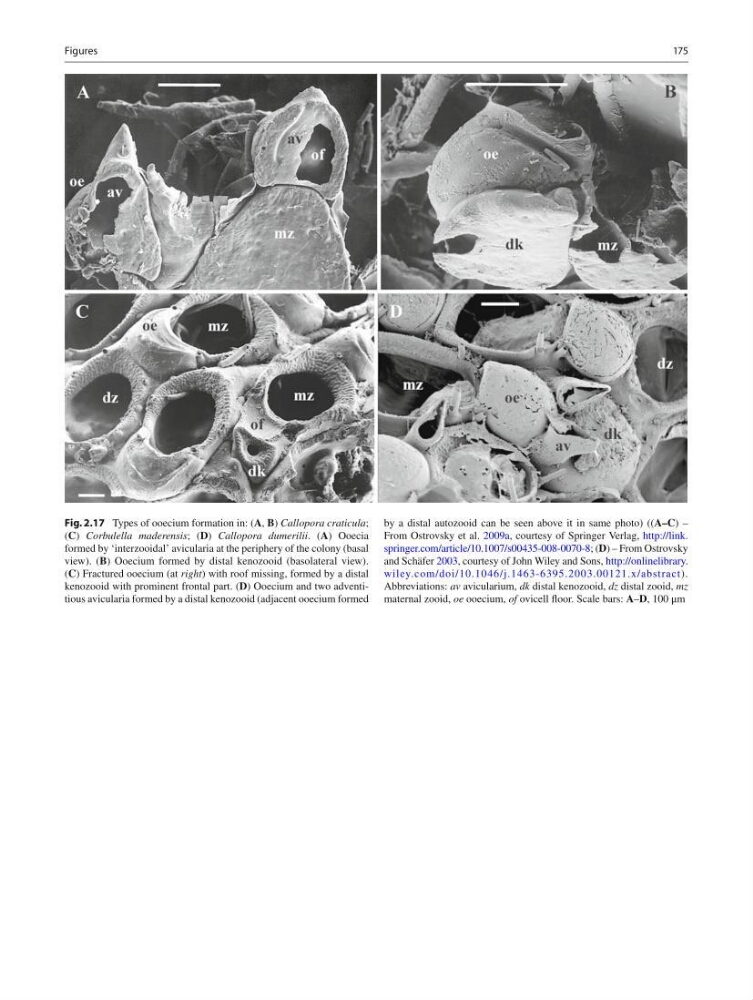
Fig. 2.17 Types of ooecium formation in: ( A , B ) Callopora craticula ;
( C ) Corbulella maderensis ; ( D ) Callopora dumerilii . ( A ) Ooecia
formed by ‘interzooidal’ avicularia at the periphery of the colony (basal
view). ( B ) Ooecium formed by distal kenozooid (basolateral view).
( C ) Fractured ooecium (at right ) with roof missing, formed by a distal
kenozooid with prominent frontal part. ( D ) Ooecium and two adventitious avicularia formed by a distal kenozooid (adjacent ooecium formed
by a distal autozooid can be seen above it in same photo) (( A–C ) –
From Ostrovsky et al. 2009a , courtesy of Springer Verlag, http://link.
springer.com/article/10.1007/s00435-008-0070-8 ; ( D ) – From Ostrovsky
and Schäfer 2003 , courtesy of John Wiley and Sons, http://onlinelibrary.
wiley.com/doi/10.1046/j.1463-6395.2003.00121.x/abstract ).
Abbreviations: av avicularium, dk distal kenozooid, dz distal zooid, mz
maternal zooid, oе ooecium, of ovicell fl oor. Scale bars: A – D , 100 μm
Figures
Fig. 2.17 Types of ooecium formation in: ( A , B ) Callopora craticula ;
( C ) Corbulella maderensis ; ( D ) Callopora dumerilii . ( A ) Ooecia
formed by ‘interzooidal’ avicularia at the periphery of the colony (basal
view). ( B ) Ooecium formed by distal kenozooid (basolateral view).
( C ) Fractured ooecium (at right ) with roof missing, formed by a distal
kenozooid with prominent frontal part. ( D ) Ooecium and two adventitious avicularia formed by a distal kenozooid (adjacent ooecium formed
by a distal autozooid can be seen above it in same photo) (( A–C ) –
From Ostrovsky et al. 2009a , courtesy of Springer Verlag, http://link.
springer.com/article/10.1007/s00435-008-0070-8 ; ( D ) – From Ostrovsky
and Schäfer 2003 , courtesy of John Wiley and Sons, http://onlinelibrary.
wiley.com/doi/10.1046/j.1463-6395.2003.00121.x/abstract ).
Abbreviations: av avicularium, dk distal kenozooid, dz distal zooid, mz
maternal zooid, oе ooecium, of ovicell fl oor. Scale bars: A – D , 100 μm
Figures