

144
Taxon
Internal brood sacs,
immersed ovicells and
endozooidal ovicells
Prominent ovicells References
Inversiulidae
*
−
Inversiula
*
−
Harmer ( 1926 ), Powell ( 1967 ), Gordon ( 1984 ), Hayward ( 1995 )
Romancheinidae
IBS
+
Arctonula
IBS
−
Gordon and Grischenko ( 1994 )
Umbonulidae
IBS, IMO
+
Oshurkovia
IBS
−
Hastings ( 1944 , 1964 ), Eggleston ( 1972 )
Desmacystis
IMO
−
Gordon and Grischenko ( 1994 )
Sclerodomidae
EZO
+
Cellarinella
EZO
−
Hayward ( 1995 )
Cellarinelloides
EZO
−
Hayward ( 1995 )
Watersiporidae
IBS
−
Watersipora
IBS
−
Waters ( 1909 , 1913 ), Mawatari ( 1952 ), Cook ( 1985 ), Zimmer (personal
communication in Reed 1991 )
Uscia
*
−
Banta ( 1969 )
Veleroa
*
−
Osburn ( 1952 )
Stomachetosellidae
*
+
Fatkullina
*
−
Grischenko et al. ( 1998 )
Tetraplariidae
*
+
Tetraplaria
*
+
Harmer ( 1957 )
Porinidae
EZO
+
Porina
EZO
−
Ostrovsky, unpublished data
Myriaporidae
EZO
−
Myriapora
EZO
−
Ostrovsky, unpublished data
Cheiloporinidae
IMO
+
Cheiloporina
IMO
−
Ostrovsky, unpublished data
Cryptosulidae
IBS
−
Cryptosula
IBS
−
Smitt ( 1863 ), Calvet ( 1900 ), Gordon ( 1977 ), Zimmer (personal
communication in Reed 1991 ), Gordon and Mawatari ( 1992 )
Harmeria
IBS
−
Kuklinski and Taylor ( 2006b )
Urceoliporidae
IBS/VO
+
Reciprocus
IBS/VO
−
Ostrovsky, unpublished data
Euthyrisellidae
IBS
−
Euthyrisella
IBS
−
Cook and Chimonides ( 1981b )
Pleurotoichus
IBS
−
Cook ( 1979 )
Tropidozoum
IBS
−
Cook and Chimonides ( 1981b )
Siphonicytaridae
*
−
Siphonicytara
*
−
Bock and Cook ( 2001b )
Hippoporidridae
IBS
+
Odontoporella
IBS
−
Gordon ( 1970 , 1989a ), Carter and Gordon ( 2007 )
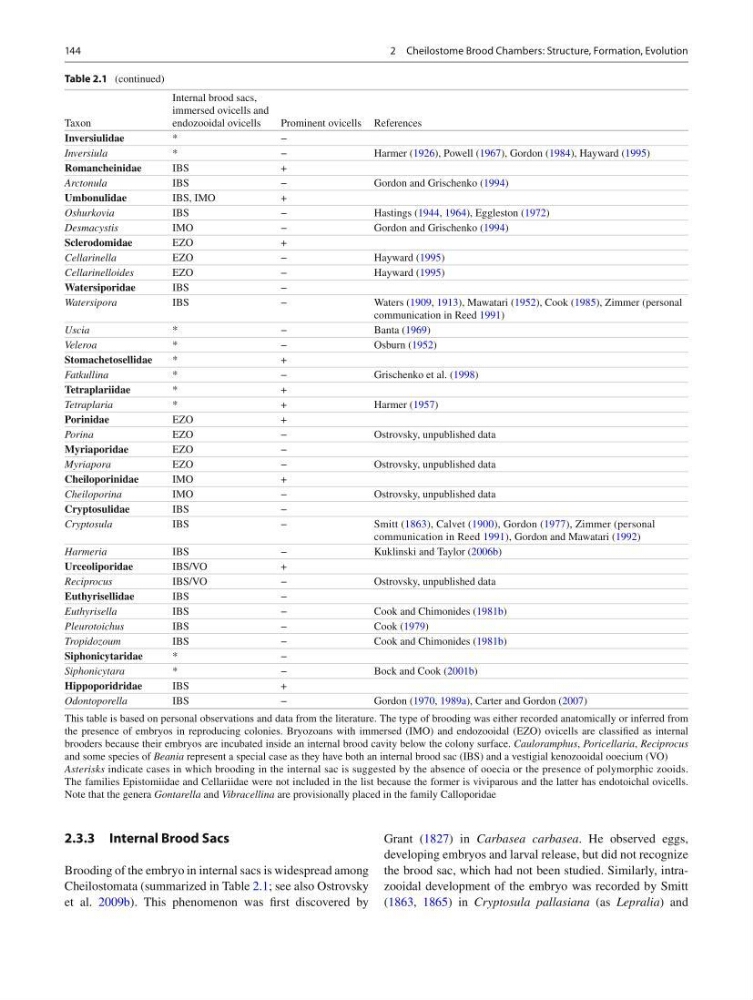
This table is based on personal observations and data from the literature. The type of brooding was either recorded anatomically or inferred from
the presence of embryos in reproducing colonies. Bryozoans with immersed (IMO) and endozooidal (EZO) ovicells are classifi ed as internal
brooders because their embryos are incubated inside an internal brood cavity below the colony surface. Cauloramphus , Poricellaria , Reciprocus
and some species of Beania represent a special case as they have both an internal brood sac (IBS) and a vestigial kenozooidal ooecium (VO)
Asterisks indicate cases in which brooding in the internal sac is suggested by the absence of ooecia or the presence of polymorphic zooids.
The families Epistomiidae and Cellariidae were not included in the list because the former is viviparous and the latter has endotoichal ovicells.
Note that the genera Gontarella and Vibracellina are provisionally placed in the family Calloporidae
Table 2.1 (continued)
2.3.3 Internal Brood Sacs
Brooding of the embryo in internal sacs is widespread among
Cheilostomata (summarized in Table 2.1 ; see also Ostrovsky
et al. 2009b ). This phenomenon was fi rst discovered by
Grant ( 1827 ) in Carbasea carbasea . He observed eggs,
developing embryos and larval release, but did not recognize
the brood sac, which had not been studied. Similarly, intrazooidal development of the embryo was recorded by Smitt
( 1863 , 1865 ) in Cryptosula pallasiana (as Lepralia ) and
2 Cheilostome Brood Chambers: Structure, Formation, Evolution
Taxon
Internal brood sacs,
immersed ovicells and
endozooidal ovicells
Prominent ovicells References
Inversiulidae
*
−
Inversiula
*
−
Harmer ( 1926 ), Powell ( 1967 ), Gordon ( 1984 ), Hayward ( 1995 )
Romancheinidae
IBS
+
Arctonula
IBS
−
Gordon and Grischenko ( 1994 )
Umbonulidae
IBS, IMO
+
Oshurkovia
IBS
−
Hastings ( 1944 , 1964 ), Eggleston ( 1972 )
Desmacystis
IMO
−
Gordon and Grischenko ( 1994 )
Sclerodomidae
EZO
+
Cellarinella
EZO
−
Hayward ( 1995 )
Cellarinelloides
EZO
−
Hayward ( 1995 )
Watersiporidae
IBS
−
Watersipora
IBS
−
Waters ( 1909 , 1913 ), Mawatari ( 1952 ), Cook ( 1985 ), Zimmer (personal
communication in Reed 1991 )
Uscia
*
−
Banta ( 1969 )
Veleroa
*
−
Osburn ( 1952 )
Stomachetosellidae
*
+
Fatkullina
*
−
Grischenko et al. ( 1998 )
Tetraplariidae
*
+
Tetraplaria
*
+
Harmer ( 1957 )
Porinidae
EZO
+
Porina
EZO
−
Ostrovsky, unpublished data
Myriaporidae
EZO
−
Myriapora
EZO
−
Ostrovsky, unpublished data
Cheiloporinidae
IMO
+
Cheiloporina
IMO
−
Ostrovsky, unpublished data
Cryptosulidae
IBS
−
Cryptosula
IBS
−
Smitt ( 1863 ), Calvet ( 1900 ), Gordon ( 1977 ), Zimmer (personal
communication in Reed 1991 ), Gordon and Mawatari ( 1992 )
Harmeria
IBS
−
Kuklinski and Taylor ( 2006b )
Urceoliporidae
IBS/VO
+
Reciprocus
IBS/VO
−
Ostrovsky, unpublished data
Euthyrisellidae
IBS
−
Euthyrisella
IBS
−
Cook and Chimonides ( 1981b )
Pleurotoichus
IBS
−
Cook ( 1979 )
Tropidozoum
IBS
−
Cook and Chimonides ( 1981b )
Siphonicytaridae
*
−
Siphonicytara
*
−
Bock and Cook ( 2001b )
Hippoporidridae
IBS
+
Odontoporella
IBS
−
Gordon ( 1970 , 1989a ), Carter and Gordon ( 2007 )
This table is based on personal observations and data from the literature. The type of brooding was either recorded anatomically or inferred from
the presence of embryos in reproducing colonies. Bryozoans with immersed (IMO) and endozooidal (EZO) ovicells are classifi ed as internal
brooders because their embryos are incubated inside an internal brood cavity below the colony surface. Cauloramphus , Poricellaria , Reciprocus
and some species of Beania represent a special case as they have both an internal brood sac (IBS) and a vestigial kenozooidal ooecium (VO)
Asterisks indicate cases in which brooding in the internal sac is suggested by the absence of ooecia or the presence of polymorphic zooids.
The families Epistomiidae and Cellariidae were not included in the list because the former is viviparous and the latter has endotoichal ovicells.
Note that the genera Gontarella and Vibracellina are provisionally placed in the family Calloporidae
Table 2.1 (continued)
2.3.3 Internal Brood Sacs
Brooding of the embryo in internal sacs is widespread among
Cheilostomata (summarized in Table 2.1 ; see also Ostrovsky
et al. 2009b ). This phenomenon was fi rst discovered by
Grant ( 1827 ) in Carbasea carbasea . He observed eggs,
developing embryos and larval release, but did not recognize
the brood sac, which had not been studied. Similarly, intrazooidal development of the embryo was recorded by Smitt
( 1863 , 1865 ) in Cryptosula pallasiana (as Lepralia ) and
2 Cheilostome Brood Chambers: Structure, Formation, Evolution