

a) Relation to Osmoregulation
Insulin and glucagon are not directly involved in the regulation of water and salt
metabolism. Insufficient insulin results in an elevated blood-glucose level, which
if it exceeds the reabsorptive capacity of the renal tubule is excreted in the urine,
with the simultaneous osmotic loss of extra water. This results in the abnormal
urinary water losses and thirst that are associated with the disease of diabetes mellitus. When diabetes mellitus is induced experimentally in laboratory rats their water
consumption increases four-fold while the plasma concentrations rise by 24 m-osmole/l (YOUNG, 1969). The vasopressin content of the neurohypophysis of such
rats declines by one-third and this seems to be due to an increased rate of release
of this peptide. Such deficiencies can be corrected by injecting insulin. Such effects
are not the principal metabolic inconvenience of the disease, except possibly if water is not freely available . The sand rat, Psammomys obesus, which lives in the deserts of North Africa and the Middle East, develops diabetes mellitus when kept
under certain laboratory conditions (SCHMIDT-NIELSEN, HAINES, and HACKEL,
1964). This is associated with an increased caloric intake when the sand rats are fed
on rat checkers instead of fresh vegetables. It is doubtful that this condition occurs
in the natural desert environment, but death could perhaps be facilitated by dehydration.
6. Steroid Hormones
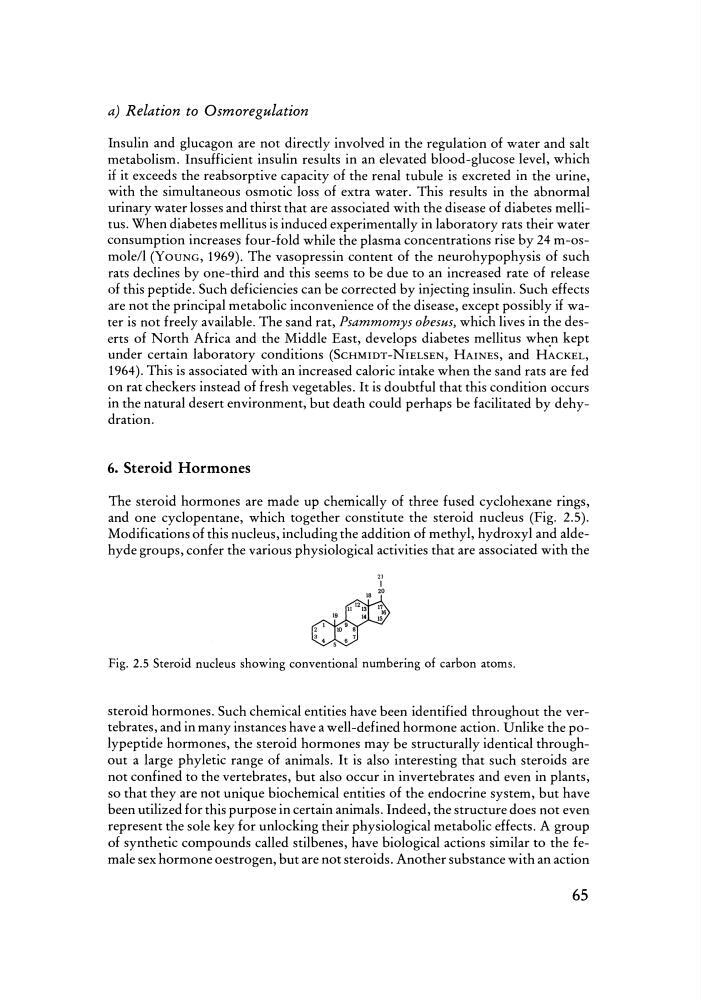
The steroid hormones are made up chemically of three fused cyclohexane rings,
and one cyclopentane, which together constitute the steroid nucleus (Fig. 2.5).
Modifications of this nucleus, including the addition of methyl, hydroxyl and aldehyde groups, confer the various physiological activities that are associated with the
Fig. 2.5 Steroid nucleus showing conventional numbering of carbon atoms.
steroid hormones. Such chemical entities have been identified throughout the vertebrates, and in many instances have a well-defined hormone action. Unlike the polypeptide hormones, the steroid hormones may be structurally identical throughout a large phyletic range of animals. It is also interesting that such steroids are
not confined to the vertebrates, but also occur in invertebrates and even in plants,
so that they are not unique biochemical entities of the endocrine system, but have
been utilized for this purpose in certain animals. Indeed, the structure does not even
represent the sole key for unlocking their physiological metabolic effects. A group
of synthetic compounds called stilbenes, have biological actions similar to the female sex hormone oestrogen, but are not steroids. Another substance with an action
65
Insulin and glucagon are not directly involved in the regulation of water and salt
metabolism. Insufficient insulin results in an elevated blood-glucose level, which
if it exceeds the reabsorptive capacity of the renal tubule is excreted in the urine,
with the simultaneous osmotic loss of extra water. This results in the abnormal
urinary water losses and thirst that are associated with the disease of diabetes mellitus. When diabetes mellitus is induced experimentally in laboratory rats their water
consumption increases four-fold while the plasma concentrations rise by 24 m-osmole/l (YOUNG, 1969). The vasopressin content of the neurohypophysis of such
rats declines by one-third and this seems to be due to an increased rate of release
of this peptide. Such deficiencies can be corrected by injecting insulin. Such effects
are not the principal metabolic inconvenience of the disease, except possibly if water is not freely available . The sand rat, Psammomys obesus, which lives in the deserts of North Africa and the Middle East, develops diabetes mellitus when kept
under certain laboratory conditions (SCHMIDT-NIELSEN, HAINES, and HACKEL,
1964). This is associated with an increased caloric intake when the sand rats are fed
on rat checkers instead of fresh vegetables. It is doubtful that this condition occurs
in the natural desert environment, but death could perhaps be facilitated by dehydration.
6. Steroid Hormones
The steroid hormones are made up chemically of three fused cyclohexane rings,
and one cyclopentane, which together constitute the steroid nucleus (Fig. 2.5).
Modifications of this nucleus, including the addition of methyl, hydroxyl and aldehyde groups, confer the various physiological activities that are associated with the
Fig. 2.5 Steroid nucleus showing conventional numbering of carbon atoms.
steroid hormones. Such chemical entities have been identified throughout the vertebrates, and in many instances have a well-defined hormone action. Unlike the polypeptide hormones, the steroid hormones may be structurally identical throughout a large phyletic range of animals. It is also interesting that such steroids are
not confined to the vertebrates, but also occur in invertebrates and even in plants,
so that they are not unique biochemical entities of the endocrine system, but have
been utilized for this purpose in certain animals. Indeed, the structure does not even
represent the sole key for unlocking their physiological metabolic effects. A group
of synthetic compounds called stilbenes, have biological actions similar to the female sex hormone oestrogen, but are not steroids. Another substance with an action
65