

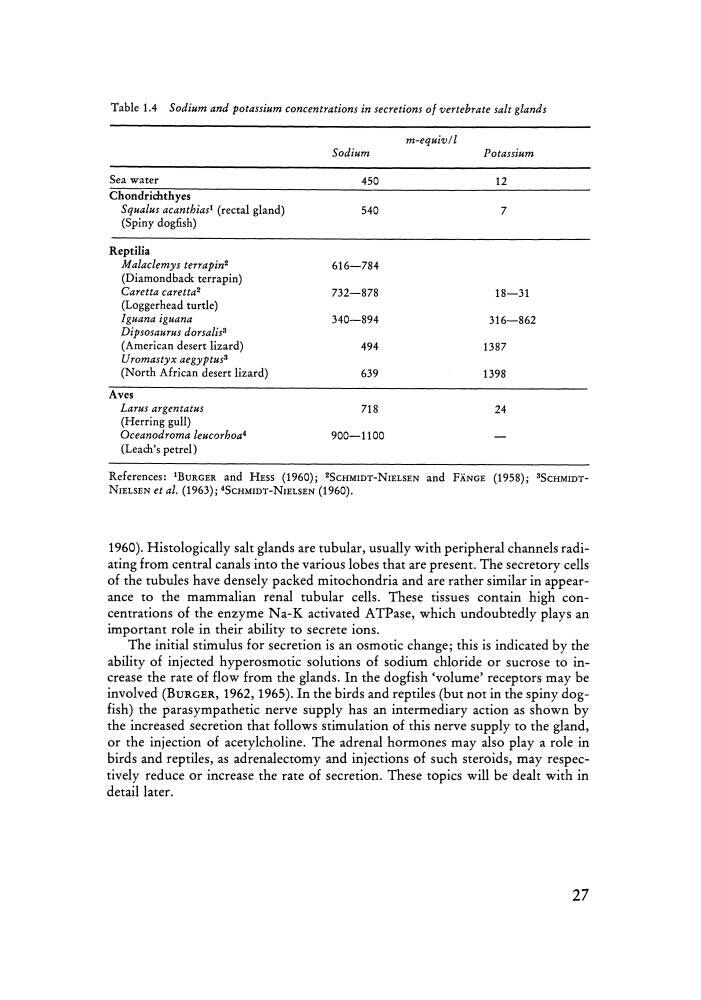
T abl e 1.4 Sod ium and potassium concen trati ons in secretions of vertebrate salt gland s
Sea w ater
Chondrichthyes
Squalus acan thiasl (r ect al gland)
(Spiny do gfish)
Sodium
450
540
m-equiu l l
Potassium
12
7
Reptilia
Malaclemy s terrapini
(D iamondback terrapin)
Caretta caretta 2
(Loggerhead turtle)
i guana iguana
Dipsosaurus dorsalis':
(Americ an desert liz ard)
U roma styx aegyptus"
(North African des ert liz ard)
Aves
Larus argentatus
(Herring gull)
O ceanodroma leucorhoas
(Leach's p etrel )
616-784
732- 878
18-31
340-894
316-862
494
1387
639
1398
718
24
900-1100
R efer enc es: IBURGER a nd HE SS (1960); 2SCHMIDT-NIELSEN a nd FANGE (1958); 3SCHMIDTNI ELSEN et al. (1963); 4SCHMIDT-N IELSEN (1960).
1960). H istologically salt glands are tubular, usually with peripheral channels radiating from central can als into the various lobes that are present. The secretory cells
of the tubules have densely packed mitochondria and are rather similar in appearance to the mammalian renal tubular cells. These tissues contain high concentrations of the enzyme Na-K activated ATPase, which undoubtedly pl ays an
im po rt ant role in th eir ability to secrete ions.
The initial stimulus for secretion is an osmotic chang e; th is is indicated by the
ability of injected hyp erosmotic solu tio ns of sodium chloride or sucrose to increase the rate of flow from the glands. In the dogfish 'volume' receptors ma y be
involved (BURGER, 1962, 1965). In the birds and reptiles (but not in the spiny do gfish) the parasympathetic nerve supply has an intermediary action as shown by
th e increased secretion that follows stimulation of this nerve supply to the gland,
or the injection of acety lcholine . The adrenal hormones m ay also pla y a rol e in
birds and reptiles, as adrenal ectomy and in ject ions of such steroids, ma y respectively reduce or increase th e rat e of secretion. These topics will be dealt w ith in
detail lat er.
27
Sea w ater
Chondrichthyes
Squalus acan thiasl (r ect al gland)
(Spiny do gfish)
Sodium
450
540
m-equiu l l
Potassium
12
7
Reptilia
Malaclemy s terrapini
(D iamondback terrapin)
Caretta caretta 2
(Loggerhead turtle)
i guana iguana
Dipsosaurus dorsalis':
(Americ an desert liz ard)
U roma styx aegyptus"
(North African des ert liz ard)
Aves
Larus argentatus
(Herring gull)
O ceanodroma leucorhoas
(Leach's p etrel )
616-784
732- 878
18-31
340-894
316-862
494
1387
639
1398
718
24
900-1100
R efer enc es: IBURGER a nd HE SS (1960); 2SCHMIDT-NIELSEN a nd FANGE (1958); 3SCHMIDTNI ELSEN et al. (1963); 4SCHMIDT-N IELSEN (1960).
1960). H istologically salt glands are tubular, usually with peripheral channels radiating from central can als into the various lobes that are present. The secretory cells
of the tubules have densely packed mitochondria and are rather similar in appearance to the mammalian renal tubular cells. These tissues contain high concentrations of the enzyme Na-K activated ATPase, which undoubtedly pl ays an
im po rt ant role in th eir ability to secrete ions.
The initial stimulus for secretion is an osmotic chang e; th is is indicated by the
ability of injected hyp erosmotic solu tio ns of sodium chloride or sucrose to increase the rate of flow from the glands. In the dogfish 'volume' receptors ma y be
involved (BURGER, 1962, 1965). In the birds and reptiles (but not in the spiny do gfish) the parasympathetic nerve supply has an intermediary action as shown by
th e increased secretion that follows stimulation of this nerve supply to the gland,
or the injection of acety lcholine . The adrenal hormones m ay also pla y a rol e in
birds and reptiles, as adrenal ectomy and in ject ions of such steroids, ma y respectively reduce or increase th e rat e of secretion. These topics will be dealt w ith in
detail lat er.
27