

c) The Hagfishes (Myxinoidea)
The hagfishes, along with the lampreys (Petromyzontidae), are thought to be the
closest contemporary relatives of the first vertebrates. It is uncertain whether the
lampreys or hagfishes are more similar to the original progenitor but both groups
have their adherents. It should be recalled that many generations of agnathans have
come and gone since those nascent times .
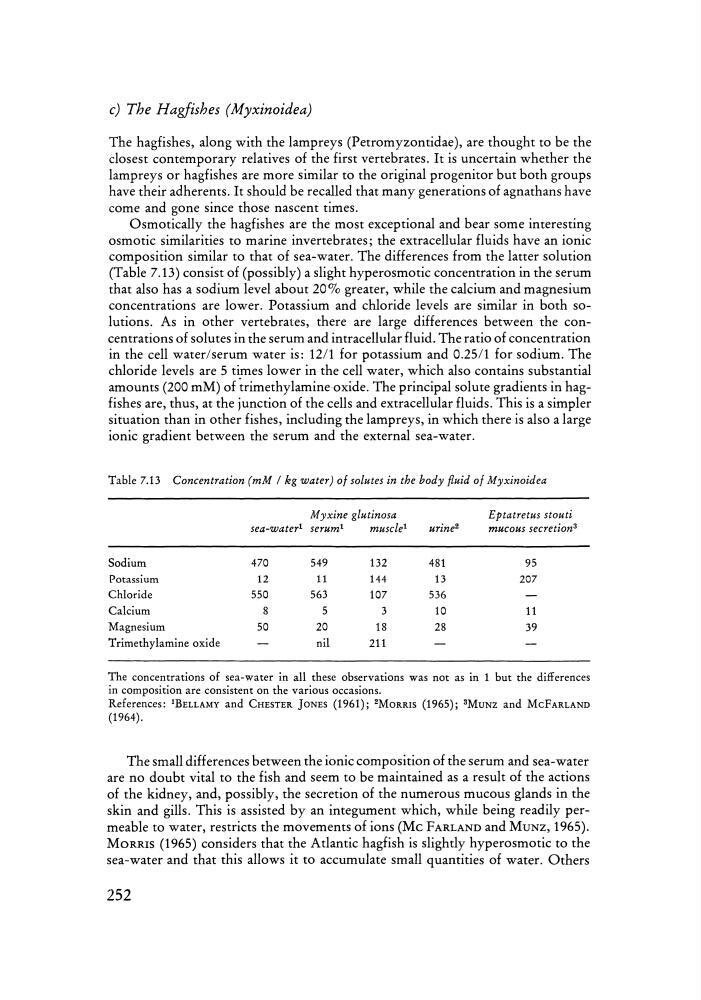
Osmotically the hagfishes are the most exceptional and bear some interesting
osmotic similarities to marine invertebrates; the extracellular fluids have an ionic
composition similar to that of sea-water. The differences from the latter solution
(Table 7.13) consist of (possibly) a slight hyperosmotic concentration in the serum
that also has a sodium level about 20% greater, while the calcium and magnesium
concentrations are lower. Potassium and chloride levels are similar in both solutions. As in other vertebrates, there are large differences between the concentrations of solutes in the serum and intracellular fluid . The ratio of concentration
in the cell water/serum water is: 12/1 for potassium and 0.25/1 for sodium. The
chloride levels are 5 times lower in the cell water, which also contains substantial
amounts (200 mM) of trimethylamine oxide. The principal solute gradients in hagfishes are, thus, at the junction of the cells and extracellular fluids . This is a simpler
situation than in other fishes , including the lampreys, in which there is also a large
ionic gradient between the serum and the external sea-water.
Table 7.13 Concentration (mM / kg water) 0/ solutes in the body fluid 0/Myxinoidea
Myxine glutinosa
Eptatretus stouti
sea-water- serums
muscle?
urine"
mucous secretions
Sodium
470
549
132
481
95
Potassium
12
11
144
13
207
Chloride
550
563
107
536
Calcium
8
5
3
10
11
Magnesium
50
20
18
28
39
Trimethylamine oxide
nil
211
The concentrations of sea-water in all these observations was not as in 1 but the differences
in composition are consistent on the various occasions.
References: 1BELLAMY and CHESTER JONES (1961); 2MoRRIS (1965); 3MuNZ and McFARLAND
(1964).
The small differences between the ionic composition of the serum and sea-water
are no doubt vital to the fish and seem to be maintained as a result of the actions
of the kidney, and, possibly, the secretion of the numerous mucous glands in the
skin and gills. This is assisted by an integument which, while being readily permeable to water, restricts the movements of ions (Me FARLAND and MUNZ, 1965).
MORRIS (1965) considers that the Atlantic hagfish is slightly hyperosmotic to the
sea-water and that this allows it to accumulate small quantities of water. Others
252
The hagfishes, along with the lampreys (Petromyzontidae), are thought to be the
closest contemporary relatives of the first vertebrates. It is uncertain whether the
lampreys or hagfishes are more similar to the original progenitor but both groups
have their adherents. It should be recalled that many generations of agnathans have
come and gone since those nascent times .
Osmotically the hagfishes are the most exceptional and bear some interesting
osmotic similarities to marine invertebrates; the extracellular fluids have an ionic
composition similar to that of sea-water. The differences from the latter solution
(Table 7.13) consist of (possibly) a slight hyperosmotic concentration in the serum
that also has a sodium level about 20% greater, while the calcium and magnesium
concentrations are lower. Potassium and chloride levels are similar in both solutions. As in other vertebrates, there are large differences between the concentrations of solutes in the serum and intracellular fluid . The ratio of concentration
in the cell water/serum water is: 12/1 for potassium and 0.25/1 for sodium. The
chloride levels are 5 times lower in the cell water, which also contains substantial
amounts (200 mM) of trimethylamine oxide. The principal solute gradients in hagfishes are, thus, at the junction of the cells and extracellular fluids . This is a simpler
situation than in other fishes , including the lampreys, in which there is also a large
ionic gradient between the serum and the external sea-water.
Table 7.13 Concentration (mM / kg water) 0/ solutes in the body fluid 0/Myxinoidea
Myxine glutinosa
Eptatretus stouti
sea-water- serums
muscle?
urine"
mucous secretions
Sodium
470
549
132
481
95
Potassium
12
11
144
13
207
Chloride
550
563
107
536
Calcium
8
5
3
10
11
Magnesium
50
20
18
28
39
Trimethylamine oxide
nil
211
The concentrations of sea-water in all these observations was not as in 1 but the differences
in composition are consistent on the various occasions.
References: 1BELLAMY and CHESTER JONES (1961); 2MoRRIS (1965); 3MuNZ and McFARLAND
(1964).
The small differences between the ionic composition of the serum and sea-water
are no doubt vital to the fish and seem to be maintained as a result of the actions
of the kidney, and, possibly, the secretion of the numerous mucous glands in the
skin and gills. This is assisted by an integument which, while being readily permeable to water, restricts the movements of ions (Me FARLAND and MUNZ, 1965).
MORRIS (1965) considers that the Atlantic hagfish is slightly hyperosmotic to the
sea-water and that this allows it to accumulate small quantities of water. Others
252