

cumulated from the diet, especially if this consists of marine invertebrates that contain large amounts of this compound (BENOIT and NORRIS, 1945). Whatever its
origins, it is, like urea, retained in the body as a form of osmotic 'stuffing'. In the
Chondrichthyes it makes up about 25% of the non-ionic osmolytes (SMITH, 1936).
It is also present in the intracellular fluids of teleosts, like the flounder and stickleback, where it accumulates in higher concentrations when the fish are in sea-water,
than when they are in fresh water (LANGE and FUGELLI, 1965). In the agnathan,
Myxine glutinosa, it is almost absent from the plasma, but is contained in the cells
at a concentration of about 200 mM (BELLAMY and CHESTER JONES, 1961) and so
makes a substantial contribution to their osmotic balance.
Although both urea and trimethylamine oxide can be filtered across the glomerulus, only small quantities are excreted in the urine. Reabsorption of these comHigher vertebrates
.and~
Rona.
AmphibIa
",z::.:1.~ _~
.~ ~-.....
~_ _~ ~ TeleO r Sf~t) ~
~ "-.)
Lepldosteus -
Amlo(gar pike)
(bow fin)
~X'~
HOIOSI\~('A;'::;~;:i:et!~ ~ La7 bYrmthO~ donlia(+)
v .>. Isturge ~n ) ~
~
~
,
_ N
.,.~a--~ .__
\.-.....~~ (TYPi cal form )
~
~
:~ ~ <.::;--..
Po/yadon 1-)
Rhlp~dlSlla
Coetocontbim +
- < - -.... .-:l ~~ ...
[ pcddlefrshl
(extinct)
Polypterusl- )
ctoaisio
Crossopteryqii t »)
A cient pcleoniscrdst-l
/;0~
\\
~~ s... ~
Cronarosteit-)
Protooterus t
\ \
Dlpnol
Actin oPterY~ 'i (-)
Sarcopterygii (.)
Deletion
(= c~oan iChth 5)
or Repress;on
" /
L-.../1 ~
Osteichthyes(+)
'
_
~
1r
ChoM';oM,¥,"
Primitive fish (.)
(Placodermi)
utation I I ~ ...;::::=::: . h ~
or Indue ion
V(
Myxme(_)
Agnatha [z}
(hagfish )
I (
Piscin e ancestors (!)
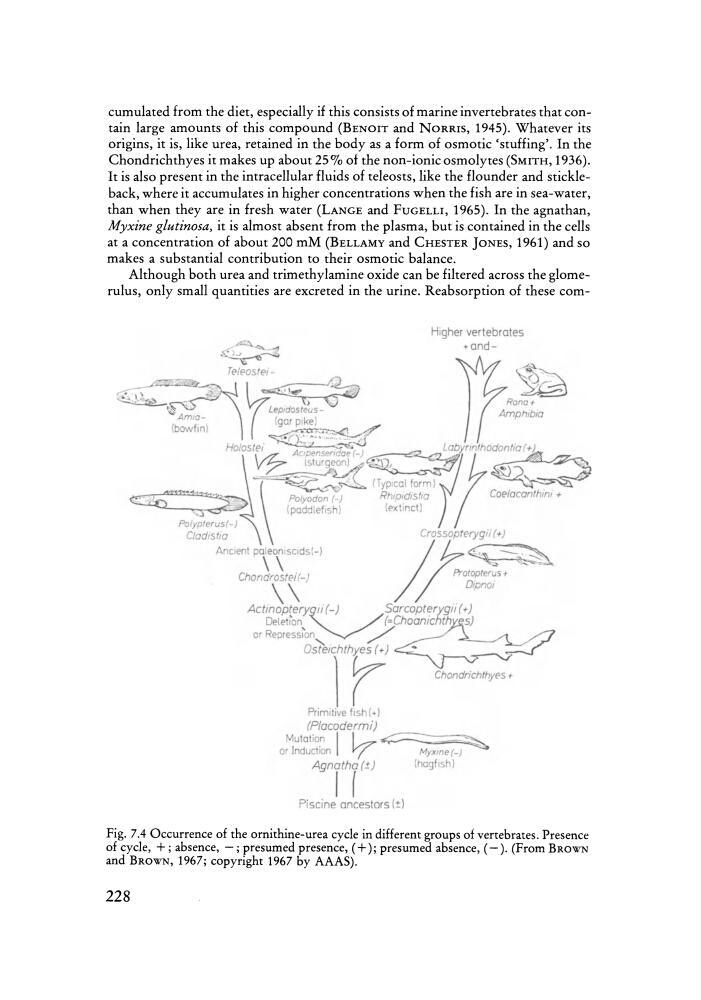
Fig. 7.4 Occurrence of the ornithine-urea cycle in different groups of vertebrates. Presence
of cycle, +; absence, -; presumed presence, (+); presumed absence, (-). (From BROWN
and BROWN, 1967; copyright 1967 by AAAS).
228
origins, it is, like urea, retained in the body as a form of osmotic 'stuffing'. In the
Chondrichthyes it makes up about 25% of the non-ionic osmolytes (SMITH, 1936).
It is also present in the intracellular fluids of teleosts, like the flounder and stickleback, where it accumulates in higher concentrations when the fish are in sea-water,
than when they are in fresh water (LANGE and FUGELLI, 1965). In the agnathan,
Myxine glutinosa, it is almost absent from the plasma, but is contained in the cells
at a concentration of about 200 mM (BELLAMY and CHESTER JONES, 1961) and so
makes a substantial contribution to their osmotic balance.
Although both urea and trimethylamine oxide can be filtered across the glomerulus, only small quantities are excreted in the urine. Reabsorption of these comHigher vertebrates
.and~
Rona.
AmphibIa
",z::.:1.~ _~
.~ ~-.....
~_ _~ ~ TeleO r Sf~t) ~
~ "-.)
Lepldosteus -
Amlo(gar pike)
(bow fin)
~X'~
HOIOSI\~('A;'::;~;:i:et!~ ~ La7 bYrmthO~ donlia(+)
v .>. Isturge ~n ) ~
~
~
,
_ N
.,.~a--~ .__
\.-.....~~ (TYPi cal form )
~
~
:~ ~ <.::;--..
Po/yadon 1-)
Rhlp~dlSlla
Coetocontbim +
- < - -.... .-:l ~~ ...
[ pcddlefrshl
(extinct)
Polypterusl- )
ctoaisio
Crossopteryqii t »)
A cient pcleoniscrdst-l
/;0~
\\
~~ s... ~
Cronarosteit-)
Protooterus t
\ \
Dlpnol
Actin oPterY~ 'i (-)
Sarcopterygii (.)
Deletion
(= c~oan iChth 5)
or Repress;on
" /
L-.../1 ~
Osteichthyes(+)
'
_
~
1r
ChoM';oM,¥,"
Primitive fish (.)
(Placodermi)
utation I I ~ ...;::::=::: . h ~
or Indue ion
V(
Myxme(_)
Agnatha [z}
(hagfish )
I (
Piscin e ancestors (!)
Fig. 7.4 Occurrence of the ornithine-urea cycle in different groups of vertebrates. Presence
of cycle, +; absence, -; presumed presence, (+); presumed absence, (-). (From BROWN
and BROWN, 1967; copyright 1967 by AAAS).
228