

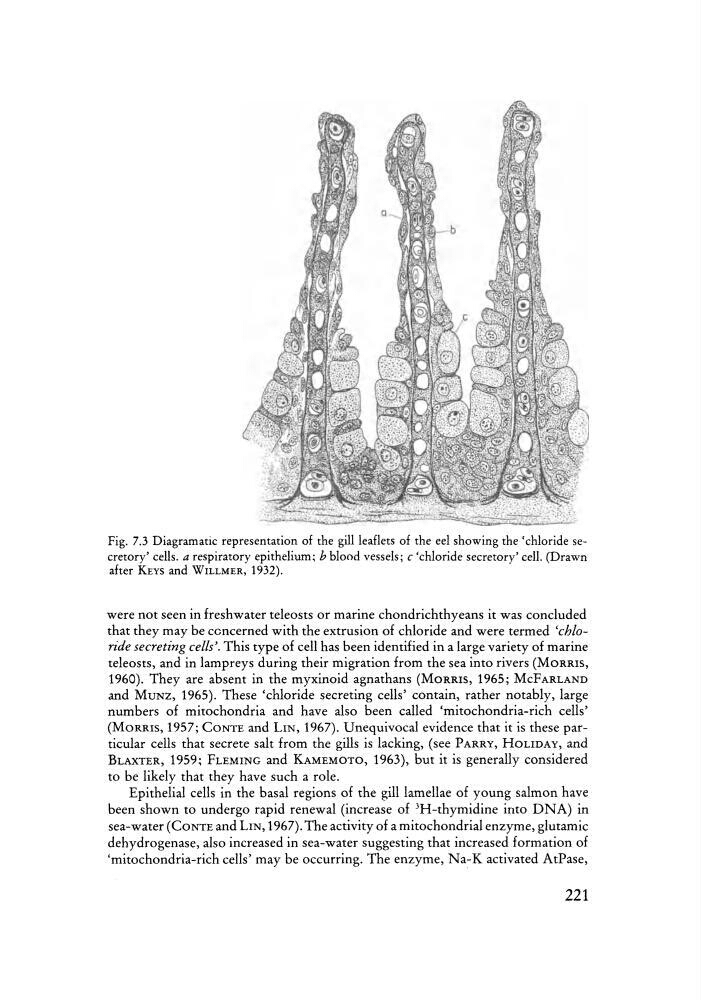
Fig. 7.3 Diagramatic representation of the gill leaflets of the eel showing the 'chloride secretory' cells. a respiratory epithelium; b blood vessels; c 'chloride secretory' cell. (Drawn
after KEYS and WILLMER, 1932).
were not seen in freshwater teleosts or marine chondrichthyeans it was concluded
that they may be ccncerned with the extrusion of chloride and were termed 'chloride secreting cells'. This type of cell has been identified in a large variety of marine
teleosts, and in lampreys during their migration from the sea into rivers (MORRIS,
1960). They are absent in the myxinoid agnathans (MORRIS , 1965; McFARLAND
and MUNZ, 1965). These 'chloride secreting cells' contain, rather notably, large
numbers of mitochondria and have also been called 'mitochondria-rich cells'
(MORRIS, 1957; CONTE and LIN, 1967). Unequivocal evidence that it is the se particular cells that secrete salt from the gills is lacking, (see PARRY, HOLIDAY, and
BLAXTER, 1959; FLEMING and KAMEMOTO, 1963), but it is generally considered
to be likely that they have such a role.
Epithelial cells in the basal regions of the gill lamellae of young salmon have
been shown to undergo rapid renewal (increase of 3H -thymidine into DNA) in
sea-water (CONTE and LIN, 1967). The activity of a mitochondrial enzyme, glutamic
dehydrogenase, also increased in sea-water suggesting that increased formation of
'mitochondria-rich cells' may be occurring. The enzyme, Na~K activated AtPase,
221
after KEYS and WILLMER, 1932).
were not seen in freshwater teleosts or marine chondrichthyeans it was concluded
that they may be ccncerned with the extrusion of chloride and were termed 'chloride secreting cells'. This type of cell has been identified in a large variety of marine
teleosts, and in lampreys during their migration from the sea into rivers (MORRIS,
1960). They are absent in the myxinoid agnathans (MORRIS , 1965; McFARLAND
and MUNZ, 1965). These 'chloride secreting cells' contain, rather notably, large
numbers of mitochondria and have also been called 'mitochondria-rich cells'
(MORRIS, 1957; CONTE and LIN, 1967). Unequivocal evidence that it is the se particular cells that secrete salt from the gills is lacking, (see PARRY, HOLIDAY, and
BLAXTER, 1959; FLEMING and KAMEMOTO, 1963), but it is generally considered
to be likely that they have such a role.
Epithelial cells in the basal regions of the gill lamellae of young salmon have
been shown to undergo rapid renewal (increase of 3H -thymidine into DNA) in
sea-water (CONTE and LIN, 1967). The activity of a mitochondrial enzyme, glutamic
dehydrogenase, also increased in sea-water suggesting that increased formation of
'mitochondria-rich cells' may be occurring. The enzyme, Na~K activated AtPase,
221