

MAN (1965) also co nsiders it likely th at such a mechanism is pr esent in th e pike,
Esox lucius. There is evidence to indicate that 'g lomerular recru itm en t' also occu rs
in amphibians and reptiles.
In tetrapods, changes in the GFR (and tubular water reabs or pti o n) may result
from the action of the neuro hypophysial pep tide, vasotocin. This hormone is released during deh ydration in tetrapods and decreases the urine flow by increasing
tubu lar water reabsorption and also oft en decreases the G FR. H owever, such effects have not been observed in the fishes, even though vasotocin is present in the ir
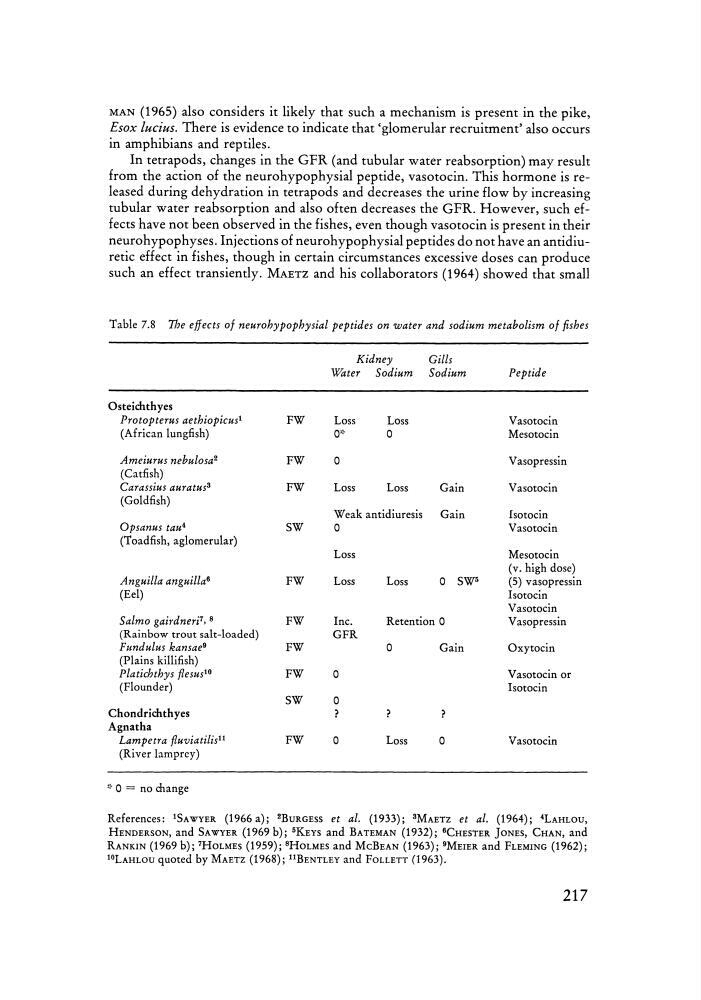
neurohypo physes. Injections of neurohyp op hysial pepti des do not have an antidiuret ic effect in fishes, though in certain circu mstances excessive dos es can produce
such an effect transiently. MAETZ and his colla borators (1964) showed that small
Ta ble 7.8 The effects of ne urohypophysial pep tides on water and sodi um m etab olism of fishes
K idn ey
Gills
water Sodium
Sodium
O steicht h yes
Protopterus aethiopicust
FW
Loss
Loss
(African lungfish)
0':0
Ameiurus nebulosa 2
FW
0
(Catfish)
Car assius auratus 3
FW
Loss
Loss
Gain
(Goldfish)
Weak antidiuresis Gain
Opsanus tau"
SW
0
(Toadfish, aglomerular)
Loss
Anguilla anguilla 6
FW
Loss
Loss
0 SW5
(Eel)
Salmo gairdneri', 8
FW
Inc.
Rete nti on 0
(Rainbow trout salt-loaded)
G FR
Fundulus leansae"
FW
0
Gain
(Plains killifish)
Platicb tbys f/esus l O
FW
0
(Flounder)
SW
0
Chondrichth yes
?
Agna tha
Lam petra f/uv iatilis ll
FW
0
Loss
0
(River lamprey)
"- 0 = no change
Pep tide
Vasotocin
Mesotocin
Vasopressin
Vasotoc in
Isotocin
Vasotocin
Mesotocin
(v, high dose)
(5) vasopressin
Isotoc in
Vasotocin
Vasopressin
O xytocin
Vasotocin or
Isotocin
Vasotocin
References: lSAWYER (1966 a) ; 2BuRGESS et al. (1933); 3MAETZ et al . (1964); 4LAHLOU,
H END ERSON, and SAWYER (1969 b); 5KEYS and BATEMAN (1932); 6CHESTER JONES, CHAN, and
RANKIN (1969 b); 7HOLMES (1959); 8H o LMES and McB EAN (1963 ); 9MEIER and FLEMING (1962);
lOLAHLOU quoted by MAETZ (1968); ll BENTLEY and FOLLETT (1963).
217
Esox lucius. There is evidence to indicate that 'g lomerular recru itm en t' also occu rs
in amphibians and reptiles.
In tetrapods, changes in the GFR (and tubular water reabs or pti o n) may result
from the action of the neuro hypophysial pep tide, vasotocin. This hormone is released during deh ydration in tetrapods and decreases the urine flow by increasing
tubu lar water reabsorption and also oft en decreases the G FR. H owever, such effects have not been observed in the fishes, even though vasotocin is present in the ir
neurohypo physes. Injections of neurohyp op hysial pepti des do not have an antidiuret ic effect in fishes, though in certain circu mstances excessive dos es can produce
such an effect transiently. MAETZ and his colla borators (1964) showed that small
Ta ble 7.8 The effects of ne urohypophysial pep tides on water and sodi um m etab olism of fishes
K idn ey
Gills
water Sodium
Sodium
O steicht h yes
Protopterus aethiopicust
FW
Loss
Loss
(African lungfish)
0':0
Ameiurus nebulosa 2
FW
0
(Catfish)
Car assius auratus 3
FW
Loss
Loss
Gain
(Goldfish)
Weak antidiuresis Gain
Opsanus tau"
SW
0
(Toadfish, aglomerular)
Loss
Anguilla anguilla 6
FW
Loss
Loss
0 SW5
(Eel)
Salmo gairdneri', 8
FW
Inc.
Rete nti on 0
(Rainbow trout salt-loaded)
G FR
Fundulus leansae"
FW
0
Gain
(Plains killifish)
Platicb tbys f/esus l O
FW
0
(Flounder)
SW
0
Chondrichth yes
?
Agna tha
Lam petra f/uv iatilis ll
FW
0
Loss
0
(River lamprey)
"- 0 = no change
Pep tide
Vasotocin
Mesotocin
Vasopressin
Vasotoc in
Isotocin
Vasotocin
Mesotocin
(v, high dose)
(5) vasopressin
Isotoc in
Vasotocin
Vasopressin
O xytocin
Vasotocin or
Isotocin
Vasotocin
References: lSAWYER (1966 a) ; 2BuRGESS et al. (1933); 3MAETZ et al . (1964); 4LAHLOU,
H END ERSON, and SAWYER (1969 b); 5KEYS and BATEMAN (1932); 6CHESTER JONES, CHAN, and
RANKIN (1969 b); 7HOLMES (1959); 8H o LMES and McB EAN (1963 ); 9MEIER and FLEMING (1962);
lOLAHLOU quoted by MAETZ (1968); ll BENTLEY and FOLLETT (1963).
217