

absorption of sodium, a large amount of salt is also absorbed. Most of the divalent
ions appear to be retained in the gut, though some are absorbed and later excreted
by the kidney. The bulk of the salt is sodium chloride, which is excreted through
the gills (KEYS, 1931) leaving osmotically-free water in the body. The amounts of
sodium (and chloride) absorbed across the intestine of fishes kept in sea-water
amounts to 100 Wequiv/100 g h in the flounder, Platichthys jlesus(MAETz, 1969 b),
280 /-t-equiv1100 g h in the sea perch, Serranus scriba (MOTAlS and MAETz, 1965)
and 170 /-t-equiv/100 g h in the eel, Anguilla anguilla (MAETz and SKADHAUGE,
1968). This is equivalent in a day to 100 to 200 % of the total sodium present in
the fish .
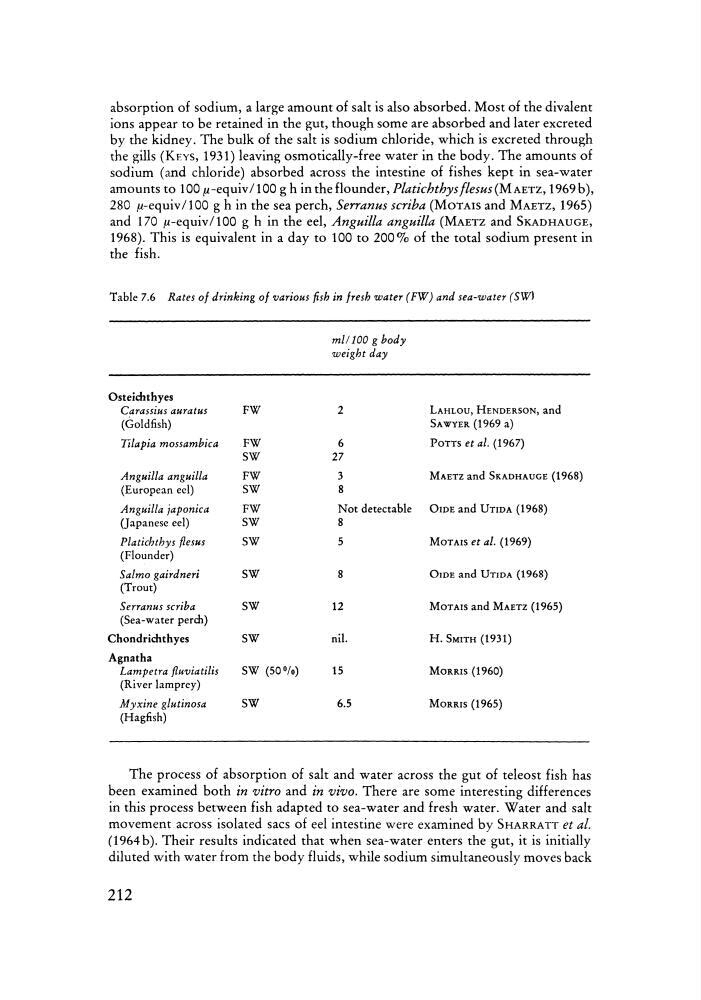
Table 7.6 Rates 0/drinking of various fish in fresh water (FW) and sea-water (SWI
mil 100 g body
weight day
Osteichthyes
Carassius auratus
FW
2
LAHLOU, HENDERSON, and
(Goldfish)
SAWYER (1969 a)
Tilapia mossambica
FW
6
POTTS et al. (1967)
SW
27
Anguilla anguilla
FW
3
MAETZ and SKADHAUGE (1968)
(European eel)
SW
8
Anguilla japonica
FW
Not detectable
aIDE and UTIDA (1968)
(Japanese eel)
SW
8
Platichtbys f/esus
SW
5
MOTAIS et al. (1969)
(Flounder)
Salmo gairdneri
SW
8
OIDE and UTIDA (1968)
(Trout)
Serranus scriba
SW
12
MOTAIS and MAETZ (1965)
(Sea-water perch)
Chondrichthyes
SW
nil.
H . SMITH (1931)
Agnatha
Lampetra f/uviatilis
SW (50 0 /0)
15
MORRIS (1960)
(River lamprey)
Myxine glutinosa
SW
6.5
MORRIS (1965)
(Hagfish)
The process of absorption of salt and water across the gut of teleost fish has
been examined both in vitro and in vivo. There are some interesting differences
in this process between fish adapted to sea-water and fresh water. Water and salt
movement across isolated sacs of eel intestine were examined by SHARRATT et al.
(1964 b). Their results indicated that when sea-water enters the gut, it is initially
diluted with water from the body fluids , while sodium simultaneously moves back
212
ions appear to be retained in the gut, though some are absorbed and later excreted
by the kidney. The bulk of the salt is sodium chloride, which is excreted through
the gills (KEYS, 1931) leaving osmotically-free water in the body. The amounts of
sodium (and chloride) absorbed across the intestine of fishes kept in sea-water
amounts to 100 Wequiv/100 g h in the flounder, Platichthys jlesus(MAETz, 1969 b),
280 /-t-equiv1100 g h in the sea perch, Serranus scriba (MOTAlS and MAETz, 1965)
and 170 /-t-equiv/100 g h in the eel, Anguilla anguilla (MAETz and SKADHAUGE,
1968). This is equivalent in a day to 100 to 200 % of the total sodium present in
the fish .
Table 7.6 Rates 0/drinking of various fish in fresh water (FW) and sea-water (SWI
mil 100 g body
weight day
Osteichthyes
Carassius auratus
FW
2
LAHLOU, HENDERSON, and
(Goldfish)
SAWYER (1969 a)
Tilapia mossambica
FW
6
POTTS et al. (1967)
SW
27
Anguilla anguilla
FW
3
MAETZ and SKADHAUGE (1968)
(European eel)
SW
8
Anguilla japonica
FW
Not detectable
aIDE and UTIDA (1968)
(Japanese eel)
SW
8
Platichtbys f/esus
SW
5
MOTAIS et al. (1969)
(Flounder)
Salmo gairdneri
SW
8
OIDE and UTIDA (1968)
(Trout)
Serranus scriba
SW
12
MOTAIS and MAETZ (1965)
(Sea-water perch)
Chondrichthyes
SW
nil.
H . SMITH (1931)
Agnatha
Lampetra f/uviatilis
SW (50 0 /0)
15
MORRIS (1960)
(River lamprey)
Myxine glutinosa
SW
6.5
MORRIS (1965)
(Hagfish)
The process of absorption of salt and water across the gut of teleost fish has
been examined both in vitro and in vivo. There are some interesting differences
in this process between fish adapted to sea-water and fresh water. Water and salt
movement across isolated sacs of eel intestine were examined by SHARRATT et al.
(1964 b). Their results indicated that when sea-water enters the gut, it is initially
diluted with water from the body fluids , while sodium simultaneously moves back
212