

sectomized fishes in fresh water (PICKFORD and PHILLIPS, 1959) and to elevate the
plasma sodium concentrations under such conditions (BALL and ENSOR, 1965).
'Prolactins' derived from the pituitaries of different vertebrates exhibit a different
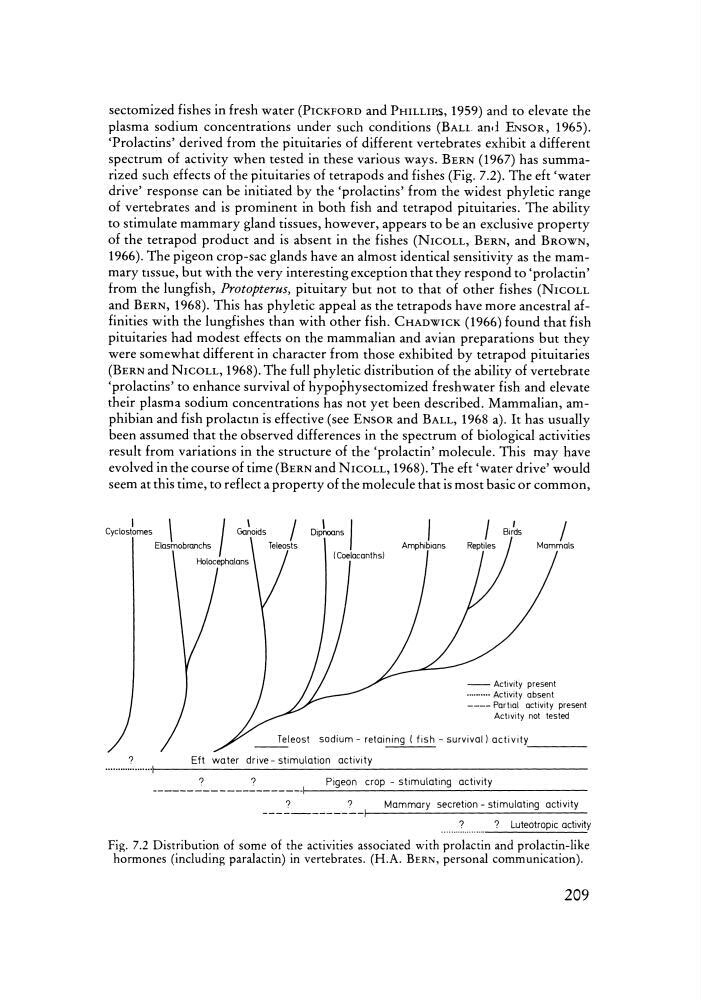
spectrum of activity when tested in these various ways. BERN (1967) has summarized such effects of the pituitaries of tetrapods and fishes (Fig. 7.2). The eft 'water
drive' response can be initiated by the 'prolactins' from the widest phyletic range
of vertebrates and is prominent in both fish and tetrapod pituitaries. The ability
to stimulate mammary gland tissues, however, appears to be an exclusive property
of the tetrapod product and is absent in the fishes (NICOLL, BERN, and BROWN,
1966). The pigeon crop-sac glands have an almost identical sensitivity as the mammary tissue, but with the very interesting exception that they respond to 'prolactin'
from the lungfish, Protopterus, pituitary but not to that of other fishes (NICOLL
and BERN, 1968). This has phyletic appeal as the tetrapods have more ancestral affinities with the lungfishes than with other fish . CHADWICK (1966) found that fish
pituitaries had modest effects on the mammalian and avian preparations but they
were somewhat different in character from those exhibited by tetrapod pituitaries
(BERN and NICOLL, 1968). The full phyletic distribution of the ability of vertebrate
'prolactins'to enhance survival of hypophysectomized freshwater fish and elevate
their plasma sodium concentrations has not yet been described. Mammalian, amphibian and fish prolactin is effective (see ENSOR and BALL, 1968 a). It has usually
been assumed that the observed differences in the spectrum of biological activities
result from variations in the structure of the 'prolactin' molecule. This may have
evolved in the course of time (BERN and NICOLL, 1968). The eft 'water drive' would
seem at this time, to reflect a property of the molecule that is most basic or common,
CYclost~mes \
/
Ga~idS /
Elasmobranchs
Teleosts
Holocephalans
- - Activit y present
•.•.•..••• Activity absent
---- Partial activity present
Activity not tested
Teleost sodium - retaining ( fish - survival) activity
- - - -
Eft water drive - stimulation activity
?
..•......·:··....··f- I - - - - - - - - - - - - - - - - - - - - - - - - - - - -
Pigeon crop - stimulating activity
?
Mammary secretion - stimulating activity
?
? Luteotropic activity
Fig . 7.2 Distribution of some of the activities associated with prolactin and prolactin-like
hormones (including paralactin) in vertebrates. (H .A. BERN, personal communication).
209
plasma sodium concentrations under such conditions (BALL and ENSOR, 1965).
'Prolactins' derived from the pituitaries of different vertebrates exhibit a different
spectrum of activity when tested in these various ways. BERN (1967) has summarized such effects of the pituitaries of tetrapods and fishes (Fig. 7.2). The eft 'water
drive' response can be initiated by the 'prolactins' from the widest phyletic range
of vertebrates and is prominent in both fish and tetrapod pituitaries. The ability
to stimulate mammary gland tissues, however, appears to be an exclusive property
of the tetrapod product and is absent in the fishes (NICOLL, BERN, and BROWN,
1966). The pigeon crop-sac glands have an almost identical sensitivity as the mammary tissue, but with the very interesting exception that they respond to 'prolactin'
from the lungfish, Protopterus, pituitary but not to that of other fishes (NICOLL
and BERN, 1968). This has phyletic appeal as the tetrapods have more ancestral affinities with the lungfishes than with other fish . CHADWICK (1966) found that fish
pituitaries had modest effects on the mammalian and avian preparations but they
were somewhat different in character from those exhibited by tetrapod pituitaries
(BERN and NICOLL, 1968). The full phyletic distribution of the ability of vertebrate
'prolactins'to enhance survival of hypophysectomized freshwater fish and elevate
their plasma sodium concentrations has not yet been described. Mammalian, amphibian and fish prolactin is effective (see ENSOR and BALL, 1968 a). It has usually
been assumed that the observed differences in the spectrum of biological activities
result from variations in the structure of the 'prolactin' molecule. This may have
evolved in the course of time (BERN and NICOLL, 1968). The eft 'water drive' would
seem at this time, to reflect a property of the molecule that is most basic or common,
CYclost~mes \
/
Ga~idS /
Elasmobranchs
Teleosts
Holocephalans
- - Activit y present
•.•.•..••• Activity absent
---- Partial activity present
Activity not tested
Teleost sodium - retaining ( fish - survival) activity
- - - -
Eft water drive - stimulation activity
?
..•......·:··....··f- I - - - - - - - - - - - - - - - - - - - - - - - - - - - -
Pigeon crop - stimulating activity
?
Mammary secretion - stimulating activity
?
? Luteotropic activity
Fig . 7.2 Distribution of some of the activities associated with prolactin and prolactin-like
hormones (including paralactin) in vertebrates. (H .A. BERN, personal communication).
209