

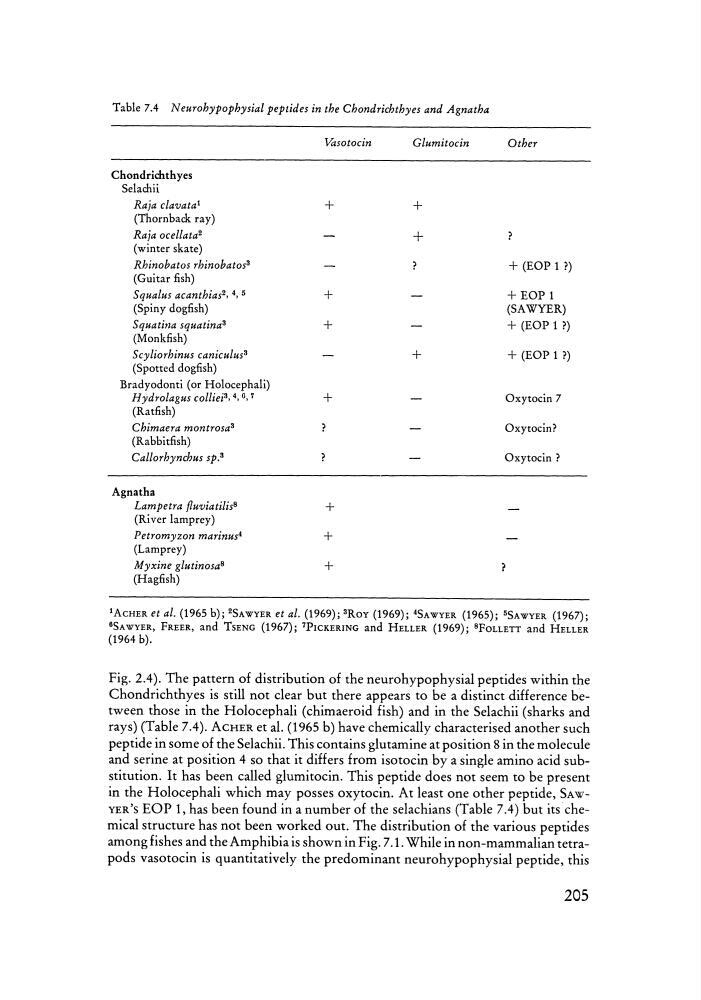
Table 7.4 Neurohypophysial peptides in the Chond rich thy es and Agnatha
l/asotocin
Glumitocin
Other
Chondrichthyes
Selachii
Ra ja clauata»
+
+
(Thornback ray)
Raja ocellata 2
+
(winter skate)
Rh inobatos rhinobatos 3
+ (EOP 1 ?)
(Guitar fish)
Squ alu s acantbiast, 4, 5
+
+ EO P 1
(Spiny dogfish)
(SAWYE R)
Squatina squatina 3
+
+ (EOP 1 ?)
(Monkfish)
Scyliorhinus caniculust
+
+ (EOP 1 ?)
(Spotted dogfish)
Brad yodonti (or Holocephali)
H ydrolagus collie ii . 4, G, 7
+
O xytocin 7
(R arfish)
Chimaera montrosas
O xytocin?
(Rabbitfish)
Callorhynchus Sp.3
Oxytocin?
Agnatha
Lampetra fluviatilis 8
+
(Rive r lamprey)
Petromyzon marinus'
+
(Lamprey)
Myxine glutinosa 8
+
(Hagfish)
IAcHER et al. (1965 b); 2SAWYER et al. (1969); 3Roy (1969) ; 4SAWYER (1965); 5SAWYER (1967);
6SAWY ER, FREER, and TSENG (1967) ; 7PICKERING an d HELLER (1969); 8Fo LLETT and H ELLER
(1964 b).
Fig. 2.4). The pattern of distrib ution of the neurohypophysia l pep tides within th e
Chondrichth yes is still no t clear but th ere appears to be a distinct difference betwee n those in the Holocephali (chimaeroid fish) and in the Selachii (sharks and
rays) (Table 7.4). ACHER et al. (1965 b) have chemically characterised another such
peptide in some of the Selachii. This contains glutamine at position 8 in the molecule
and serine at position 4 so that it differs from isotocin by a single amino acid substitution. It has been called glumitocin. This peptide does not seem to be present
in the H olocephali which may posses oxytocin. At least one other peptide, SAWYER 'SEO P 1, has been found in a number of the selachian s (T able 7.4) but itschemical structure has not been worked out. The distribution of the various peptides
among fishes and the Amp hibia is shown in Fig. 7.1. While in non-mammalian tetrapods vaso tocin is quantitatively the predominant neuro hypoph ysial peptide, this
205
l/asotocin
Glumitocin
Other
Chondrichthyes
Selachii
Ra ja clauata»
+
+
(Thornback ray)
Raja ocellata 2
+
(winter skate)
Rh inobatos rhinobatos 3
+ (EOP 1 ?)
(Guitar fish)
Squ alu s acantbiast, 4, 5
+
+ EO P 1
(Spiny dogfish)
(SAWYE R)
Squatina squatina 3
+
+ (EOP 1 ?)
(Monkfish)
Scyliorhinus caniculust
+
+ (EOP 1 ?)
(Spotted dogfish)
Brad yodonti (or Holocephali)
H ydrolagus collie ii . 4, G, 7
+
O xytocin 7
(R arfish)
Chimaera montrosas
O xytocin?
(Rabbitfish)
Callorhynchus Sp.3
Oxytocin?
Agnatha
Lampetra fluviatilis 8
+
(Rive r lamprey)
Petromyzon marinus'
+
(Lamprey)
Myxine glutinosa 8
+
(Hagfish)
IAcHER et al. (1965 b); 2SAWYER et al. (1969); 3Roy (1969) ; 4SAWYER (1965); 5SAWYER (1967);
6SAWY ER, FREER, and TSENG (1967) ; 7PICKERING an d HELLER (1969); 8Fo LLETT and H ELLER
(1964 b).
Fig. 2.4). The pattern of distrib ution of the neurohypophysia l pep tides within th e
Chondrichth yes is still no t clear but th ere appears to be a distinct difference betwee n those in the Holocephali (chimaeroid fish) and in the Selachii (sharks and
rays) (Table 7.4). ACHER et al. (1965 b) have chemically characterised another such
peptide in some of the Selachii. This contains glutamine at position 8 in the molecule
and serine at position 4 so that it differs from isotocin by a single amino acid substitution. It has been called glumitocin. This peptide does not seem to be present
in the H olocephali which may posses oxytocin. At least one other peptide, SAWYER 'SEO P 1, has been found in a number of the selachian s (T able 7.4) but itschemical structure has not been worked out. The distribution of the various peptides
among fishes and the Amp hibia is shown in Fig. 7.1. While in non-mammalian tetrapods vaso tocin is quantitatively the predominant neuro hypoph ysial peptide, this
205