

Chapter 7
The Fishes
The fishes, or Pisces, are aquatic vert ebrates that breathe with the aid of gills. They
are thought to have originated 500 million years ago, a time that predates the origin
of tetrapods by some 200 million years. It is uncertain whether the transformation
from an invertebrate ancester took place in fresh water or in the sea (see Page 35),
but subsequently fish have adopted both of th ese environments, as well as inland
lakes and springs where the solute concentrations of the waters may even exceed
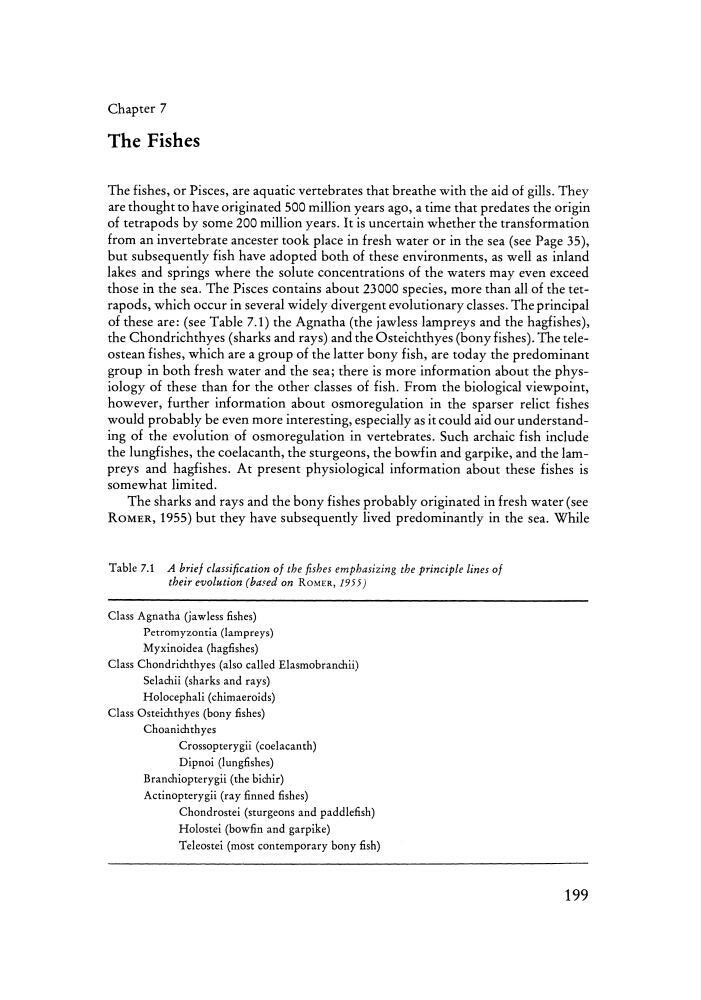
those in the sea. The Pisces contains about 23000 species, more than all of the tetrapods, which occur in several widely divergent evolutionary classes. The principal
of these are: (see Table 7.1) the Agnatha (the jawless lampreys and the hagfishes),
the Chondrichthyes (sharks and rays) and the Osteichthyes (bony fishes). The teleostean fishes, which are a group of the latter bony fish, are today the predominant
group in both fresh water and the sea; there is more information about the physiology of these than for the other classes of fish. From the biological viewpoint,
however, further information about osmoregulation in the sparser relict fishes
would probably be even more interesting, especially as it could aid our understanding of the evolution of osmoregulation in vertebrates. Such archaic fish include
the lungfishes, the coelacanth, the sturgeons, the bowfin and garpike, and the lampreys and hagfishes . At present physiological information about these fishes is
somewhat limited .
The sharks and rays and the bony fishes probably originated in fresh water (see
ROMER, 1955) but they have subsequently lived predominantly in the sea. While
Table 7.1 A brief classification of the fishes emphasiz ing the prin ciple line s of
their evolution (ba sed on R O MER , 195 5)
Class Agnatha (jawless fishes)
Petromyzontia (lampreys)
Myxinoidea (hagfishes)
Class Chondrichthyes (also called Elasmobranchii)
Selachii (sharks and ra ys)
Holocephali (chimaeroids)
Class Osteichthyes (bony fishes)
Choanichthyes
Cros sopterygii (coelacan th)
Dipnoi (lungfishes)
Branchiopterygii (the bichir)
Act inopterygii (ray finned fishes)
Chondrostei (sturg eons and paddlefish)
Holostei (bowfin and garpike)
Teleostei (most contemporary bony fish)
199
The Fishes
The fishes, or Pisces, are aquatic vert ebrates that breathe with the aid of gills. They
are thought to have originated 500 million years ago, a time that predates the origin
of tetrapods by some 200 million years. It is uncertain whether the transformation
from an invertebrate ancester took place in fresh water or in the sea (see Page 35),
but subsequently fish have adopted both of th ese environments, as well as inland
lakes and springs where the solute concentrations of the waters may even exceed
those in the sea. The Pisces contains about 23000 species, more than all of the tetrapods, which occur in several widely divergent evolutionary classes. The principal
of these are: (see Table 7.1) the Agnatha (the jawless lampreys and the hagfishes),
the Chondrichthyes (sharks and rays) and the Osteichthyes (bony fishes). The teleostean fishes, which are a group of the latter bony fish, are today the predominant
group in both fresh water and the sea; there is more information about the physiology of these than for the other classes of fish. From the biological viewpoint,
however, further information about osmoregulation in the sparser relict fishes
would probably be even more interesting, especially as it could aid our understanding of the evolution of osmoregulation in vertebrates. Such archaic fish include
the lungfishes, the coelacanth, the sturgeons, the bowfin and garpike, and the lampreys and hagfishes . At present physiological information about these fishes is
somewhat limited .
The sharks and rays and the bony fishes probably originated in fresh water (see
ROMER, 1955) but they have subsequently lived predominantly in the sea. While
Table 7.1 A brief classification of the fishes emphasiz ing the prin ciple line s of
their evolution (ba sed on R O MER , 195 5)
Class Agnatha (jawless fishes)
Petromyzontia (lampreys)
Myxinoidea (hagfishes)
Class Chondrichthyes (also called Elasmobranchii)
Selachii (sharks and ra ys)
Holocephali (chimaeroids)
Class Osteichthyes (bony fishes)
Choanichthyes
Cros sopterygii (coelacan th)
Dipnoi (lungfishes)
Branchiopterygii (the bichir)
Act inopterygii (ray finned fishes)
Chondrostei (sturg eons and paddlefish)
Holostei (bowfin and garpike)
Teleostei (most contemporary bony fish)
199