

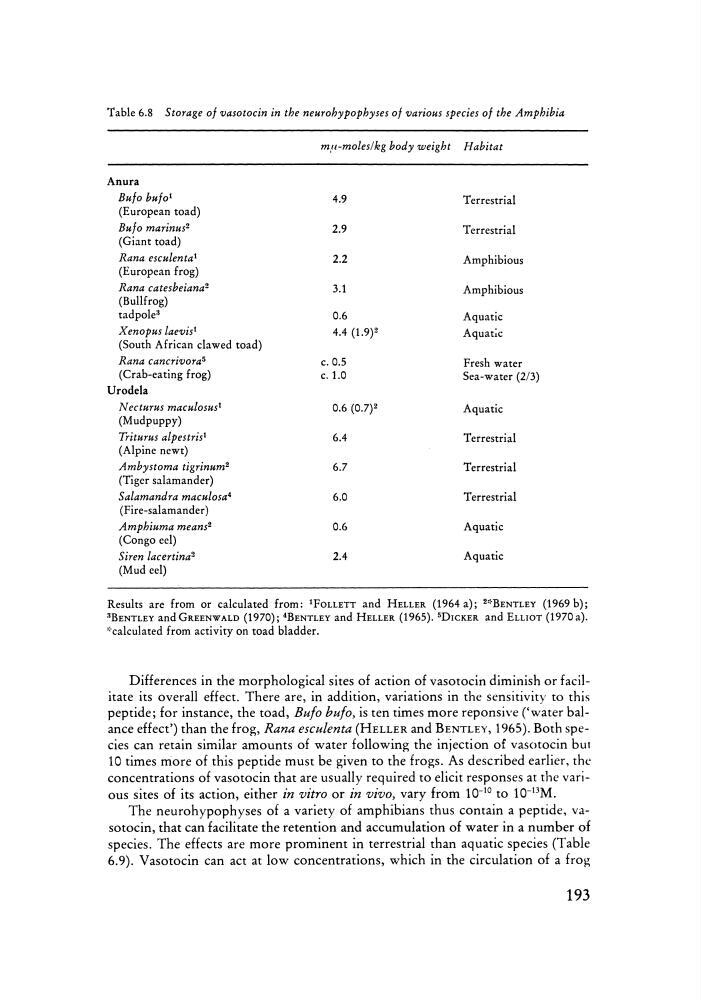
'fable 6.8 Storage of vasotocin in the neurohypophyses of various species of the Amphibia
mil-moles/kg body weight Habitat
Anura
Bufo bufo!
4.9
Terrestrial
(European toad)
Bujo marinusl
2.9
Terrestrial
(Giant toad)
Rana esculenta'
2.2
Amphibious
(European frog)
Rana catesbeianas
3.1
Amphibious
(Bullfrog)
tadpole"
0.6
Aquatic
Xenopus laeuis'
4.4 (1.9)2
Aquatic
(South African clawed toad)
Rana cancriuoras
c.0.5
Fresh water
(Crab-eating frog)
c.1.0
Sea-water (2/3)
Urodela
Necturus maculosus!
0.6 (0.7)2
Aquatic
(Mudpuppy)
Triturus alpestris'
6.4
Terrestrial
(Alpine newt)
Ambystoma tigrinum»
6.7
Terrestrial
(Tiger salamander)
Salamandra maculosa"
6.0
Terrestrial
(Fire-salamander)
Amphiuma means»
0.6
Aquatic
(Congo eel)
Siren lacertina»
2.4
Aquatic
(Mud eel)
Results are from or calculated from: !FOLLETT and HELLER (1964 a); 2'fBENTLEY (1969 b);
:!BENTLEY and GREENWALD (1970); 4BENTLEY and HELLER (1965) . 5DICKER and ELLIOT (1970 a).
"calculated from activity on toad bladder.
Differences in the morphological sites of action of vasotocin diminish or facilitate its overall effect. There are, in addition, variations in the sensitivity to this
peptide; for instance, the toad, Bufo bufo, is ten times more reponsive ('water balance effect') than the frog, Rana esculenta (HELLER and BENTLEY, 1965). Both species can retain similar amounts of water following the injection of vasotocin but
10 times more of this peptide must be given to the frogs . As described earlier, the
concentrations of vasotocin that are usually required to elicit responses at the various sites of its action, either in vitro or in vivo, vary from 1010
to to13
M.
The neurohypophyses of a variety of amphibians thus contain a peptide, vasotocin, that can facilitate the retention and accumulation of water in a number of
species . The effects are more prominent in terrestrial than aquatic species (Table
6.9). Vasotocin can act at low concentrations, which in the circulation of a frog
193
mil-moles/kg body weight Habitat
Anura
Bufo bufo!
4.9
Terrestrial
(European toad)
Bujo marinusl
2.9
Terrestrial
(Giant toad)
Rana esculenta'
2.2
Amphibious
(European frog)
Rana catesbeianas
3.1
Amphibious
(Bullfrog)
tadpole"
0.6
Aquatic
Xenopus laeuis'
4.4 (1.9)2
Aquatic
(South African clawed toad)
Rana cancriuoras
c.0.5
Fresh water
(Crab-eating frog)
c.1.0
Sea-water (2/3)
Urodela
Necturus maculosus!
0.6 (0.7)2
Aquatic
(Mudpuppy)
Triturus alpestris'
6.4
Terrestrial
(Alpine newt)
Ambystoma tigrinum»
6.7
Terrestrial
(Tiger salamander)
Salamandra maculosa"
6.0
Terrestrial
(Fire-salamander)
Amphiuma means»
0.6
Aquatic
(Congo eel)
Siren lacertina»
2.4
Aquatic
(Mud eel)
Results are from or calculated from: !FOLLETT and HELLER (1964 a); 2'fBENTLEY (1969 b);
:!BENTLEY and GREENWALD (1970); 4BENTLEY and HELLER (1965) . 5DICKER and ELLIOT (1970 a).
"calculated from activity on toad bladder.
Differences in the morphological sites of action of vasotocin diminish or facilitate its overall effect. There are, in addition, variations in the sensitivity to this
peptide; for instance, the toad, Bufo bufo, is ten times more reponsive ('water balance effect') than the frog, Rana esculenta (HELLER and BENTLEY, 1965). Both species can retain similar amounts of water following the injection of vasotocin but
10 times more of this peptide must be given to the frogs . As described earlier, the
concentrations of vasotocin that are usually required to elicit responses at the various sites of its action, either in vitro or in vivo, vary from 1010
to to13
M.
The neurohypophyses of a variety of amphibians thus contain a peptide, vasotocin, that can facilitate the retention and accumulation of water in a number of
species . The effects are more prominent in terrestrial than aquatic species (Table
6.9). Vasotocin can act at low concentrations, which in the circulation of a frog
193