

a) The Neurohypophysis
In contrast to most fishes, the neurohypophysis of amphibians is enlarged posteriorly to form a neural lobe. This persists throughout the tetrapods . Among the
lungfishes, the size of the neurohypophysis may be somewhat increased in this
manner, while a few amphibians, like the mudpuppy, may have a neurohypophysis
that retains a more fish-like form (see WINGSTRAND, 1966). In 1921 BRUNN showed
that when extracts from the neurohypophysis of mammals, which have an antidiuretic action in this group, are injected into frogs kept in water, there is an increase
in weight due to an accumulation of water. This action has been called the BRUNN
effect or 'water balance effect'. HELLER in 1941 found that while the pituitary of
English frogs, Rana temporaria, contains a substance that causes an antidiuresis
when injected into rats, this was not identical with the activity present in the mammalian neural lobe. The amphibian extract, when injected into frogs, was far more
potent in its ability to produce a ' water balance effect' than similar mammalian extracts and HELLER called this substance the 'amphibian water balance principle' .
Nearly 20 years later this was shown to be identical to arginine-vasotocin (PICKERING and HELLER, 1959), a peptide that is also present in birds, reptiles and most
of the fishes, but is absent from mammals. A second substance, with properties
similar to those of oxytocin, was also found to be present in amphibian
neurohypophysial extracts. This was pharmacologically similar to 8-isoleucine oxytocin (FOLLETT and HELLER, 1964 a). It was chemically identified as this by
ACHER and his collaborators (Table 6.3). This peptide differs from oxytocin by
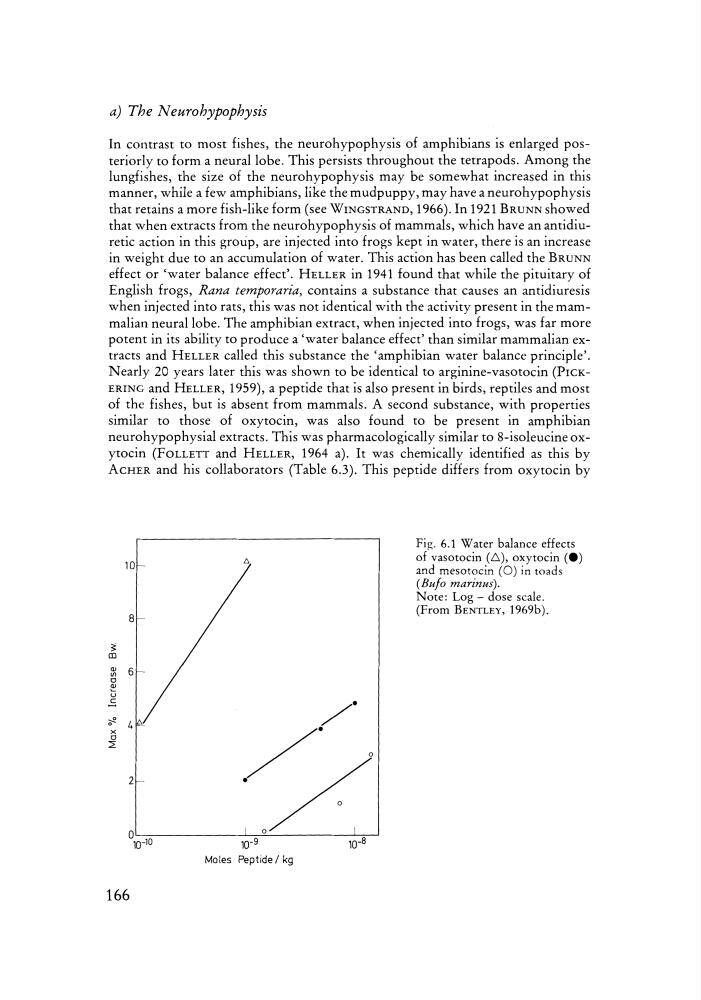
Fig. 6.1 Water balance effects
of vasotocin (6), oxytocin (e)
and mesorocin (0) in toad s
tBufo marinus).
Note: Log - dose scale.
(From BENTLEY, 1969b) .
I
10- 8
10- 9
Moles Peptide / kg
QL-,--'--=-"
'--;,----'
10- 10
10
8
~
CD
VI
0
~
o
oS
-:
~
" -
x
.:
0
L
0
2
e
166
In contrast to most fishes, the neurohypophysis of amphibians is enlarged posteriorly to form a neural lobe. This persists throughout the tetrapods . Among the
lungfishes, the size of the neurohypophysis may be somewhat increased in this
manner, while a few amphibians, like the mudpuppy, may have a neurohypophysis
that retains a more fish-like form (see WINGSTRAND, 1966). In 1921 BRUNN showed
that when extracts from the neurohypophysis of mammals, which have an antidiuretic action in this group, are injected into frogs kept in water, there is an increase
in weight due to an accumulation of water. This action has been called the BRUNN
effect or 'water balance effect'. HELLER in 1941 found that while the pituitary of
English frogs, Rana temporaria, contains a substance that causes an antidiuresis
when injected into rats, this was not identical with the activity present in the mammalian neural lobe. The amphibian extract, when injected into frogs, was far more
potent in its ability to produce a ' water balance effect' than similar mammalian extracts and HELLER called this substance the 'amphibian water balance principle' .
Nearly 20 years later this was shown to be identical to arginine-vasotocin (PICKERING and HELLER, 1959), a peptide that is also present in birds, reptiles and most
of the fishes, but is absent from mammals. A second substance, with properties
similar to those of oxytocin, was also found to be present in amphibian
neurohypophysial extracts. This was pharmacologically similar to 8-isoleucine oxytocin (FOLLETT and HELLER, 1964 a). It was chemically identified as this by
ACHER and his collaborators (Table 6.3). This peptide differs from oxytocin by
Fig. 6.1 Water balance effects
of vasotocin (6), oxytocin (e)
and mesorocin (0) in toad s
tBufo marinus).
Note: Log - dose scale.
(From BENTLEY, 1969b) .
I
10- 8
10- 9
Moles Peptide / kg
QL-,--'--=-"
'--;,----'
10- 10
10
8
~
CD
VI
0
~
o
oS
-:
~
" -
x
.:
0
L
0
2
e
166