

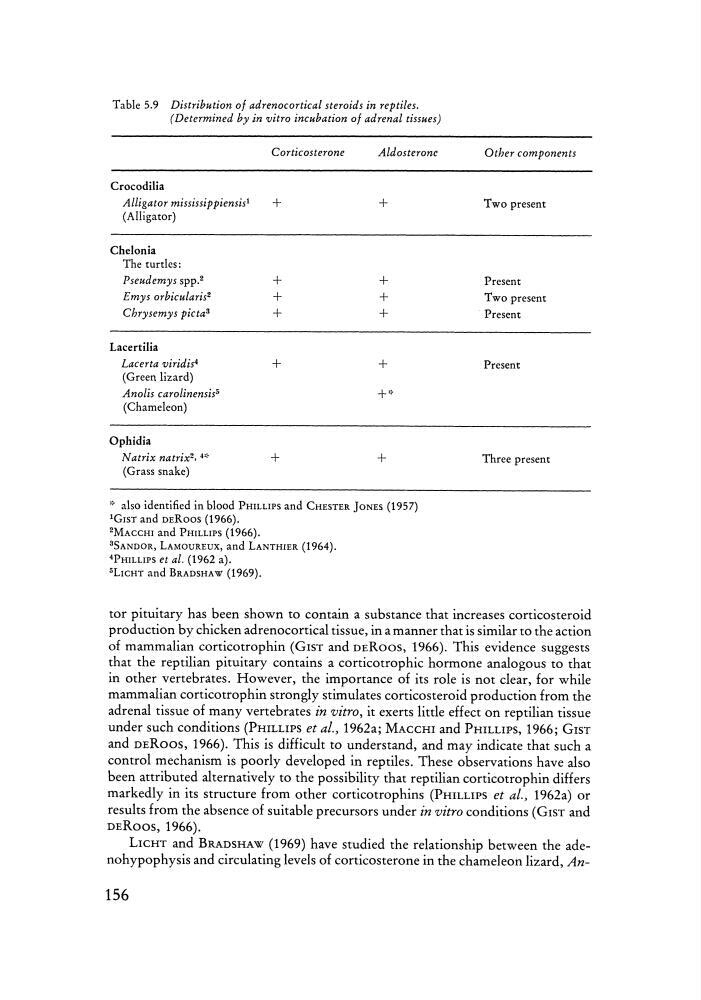
Tabl e 5.9 Distribution of adrenocortical steroid s in reptiles.
( De ter m ined by in v it ro incubation of adrenal tissues)
Crocodilia
A lligator m ississip piensist
(Alligato r)
Corticosterone
+
Aldosterone
+
Other component s
Two pre sent
Chelonia
Th e tu rtl es:
Pseudemys Spp.2
Emys orbicularisi
Chry semys picta 3
Lacertilia
Lacerta oiridis:
(G reen lizard)
Anolis carolinen siss
(Chameleon)
+
+
P resent
+
+
Two pre sent
+
+
. Present
+
+
Present
+': .
Ophidia
N at rix nat rixi . 4 <"
(Grass snake)
+
+
Three pr esent
,~ also identified in blood PHILLIPSand CHESTER JONES (1957)
IGIST and DERoos (1966) .
2MACCHI and PHILLIPS (1966) .
3SANDOR, LAMOUREUX , and LANTHIER (1964).
4PHILLIPS et al. (1962 a).
5LICHT and BRADSHAW (1969).
tor pituitary has been show n to contain a substance that increases corticosteroid
production by chicken adrenocortical tissue, in a manner that is similar to th e action
of mammalian corticotrophin (GIST and DERoos, 1966). This evidence suggests
that th e reptilian pituitary contains a corticotrophic hormone analogous to that
in other vertebrates. However, the importance of its role is not clear , for while
mammalian corticotrophin strongly stimulates corticosteroid production from the
adrenal tissue of many vertebrates in vitro, it exerts little effect on reptilian tissue
under such conditions (PHILLIPS et al., 1962a; MACCHI and PHILLIPS, 1966; GIST
and DERoos, 1966). This is difficult to understand, and may indicate that such a
control mechanism is poorly developed in reptiles. These observations have also
been attributed alternatively to th e po ssibility that reptilian corticotrophin differs
markedly in its structure from other corticotrophins (PHILLIPS et al., 1962a) or
results from th e abse nce of suitable precursor s under in v itro conditions (G IST and
DERoos, 1966).
LICHT and BRADSHAW (1969) have studied the relationship between the adenoh ypophysis and circulating levels of corticosterone in the chameleon lizard, An156
( De ter m ined by in v it ro incubation of adrenal tissues)
Crocodilia
A lligator m ississip piensist
(Alligato r)
Corticosterone
+
Aldosterone
+
Other component s
Two pre sent
Chelonia
Th e tu rtl es:
Pseudemys Spp.2
Emys orbicularisi
Chry semys picta 3
Lacertilia
Lacerta oiridis:
(G reen lizard)
Anolis carolinen siss
(Chameleon)
+
+
P resent
+
+
Two pre sent
+
+
. Present
+
+
Present
+': .
Ophidia
N at rix nat rixi . 4 <"
(Grass snake)
+
+
Three pr esent
,~ also identified in blood PHILLIPSand CHESTER JONES (1957)
IGIST and DERoos (1966) .
2MACCHI and PHILLIPS (1966) .
3SANDOR, LAMOUREUX , and LANTHIER (1964).
4PHILLIPS et al. (1962 a).
5LICHT and BRADSHAW (1969).
tor pituitary has been show n to contain a substance that increases corticosteroid
production by chicken adrenocortical tissue, in a manner that is similar to th e action
of mammalian corticotrophin (GIST and DERoos, 1966). This evidence suggests
that th e reptilian pituitary contains a corticotrophic hormone analogous to that
in other vertebrates. However, the importance of its role is not clear , for while
mammalian corticotrophin strongly stimulates corticosteroid production from the
adrenal tissue of many vertebrates in vitro, it exerts little effect on reptilian tissue
under such conditions (PHILLIPS et al., 1962a; MACCHI and PHILLIPS, 1966; GIST
and DERoos, 1966). This is difficult to understand, and may indicate that such a
control mechanism is poorly developed in reptiles. These observations have also
been attributed alternatively to th e po ssibility that reptilian corticotrophin differs
markedly in its structure from other corticotrophins (PHILLIPS et al., 1962a) or
results from th e abse nce of suitable precursor s under in v itro conditions (G IST and
DERoos, 1966).
LICHT and BRADSHAW (1969) have studied the relationship between the adenoh ypophysis and circulating levels of corticosterone in the chameleon lizard, An156