

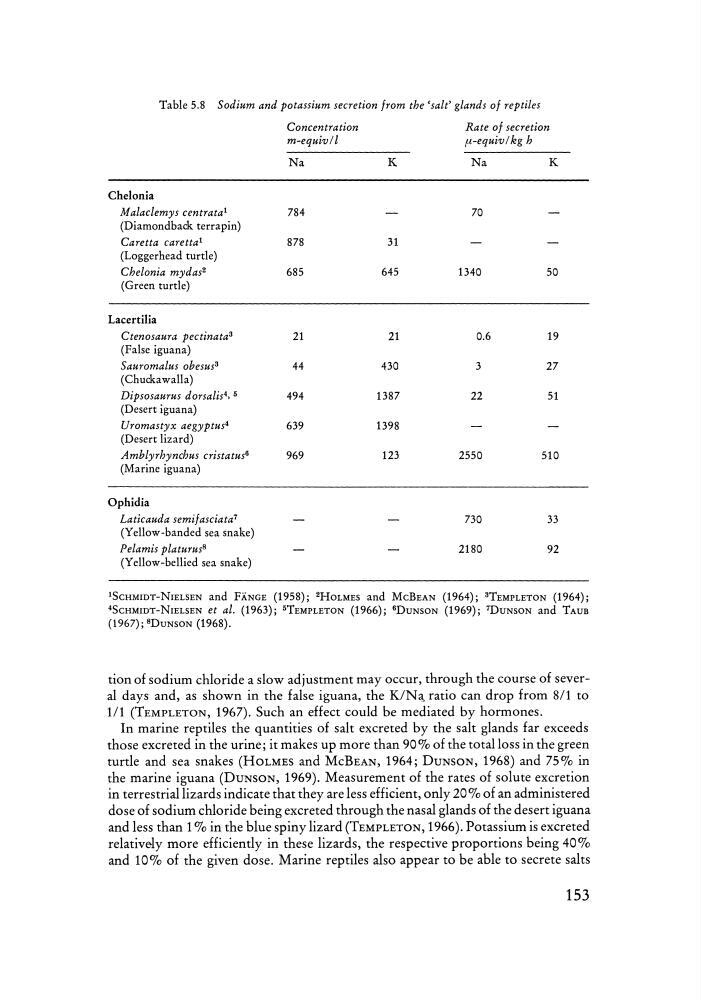
Table 5.8 Sodium and potassium secretion from the 'salt ' glands of reptiles
Concentration
Rate of secretion
m-equiul l
u-equio! kg h
Na
K
Na
K
Chelonia
Malaclemys cerurata'
784
70
(Diamondback terrapin)
Caretta caretta!
878
31
(Loggerhead turtle)
Chelonia mydas 2
685
645
1340
50
(Green turtle)
Lacertilia
Ctenosaura pectinatas
21
21
0.6
19
(False iguana)
Sauro malus obe sus»
44
430
3
27
(Chuckawalla)
Dipsosaurus dorsalis', 5
494
1387
22
51
(Desert iguana)
Uromastyx aegyptus"
639
1398
(Desert lizard)
Amblyrhynchus cristatus':
969
123
2550
510
(Marine iguana)
Ophidia
Laticauda semijasciatal
730
33
(Yellow-banded sea snake)
Pelamis platurus 8
2180
92
(Yellow-bellied sea snake)
!SCHMlDT-NIELSEN and FANGE (1958); 2HoLMES and McBEAN (1964) ; 3T EMPLETON (1964);
4SCHMlDT-NIELSEN et al. (1963) ; 5TEMPLETON (1966); 6DuNsoN (1969); 7D u Nso N and TAUB
(1967); 8DuNsoN (1968) .
tion of sodium chloride a slow adjustment may occur, through the course of several days and, as shown in the false iguana, the KINa, ratio can drop from 8/1 to
1/1 (TEMPLETON, 1967). Such an effect could be mediated by hormones.
In marine reptiles the quantities of salt excreted by the salt glands far exceeds
those excreted in the urine; it makes up more than 90% of the total loss in the green
turtle and sea snakes (HOLMES and McBEAN, 1964; DUNSON, 1968) and 75% in
the marine iguana (DUNSON, 1969). Measurement of the rates of solute excretion
in terrestrial lizards indicate that they are less efficient, only 20 % of an administered
dose of sodium chloride being excreted through the nasal glands of the desert iguana
and less than 1% in the blue spiny lizard (TEMPLETON, 1966). Potassium is excreted
relatively more efficiently in these lizards, the respective proportions being 40%
and 10% of the given dose. Marine reptiles also appear to be able to secrete salts
153
Concentration
Rate of secretion
m-equiul l
u-equio! kg h
Na
K
Na
K
Chelonia
Malaclemys cerurata'
784
70
(Diamondback terrapin)
Caretta caretta!
878
31
(Loggerhead turtle)
Chelonia mydas 2
685
645
1340
50
(Green turtle)
Lacertilia
Ctenosaura pectinatas
21
21
0.6
19
(False iguana)
Sauro malus obe sus»
44
430
3
27
(Chuckawalla)
Dipsosaurus dorsalis', 5
494
1387
22
51
(Desert iguana)
Uromastyx aegyptus"
639
1398
(Desert lizard)
Amblyrhynchus cristatus':
969
123
2550
510
(Marine iguana)
Ophidia
Laticauda semijasciatal
730
33
(Yellow-banded sea snake)
Pelamis platurus 8
2180
92
(Yellow-bellied sea snake)
!SCHMlDT-NIELSEN and FANGE (1958); 2HoLMES and McBEAN (1964) ; 3T EMPLETON (1964);
4SCHMlDT-NIELSEN et al. (1963) ; 5TEMPLETON (1966); 6DuNsoN (1969); 7D u Nso N and TAUB
(1967); 8DuNsoN (1968) .
tion of sodium chloride a slow adjustment may occur, through the course of several days and, as shown in the false iguana, the KINa, ratio can drop from 8/1 to
1/1 (TEMPLETON, 1967). Such an effect could be mediated by hormones.
In marine reptiles the quantities of salt excreted by the salt glands far exceeds
those excreted in the urine; it makes up more than 90% of the total loss in the green
turtle and sea snakes (HOLMES and McBEAN, 1964; DUNSON, 1968) and 75% in
the marine iguana (DUNSON, 1969). Measurement of the rates of solute excretion
in terrestrial lizards indicate that they are less efficient, only 20 % of an administered
dose of sodium chloride being excreted through the nasal glands of the desert iguana
and less than 1% in the blue spiny lizard (TEMPLETON, 1966). Potassium is excreted
relatively more efficiently in these lizards, the respective proportions being 40%
and 10% of the given dose. Marine reptiles also appear to be able to secrete salts
153