

T abl e 5.3 Cu tan eous wate r exchange in rept iles k ept in fr esh water or 3.3% sodiu m chlorid e
solut ion (= sea-wate r)
mgt em» day
fresh water
3.3 % NaCI
(gain)
(loss)
Crocodilia
Caim an scleropss
(C aiman)
Chelonia
Trionyx spin ifer 2
(Softshell turtle)
Pseudemys scripta 2
(Slider turtle)
Lacertilia
Saur omalus obesus 2
(C huckawalla )
IBENTLEY an d SCHMIDT-NIELSEN (1965)
2BENTLEY and SCHMIDT-NIELSEN (1970)
26
26
6
Not d et ectable
14
38
10
dr y habitats suffer a smaller loss in this way than those from wetter situations. Thus,
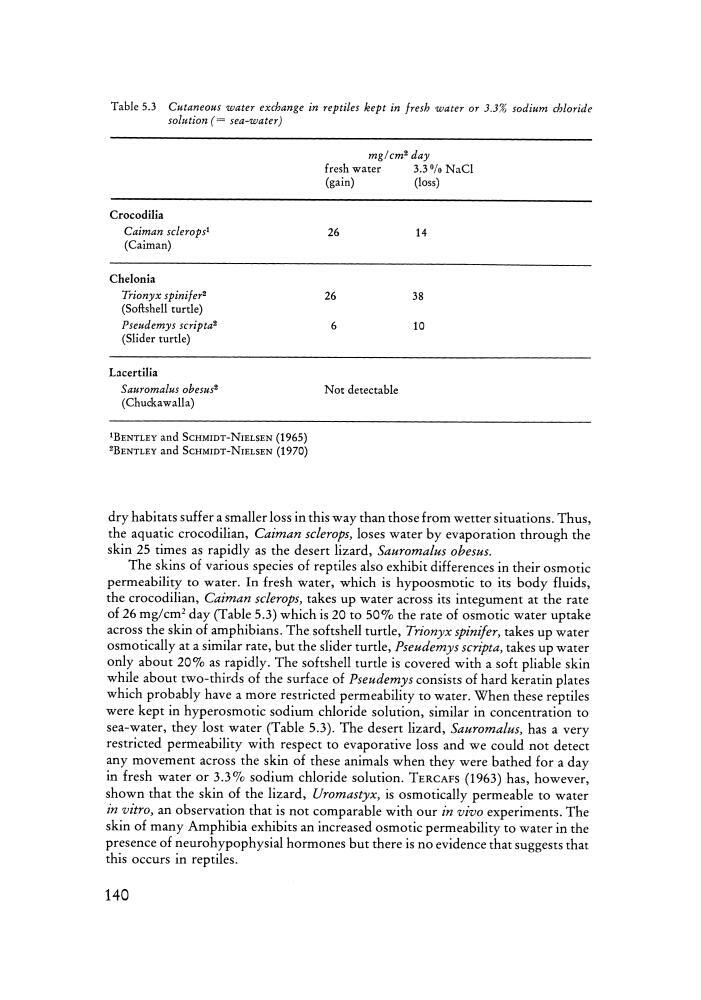
th e aquatic crocodilian, Caiman sclerops, loses water by evaporation through the
skin 25 times as rapidly as the desert lizard, Sauromalus obesus.
The skins of various species of reptiles also exhibit differ ences in their osmotic
perm eability to water. In fresh water, whi ch is hypoosmotic to its body flu ids,
th e crocodilian, Caim an sclerops, takes up water acro ss its inte gum ent at th e rate
of 26 mg/crrr' day (Table 5.3) which is 20 to 50 % the rate of osmotic water uptake
across the skin of amphibians. The softshell turtle, Trionyx spinifer, takes up water
osmotically at a similar rate , but th e slider turtle, Pseudemys scripta, takes up water
onl y about 20% as rapidl y . The softshell turtle is covered with a soft pliable skin
whil e about two-thirds of the sur face of Pseudemys consists of hard keratin plates
which probably have a more restricted permeability to water. When these reptiles
were kept in hyperosmotic sodium chloride solution, similar in concentration to
sea-water, the y lost water (Table 5.3). The desert lizard, Sauromalus, has a very
restricted permeability with respect to evaporative loss and we could not detect
any mo vement across the skin of these animals when th ey we re bathed for a day
in fr esh water or 3.3 % sodium chloride solution. T ERcAFs (1963) has, ho wever,
show n that the skin of the lizard, Urom astyx, is osmotically permeable to water
in vitro, an ob servation that is not comparable with ou r in v ivo experime nts. The
skin of man y Amphibia exhibits an increas ed osmotic permeability to water in the
pres ence of neu rohypophysial hormones but th ere is no evidence that suggests that
this occurs in reptiles.
140
solut ion (= sea-wate r)
mgt em» day
fresh water
3.3 % NaCI
(gain)
(loss)
Crocodilia
Caim an scleropss
(C aiman)
Chelonia
Trionyx spin ifer 2
(Softshell turtle)
Pseudemys scripta 2
(Slider turtle)
Lacertilia
Saur omalus obesus 2
(C huckawalla )
IBENTLEY an d SCHMIDT-NIELSEN (1965)
2BENTLEY and SCHMIDT-NIELSEN (1970)
26
26
6
Not d et ectable
14
38
10
dr y habitats suffer a smaller loss in this way than those from wetter situations. Thus,
th e aquatic crocodilian, Caiman sclerops, loses water by evaporation through the
skin 25 times as rapidly as the desert lizard, Sauromalus obesus.
The skins of various species of reptiles also exhibit differ ences in their osmotic
perm eability to water. In fresh water, whi ch is hypoosmotic to its body flu ids,
th e crocodilian, Caim an sclerops, takes up water acro ss its inte gum ent at th e rate
of 26 mg/crrr' day (Table 5.3) which is 20 to 50 % the rate of osmotic water uptake
across the skin of amphibians. The softshell turtle, Trionyx spinifer, takes up water
osmotically at a similar rate , but th e slider turtle, Pseudemys scripta, takes up water
onl y about 20% as rapidl y . The softshell turtle is covered with a soft pliable skin
whil e about two-thirds of the sur face of Pseudemys consists of hard keratin plates
which probably have a more restricted permeability to water. When these reptiles
were kept in hyperosmotic sodium chloride solution, similar in concentration to
sea-water, the y lost water (Table 5.3). The desert lizard, Sauromalus, has a very
restricted permeability with respect to evaporative loss and we could not detect
any mo vement across the skin of these animals when th ey we re bathed for a day
in fr esh water or 3.3 % sodium chloride solution. T ERcAFs (1963) has, ho wever,
show n that the skin of the lizard, Urom astyx, is osmotically permeable to water
in vitro, an ob servation that is not comparable with ou r in v ivo experime nts. The
skin of man y Amphibia exhibits an increas ed osmotic permeability to water in the
pres ence of neu rohypophysial hormones but th ere is no evidence that suggests that
this occurs in reptiles.
140