

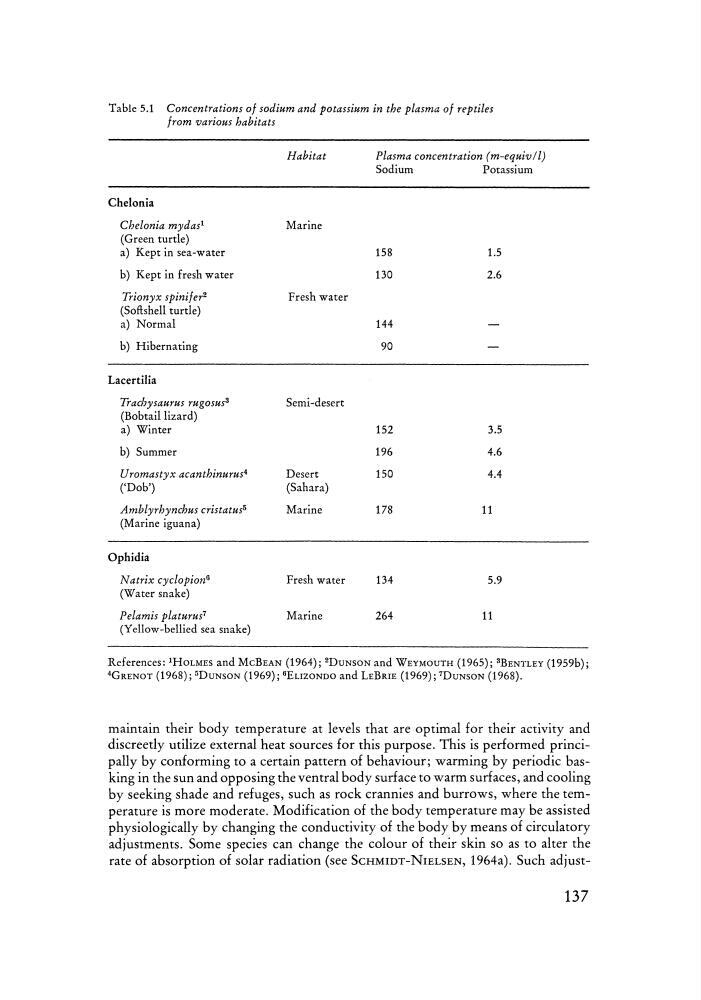
Table 5.1 Concentrations of sodium and potassium in the plasma of reptiles
from various habitats
Habitat
Plasma concentration (m-equiv/l)
Sodium
Potassium
Chelonia
Chelonia mydas l
(Green turtle)
a) Kept in sea-water
b) Kept in fresh water
Trionyx spinifer 2
(Soflshell turtle)
a) Normal
b) Hibernating
Lacertilia
Trachysaurus rugosus 3
(Bobtail lizard)
a) Winter
b) Summer
Uromastyx acantbinurust
('Dob')
Amblyrhynchus crlstatusr
(Marine iguana)
Marine
158
1.5
130
2.6
Fresh water
144
90
Semi-desert
152
3.5
196
4.6
Desert
150
4.4
(Sahara)
Marine
178
11
Ophidia
N atrix cyclopiont
(Water snake)
Pelamis platurus'
(Yellow-bellied sea snake)
Fresh water
Marine
134
264
5.9
11
References: IHOLMES and McBEAN (1964); 2DuNSON and W EYMOUTH (1965); 3BENTLEY (1959b);
4GRENOT (1968); 5D u Nso N (1969) ; 6ELIZONDO and LEBRJE (1969); 7DuNsoN (1968).
maintain their body temperature at levels that are optimal for their activity and
discreetly utilize external heat sources for this purpose. This is performed principally by conforming to a certain pattern of behaviour; warming by periodic basking in the sun and opposing the ventral body surface to warm surfaces, and cooling
by seeking shade and refuges, such as rock crannies and burrows, where the temperature is more moderate. Modification of the body temperature may be assisted
physiologically by changing the conductivity of the body by means of circulatory
adjustments. Some species can change the colour of their skin so as to alter the
rate of absorption of solar radiation (see SCHMIDT-NIELSEN, 1964a). Such adjust137
from various habitats
Habitat
Plasma concentration (m-equiv/l)
Sodium
Potassium
Chelonia
Chelonia mydas l
(Green turtle)
a) Kept in sea-water
b) Kept in fresh water
Trionyx spinifer 2
(Soflshell turtle)
a) Normal
b) Hibernating
Lacertilia
Trachysaurus rugosus 3
(Bobtail lizard)
a) Winter
b) Summer
Uromastyx acantbinurust
('Dob')
Amblyrhynchus crlstatusr
(Marine iguana)
Marine
158
1.5
130
2.6
Fresh water
144
90
Semi-desert
152
3.5
196
4.6
Desert
150
4.4
(Sahara)
Marine
178
11
Ophidia
N atrix cyclopiont
(Water snake)
Pelamis platurus'
(Yellow-bellied sea snake)
Fresh water
Marine
134
264
5.9
11
References: IHOLMES and McBEAN (1964); 2DuNSON and W EYMOUTH (1965); 3BENTLEY (1959b);
4GRENOT (1968); 5D u Nso N (1969) ; 6ELIZONDO and LEBRJE (1969); 7DuNsoN (1968).
maintain their body temperature at levels that are optimal for their activity and
discreetly utilize external heat sources for this purpose. This is performed principally by conforming to a certain pattern of behaviour; warming by periodic basking in the sun and opposing the ventral body surface to warm surfaces, and cooling
by seeking shade and refuges, such as rock crannies and burrows, where the temperature is more moderate. Modification of the body temperature may be assisted
physiologically by changing the conductivity of the body by means of circulatory
adjustments. Some species can change the colour of their skin so as to alter the
rate of absorption of solar radiation (see SCHMIDT-NIELSEN, 1964a). Such adjust137