

for temperature regulation until th e ambient temperature is greater than about 35 °,
while prominent increases are not seen until 40
0
• These bird s are poorly insulated
so that heat loss readily occurs by radiation, conduction and convection. TUCKER
(1968) has calculated that in flying budgerygahs only 15% of the metabolic heat
production is dissipated by evaporation at 20 0 , w hile even at 36 ° just 50% of the
heat is lost in this manner.
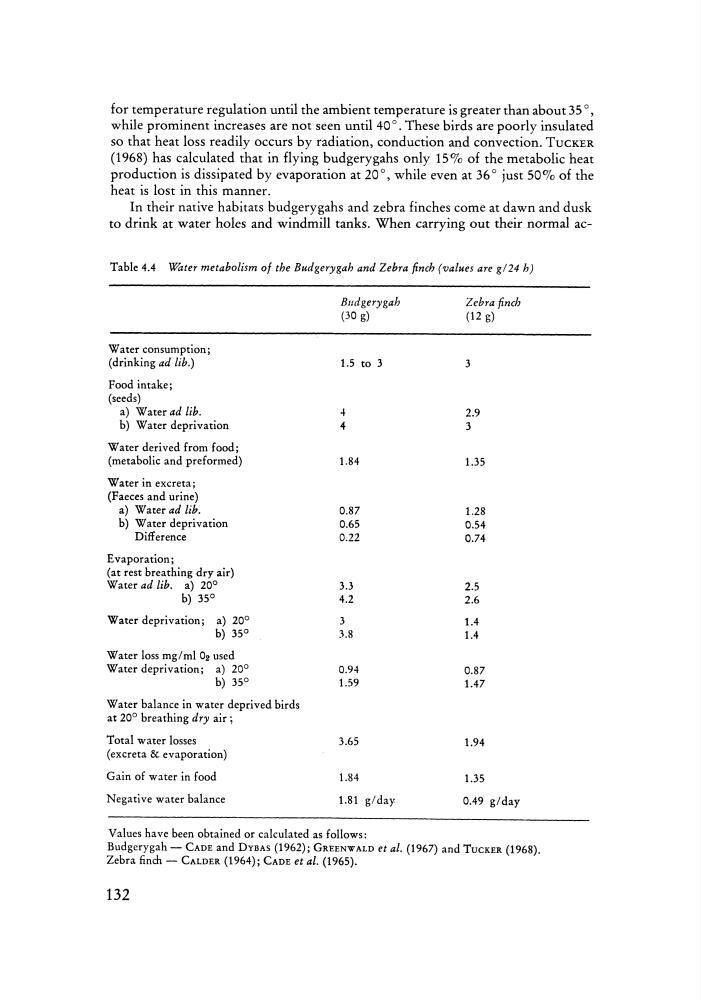
In th eir native habitats budgerygahs and zebra finche s come at dawn and du sk
to drink at w ater hol es and w indmill tanks. When carrying out the ir normal acTable 4.4 wa ter metabo lism 0/ the Budgeryg ah and Zebra finch (v alues are g/24 h )
Water con sumption;
(drinking ad lib.)
Food inta ke ;
(seeds)
a) Wa ter ad lib.
b) Wa ter deprivatio n
Wat er deri ved fro m food;
(metabol ic and pr eform ed)
Water in excreta ;
(Faeces and urine)
a) Water ad lib.
b) Water deprivation
Difference
Evap or ation ;
(at rest breathing dr y ai r)
Wat er ad lib . a) 20°
b) 35°
Water depr ivation ; a) 20°
b) 35°
Wat er loss mg/ml 02 used
Wat er depri vation ; a) 20°
b) 35°
Budge rygah
Zebra finch
(30 g)
(12 g)
1.5 to 3
3
~
2.9
4
3
1.84
1.35
0.87
1.28
0.65
0.54
0.22
0.74
3.3
2.5
4.2
2.6
3
1.4
3.8
1.4
0.94
0.87
1.59
1.47
Wat er bal anc e in water deprived birds
at 20° breathing dry air ;
Total wa te r losses
(excre ta & ev aporatio n)
Gain of water in food
Negative wa ter balan ce
3.65
1.84
1.81 g/ day
1.94
1.35
0.49 g/day
Valu es have been obt ain ed or calcul at ed as follows :
Budgerygah - CADE and DYBAS (1962); GREENWALD et al. (1967) and TUCKER (1968) .
Zebr a finch - CALD ER (1964); CADE et al. (1965).
132
while prominent increases are not seen until 40
0
• These bird s are poorly insulated
so that heat loss readily occurs by radiation, conduction and convection. TUCKER
(1968) has calculated that in flying budgerygahs only 15% of the metabolic heat
production is dissipated by evaporation at 20 0 , w hile even at 36 ° just 50% of the
heat is lost in this manner.
In th eir native habitats budgerygahs and zebra finche s come at dawn and du sk
to drink at w ater hol es and w indmill tanks. When carrying out the ir normal acTable 4.4 wa ter metabo lism 0/ the Budgeryg ah and Zebra finch (v alues are g/24 h )
Water con sumption;
(drinking ad lib.)
Food inta ke ;
(seeds)
a) Wa ter ad lib.
b) Wa ter deprivatio n
Wat er deri ved fro m food;
(metabol ic and pr eform ed)
Water in excreta ;
(Faeces and urine)
a) Water ad lib.
b) Water deprivation
Difference
Evap or ation ;
(at rest breathing dr y ai r)
Wat er ad lib . a) 20°
b) 35°
Water depr ivation ; a) 20°
b) 35°
Wat er loss mg/ml 02 used
Wat er depri vation ; a) 20°
b) 35°
Budge rygah
Zebra finch
(30 g)
(12 g)
1.5 to 3
3
~
2.9
4
3
1.84
1.35
0.87
1.28
0.65
0.54
0.22
0.74
3.3
2.5
4.2
2.6
3
1.4
3.8
1.4
0.94
0.87
1.59
1.47
Wat er bal anc e in water deprived birds
at 20° breathing dry air ;
Total wa te r losses
(excre ta & ev aporatio n)
Gain of water in food
Negative wa ter balan ce
3.65
1.84
1.81 g/ day
1.94
1.35
0.49 g/day
Valu es have been obt ain ed or calcul at ed as follows :
Budgerygah - CADE and DYBAS (1962); GREENWALD et al. (1967) and TUCKER (1968) .
Zebr a finch - CALD ER (1964); CADE et al. (1965).
132