

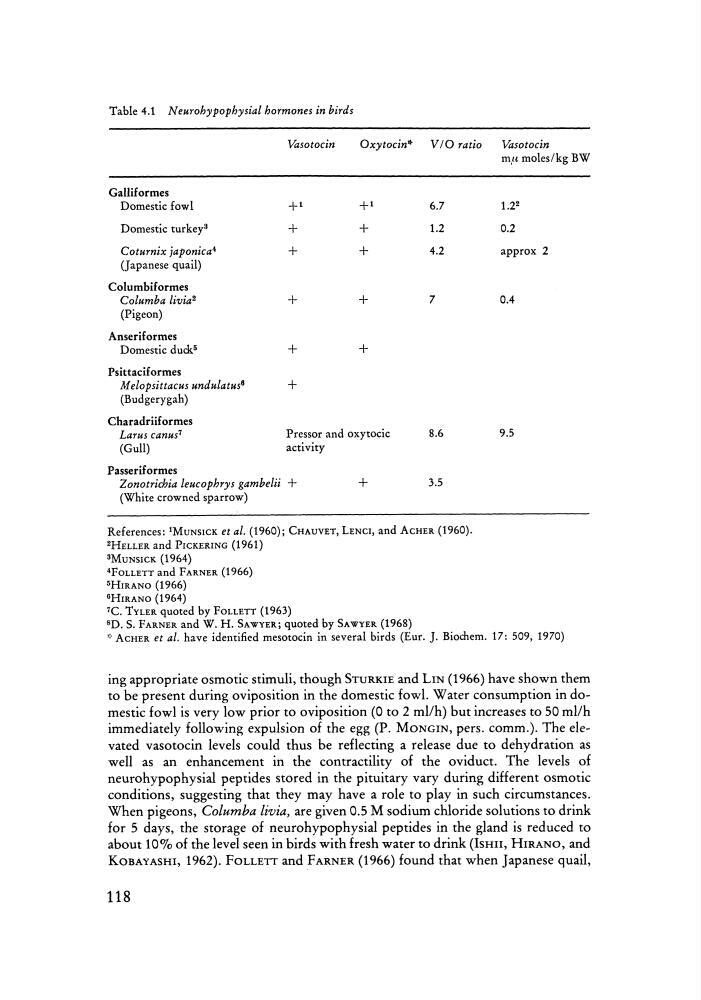
Table 4.1 Neurohypophysial horm ones in birds
Vasotocin
O xy tocin"
V /O rati o
vasotocin
m« moles/kg BW
Galliformes
Domestic fowl
+1
+1
6.7
1.2 2
Domestic turkey"
+
+
1.2
0.2
Coturnix japonica 4
+
+
4.2
approx 2
(Japanese quail)
Columbiformes
Columba livia 2
+
+
7
0.4
(Pigeon)
Anse rif or mes
Domestic duck 5
+
+
Psittaciformes
Melopsittacus undulatus 6
+
(Budgerygah)
Charadriiformes
Lams canus'
Pressor and oxytocic
8.6
9.5
(Gull)
activity
Passer iformes
Zonotrichia leucophrys gambeli i +
+
3.5
(White crowned sparrow)
References: IMuNSICK et al. (1960); CHAUVET, LENCI, and ACHER (1960) .
2H ELLER and PICKERING (1961)
3MuNSICK (1964)
4FOLLETT and FARNER (1966)
5H IRANO (1966)
G H IRANO (1964)
7C. TYLER quoted by FOLLETT (1963)
sD. S. FARNER and W. H. SAWYER; quoted by SAWYER (1968)
':. ACHER et al. have identified mesotocin in several birds (Eur. J. Biochem. 17 : 509, 1970)
ing appro priate osmotic stimuli, thou gh STURKIE and L I N (1966) have shown them
to be pr esent during oviposition in the domestic fowl. Water consumption in domestic fow l is very low prior to oviposition (0 to 2 mllh) but increases to somllh
immediately following expulsion of the egg (P. MaNGIN, pers. comm.). The elevated vasotocin levels could thus be reflecting a release due to dehydration as
well as an enhancement in the contractility of the oviduct. The levels of
neurohypophysial pep tides stored in the pituitary vary during different osmotic
conditions, suggesting that they may have a role to play in such circumstances.
When pigeons, Columba lioia, are given 0.5 M sodium chloride solutions to drink
for 5 days, the storage of neurohypophysial peptides in the gland is reduced to
about 10% of the level seen in birds with fresh water to drink (ISHII, HIRANO, and
KOBAYASHI, 1962). FOLLETT and FARNER (1966) found that when Japanese quail,
118
Vasotocin
O xy tocin"
V /O rati o
vasotocin
m« moles/kg BW
Galliformes
Domestic fowl
+1
+1
6.7
1.2 2
Domestic turkey"
+
+
1.2
0.2
Coturnix japonica 4
+
+
4.2
approx 2
(Japanese quail)
Columbiformes
Columba livia 2
+
+
7
0.4
(Pigeon)
Anse rif or mes
Domestic duck 5
+
+
Psittaciformes
Melopsittacus undulatus 6
+
(Budgerygah)
Charadriiformes
Lams canus'
Pressor and oxytocic
8.6
9.5
(Gull)
activity
Passer iformes
Zonotrichia leucophrys gambeli i +
+
3.5
(White crowned sparrow)
References: IMuNSICK et al. (1960); CHAUVET, LENCI, and ACHER (1960) .
2H ELLER and PICKERING (1961)
3MuNSICK (1964)
4FOLLETT and FARNER (1966)
5H IRANO (1966)
G H IRANO (1964)
7C. TYLER quoted by FOLLETT (1963)
sD. S. FARNER and W. H. SAWYER; quoted by SAWYER (1968)
':. ACHER et al. have identified mesotocin in several birds (Eur. J. Biochem. 17 : 509, 1970)
ing appro priate osmotic stimuli, thou gh STURKIE and L I N (1966) have shown them
to be pr esent during oviposition in the domestic fowl. Water consumption in domestic fow l is very low prior to oviposition (0 to 2 mllh) but increases to somllh
immediately following expulsion of the egg (P. MaNGIN, pers. comm.). The elevated vasotocin levels could thus be reflecting a release due to dehydration as
well as an enhancement in the contractility of the oviduct. The levels of
neurohypophysial pep tides stored in the pituitary vary during different osmotic
conditions, suggesting that they may have a role to play in such circumstances.
When pigeons, Columba lioia, are given 0.5 M sodium chloride solutions to drink
for 5 days, the storage of neurohypophysial peptides in the gland is reduced to
about 10% of the level seen in birds with fresh water to drink (ISHII, HIRANO, and
KOBAYASHI, 1962). FOLLETT and FARNER (1966) found that when Japanese quail,
118